Knowing AI-Powered DevOps
How is AI different from traditional DevOps automation?
- Traditional automation will execute a predefined response when any sort of specified condition occurs.
- AI-powered automation will analyze available content to identify patterns, estimate risk, and recommend an appropriate response.
- Creating AI Agents: They will perform a sequence of permitted tasks, use approved tools, and work toward a defined operational objective.
Software Deployment Automation with AI
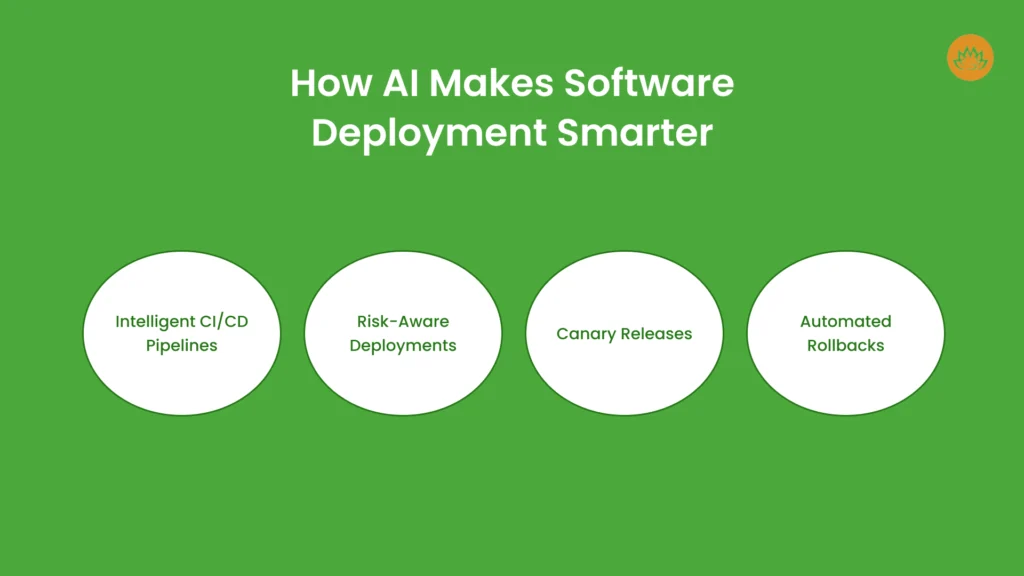
Intelligent CI/CD Pipelines
Risk-aware Deployments
- Size and complexity of code
- Historical production incidents having similar changes
- Test coverage and failed test patterns
- Dependency vulnerabilities and configuration changes
- Recent application performance and infrastructure stability
Canary releases and automated rollbacks
Smarter Application Monitoring with AIOps
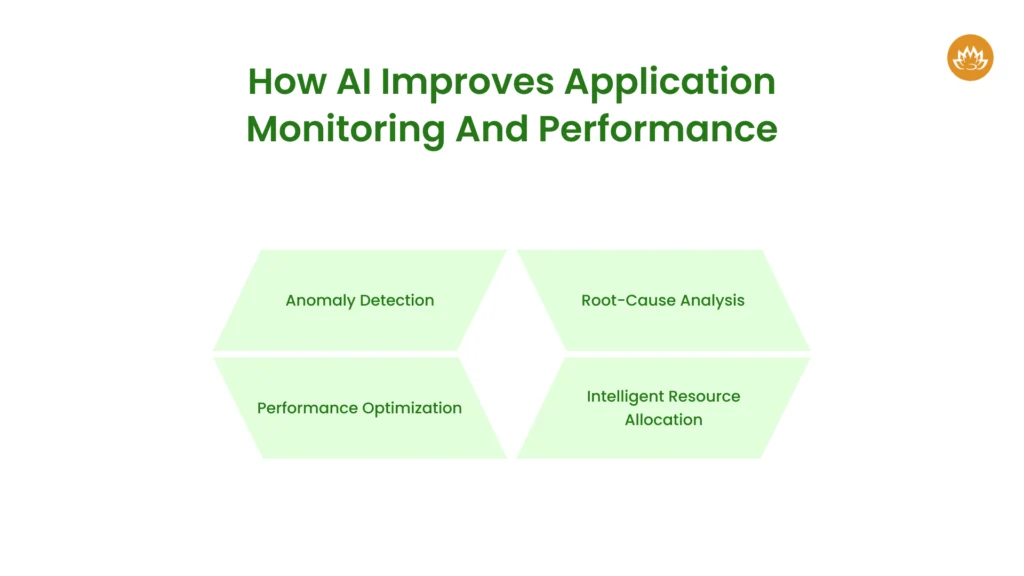
Detection of anomalies and intelligent alerts
Root-cause analysis
- Response times increase shortly after deployment
- Database queries start taking longer than usual
- Connection pool usage rises sharply
- Several application services start generating timeout errors.
Moving toward proactive operations
Application Performance Optimization with AI
Predictive Performance Analysis
Intelligent Resource Allocation
Modern Technologies Powering AI + DevOps in 2026
Kubernetes Container Orchestration
GitOps and declarative infrastructure
OpenTelemetry and modern observability
For gathering and exporting telemetry, such as metrics, logs, and distributed traces, OpenTelemetry offers vendor-neutral tools and standards.
Teams can understand application activity across services with collectors, operators, and instrumentation tools. These tools are found in Kubernetes ecosystem. AI can correlate operational events and identify anomalies through information analysis.
Generative AI and AI agents
Infrastructure as Code and platform engineering
Security and Governance In AI-Powered DevOps
- Give AI tools and agents limited permission according to the requirements of the assigned tasks.
- Must include static application security testing, secret detection, and container image scanning in CI/CD pipelines using automated security testing
- Should implement authorized review for high-risk deployments, destructive operations, and infrastructure changes.
- Record all agent actions, deployment decisions, and tool calls
- Apply appropriate access controls, redaction, retention policies, and restrictions to prevent sending sensitive data
- Use automated checks to prevent deployments that violate security and compliance requirements.
How Can Any Business Implement AI+DevOps Successfully?
Examine deployment delays, recurrent issues, sluggish troubleshooting, exorbitant cloud spending, and tedious manual operations first. Pick one issue where progress may be quantified.
Ensure version control, automated testing, infrastructure definitions, monitoring, and CI/CD pipelines are reliable. AI cannot make up for inconsistent procedures or subpar operational data.
Start with lower-risk use cases, like performance suggestions, deployment risk assessment, log summarizing, and incident classification. To assess the correctness of AI recommendations, compare them with engineer findings.
Allow automation to handle specific activities under predetermined criteria once the outcomes are trustworthy. Examples include creating incident tickets, scaling within authorized bounds, and stopping a deployment when predetermined health checks fail.
Monitor deployment frequency, change failure rates, recovery times, change lead times, service availability, performance, and cloud expenses. Examine ineffective suggestions, erroneous notifications, and unexpected automatic activities.