As we know, Artificial Intelligence is no longer a technology that is specifically made for large enterprises or research houses. Now, it has become the most crucial part of every modern digital experience. Whether it is a chatbot that answers customer queries or mobile apps that identify images and websites and offer personalized recommendations, AI is driving a sea change in how people interact with, respond to, and use technology.
Well, this drastic change surely provides great opportunities for businesses. They don’t need to wait months to build complex AI models from scratch. Modern AI tools help you build intelligent features into applications using AI APIs. When you hire an AI developer from a reputed AI development company, you can work hassle-free. Because developers can easily connect existing AI capabilities to web and mobile applications, creating smarter digital products.
Although you need more than merely connecting endpoints and displays to integrate AI API, a well-structured planning, correct use of technology, safe data handling, and clear knowledge of what the users actually need are the basic requirements to integrate AI APIs successfully into any web or mobile application.
So, if you develop a new application or upgrade to a better one, you must understand how to integrate AI APIs, as it helps build reliable solutions that turn out to be more practical and scalable.
Let us find out how the process works. We will also learn the factors that matter most, including the way businesses do AI integration to improve their digital strategy.
What is an AI API? Why do apps need them?
An AI API connects an application to an artificial intelligence service. It empowers the developers to access advanced features with no need to create, train, and maintain their own AI models.
An AI API is just a service you can use. Your application submits a request with the information needed. The AI service processes the request, and the API delivers a response your application can consume.
The true value comes from how these capabilities enhance the entire user experience.
AI APIs can assist applications:
- Understand and respond to natural language.
- Analyze photos, documents, and other types of data.
- Create tailored content and recommendations.
- Automate repetitive chores and workflows.
- Enhance search functionality through semantic understanding.
- Provide faster and more contextual client support.
Instead of introducing AI just because it’s popular, organizations should concentrate on solving specific challenges. A well-integrated AI element should improve an application’s usability, usefulness, or efficiency.
A Step-by-Step Guide to Integrating AI API into Web and Mobile Applications
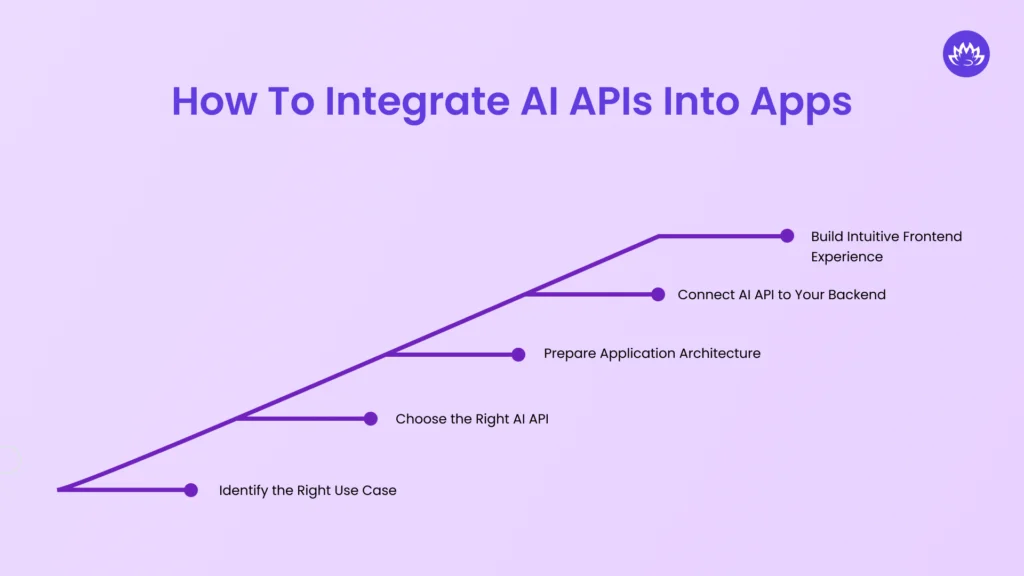
Integrating AI APIs will be very easy if the process is bifurcated into well manageable steps. Each stage will play an important part to ensure that the final application becomes super deliverable and reliable, to give meaningful results. So let us understand each step in detail.
1. Identify the Right Use Case
Before choosing an AI API, consider what you want it to accomplish.
Begin by reviewing your application’s existing features to identify areas where intelligence or automation could help. An AI chatbot, for example, could be useful in a customer care application, but a content platform could utilize AI to summarize long pieces.
Some top use cases are:
- Using conversational AI for building chatbots and interactive support systems.
- Use Predictive analytics to identify patterns and forecast user behavior
- With personalization, you can recommend products, services, and content based on individual preferences.
- Another is computer vision, which will recognize objects, analyze images, and extract information from visual content.
- Natural language processing will classify images, analyze sentiment, and understand user requests.
The entire motive is to choose a use case that will align with your business goals and will deliver measurable value.
2. Choose the Right AI API
Once you’ve chosen a use case, the next step is to select an API that meets your technical and functional requirements.
Several AI services provide text production, audio recognition, image analysis, translation, and predictive modeling. Your choice should be based on the work, desired response quality, pricing, integration complexity, and scalability. Also, it matters a lot which type of software development partner you choose for integrating AI APIs.
The following factors must be considered:
- Consider the functionality and find out whether the API supports the features that your app needs.
- Documentation is important. Know whether the integration instructions are clear and developer-friendly.
- It must deliver responses within the acceptable time limit.
- The pricing must be as per your expectations and according to usage and budgets.
- Scalability is another criterion, as the service must handle increasing traffic and incoming requests.
- The provider must offer suitable data protection and access controls.
It is also recommended to try several APIs before making a final decision. A simple proof of concept might help you assess response quality and performance under realistic settings.
3. Prepare Application Architecture
Every successful AI integration starts with well-structured architecture planning.
All types of web and mobile applications mostly communicate via a frontend with a backend server. This server will interact with the AI API continuously. Hence, all sensitive credentials will be kept away from client-side code, and developers get a higher level of control over all requests, responses, and data processing.
Typically, every integration will follow the flow below:
User Input→Web or Mobile Interface→Backend Server→ AI API→ Response Processing→User Interface.
So when a user asks any type of question through a mobile chatbot, for example, the app will send the message to your backend. The backend will further validate the request and forward it to the AI service. It will then process the response and return the result to the app.
This structure also simplifies adding authentication, rate limiting, logging, and error handling.
For apps with complex needs, developers can employ microservices or specialized AI service layers to isolate AI features from the main application.
4. Connect AI API to Your Backend
Once the architecture is set, developers can begin the process of AI integration as the per the chosen API.
Most AI APIs offer REST endpoints, SDKs, or both. REST APIs let applications exchange data using standard HTTP requests, while SDKs streamline integration with pre-built functions tailored to specific programming languages.
The basic process includes Acquiring API credentials from the service provider.
- Setting up the API endpoint and authentication method.
- Gathering the necessary input data.
- Making requests from the backend.
- Collecting and confirming responses.
- Sending the processed output back to the frontend.
Developers should also ensure appropriate error handling is in place. API requests may be impacted by network failures, incorrect inputs, rate limits, and service outages. Rather than letting these issues interfere with the application, offer useful fallback messages and retry options where suitable.
To enhance user experience, use asynchronous processing for time-consuming tasks like document analysis or large-scale data processing.
5. Build Intuitive Frontend Experience
An AI feature might function flawlessly behind the scenes, but its true success hinges on the user experience it delivers.
The frontend must have the capability to design AI interactions that are intuitive and less complex. For instance, a chatbot should provide clear answers, show when it’s handling a request, and let users keep talking without extra hurdles.
Most AI APIs offer REST endpoints, SDKs, or both. REST APIs let applications exchange data using standard HTTP requests, while SDKs streamline integration with pre-built functions tailored to specific programming languages.
For web applications, you can hire AI developers who often turn to frameworks like React, Angular, or Vue.js. They build responsive interfaces. For mobile apps, Flutter and React Native provide effective methods to incorporate AI-driven features across multiple platforms.
Some of the most common design considerations will make a significant change:
- Put the loading indicators on display meanwhile AI responses are generated.
- Provide lengthy responses in the sections readable
- Give users permission to correct inputs or request alternative results
- Give appropriate feedback in case AI fails to finish the task
- Create AI-generated content that is unique and competent whenever required
The aim is to ensure that intelligent features seem like a seamless part of the application, rather than an extra layer requiring users to learn new things.
Key Factors for Secure and Dependable AI Implementation
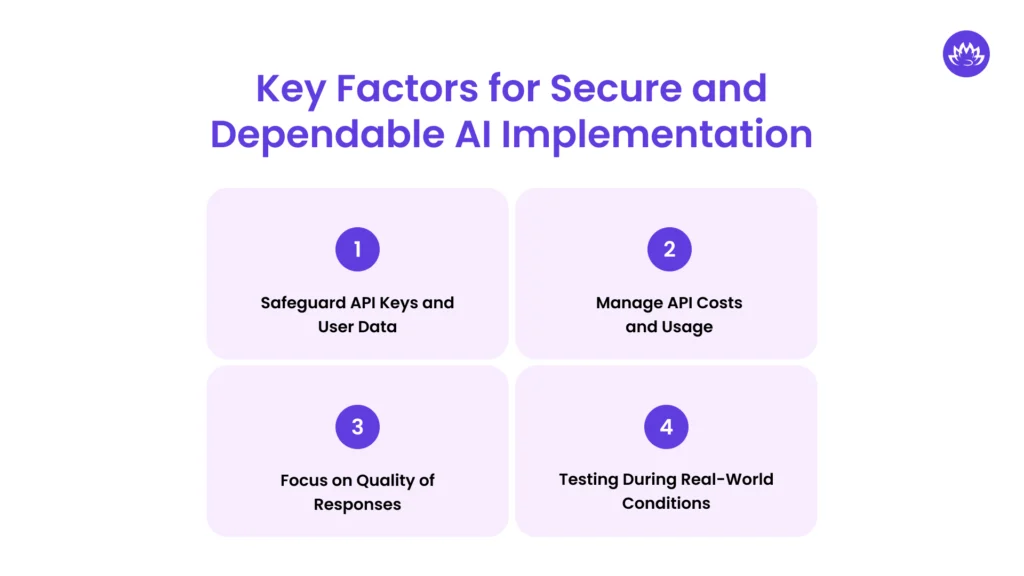
Integrating an AI API represents just one aspect of the development process. Security, reliability, and performance are equally crucial, especially when applications handle sensitive data or support many users. Always ensure you choose an experienced AI-powered mobile app development company to create futuristic web and mobile applications. The following are the factors.
Safeguard API Keys and User Data
Also, send data through encrypted connections and gather only the information required for processing. If your application is dealing with personal or confidential data, then you must check the AI provider’s data retention policies. And thereafter, you must also verify that your implementation complies with relevant privacy regulations.
Avoid adding private API keys in frontend code, mobile app packages, or public repositories. Instead, we suggest you store credentials securely by using environment variables or a specialized secrets management system.
Manage API Costs and Usage
As application traffic increases, AI API costs may also increase considerably sometimes. Unregulated requests, frequent prompts, and overly large inputs can impact your operational budget.
Developers can control usage by implementing rate limits, caching, request validation, and token optimization. Tracking API usage also enables early detection of abnormal activity before it escalates into a bigger problem.
Focus on Quality of Responses
AI-generated responses can sometimes sound inaccurate and inconsistent. This is very crucial in situations where users might depend on the information to make decisions.
Put in place validation checks, include suitable disclaimers when necessary. Also, incorporate human oversight for critical processes. In generative AI applications, carefully crafted prompts and pertinent contextual details can likewise enhance response quality.
Testing During Real-World Conditions
Testing should include more than just successful API requests. Assess the application’s behavior under scenarios such as users submitting incomplete data, network connections dropping or becoming unreliable, or the AI service delivering unforeseen outputs.
Performance testing, security testing, and user acceptance testing can uncover problems that might not surface during the initial development phase.
Common Mistakes to Avoid During AI API Integration
Even a carefully planned integration can run into trouble if you neglect key development practices.
Here are some frequent errors to steer clear of:
Adding AI features without a defined goal: Those that don’t meet real user needs can add unnecessary complexity without enhancing the experience.
Relying solely on AI responses: AI must enhance application functionality without substituting critical business rules, validation, or human judgment.
Neglecting scalability: An integration functional for a small user base may falter as request volumes grow. Build with growth in mind from the start.
Ignoring fallback options: Applications must stay functional even if an AI service is temporarily down.
Ignoring continuous monitoring: AI integration requires sustained effort, not a single implementation. Routine assessment enables the detection of performance problems, unforeseen expenses, and areas for enhancement.
Steering clear of these errors can enable companies to develop AI-driven applications that stay reliable as their requirements change.
Future of AI-Powered Web and Mobile Applications
AI integration is expanding past individual chatbots and recommendation engines. Today’s applications are increasingly integrating several AI features to deliver experiences that interpret context, streamline workflows, and adapt to evolving user demands.
For example, multimodal AI allows applications to process text, images, audio, and other types of input. AI agents are also enabling applications to handle multi-step tasks, engage with external tools, and support users in more complex activities.
Meanwhile, advances in edge AI and on-device processing are unlocking new opportunities for mobile apps requiring quicker responses or less reliance on cloud connectivity.
These developments underscore the growing importance of thoughtful architecture. Companies that develop adaptable systems now will have an easier time incorporating new AI features as the technology evolves.
Final Thoughts
Incorporating AI APIs into modern web and mobile applications goes beyond simply adopting a new technology. It’s about designing digital experiences that are more adaptive, tailored to individual needs, and more beneficial.
Every stage, from pinpointing the appropriate use case and choosing the right APIs to building secure architectures and evaluating real-world performance, plays a vital role in ensuring the success of an AI-driven application.
Start with a well-defined business goal, design around real user requirements, and treat AI as a continuously evolving part of your tech environment.
At Whitelotus Corporation, we assist businesses in discovering and putting into practice AI-powered solutions that match their objectives. We are an AI development company with a team skilled in AI development, software engineering, and creating AI-driven mobile apps. We concentrate on developing smart applications that merge real-world usability with scalable technology.
The future of application development goes beyond just making software smarter. It’s about improving how technology serves the people who use it. Contact us to learn more about our services.