Real estate and artificial intelligence are working together to make buying real estate faster, easier, and smarter than ever. Real estate AI is fundamentally changing the game, whether you’re an investor looking at commercial spaces in Bangalore or a first-time house buyer in Mumbai. AI is helping millions of people find their ideal home in India, where the real estate market is valued at over $180 billion.
Developers, investors, and real estate professionals now use AI to improve decision-making, reduce risk, and deliver highly customized experiences. Real estate companies now partner with a reputable AI development company to build futuristic, reliable AI solutions that can amplify their business and help clients make decisions with logical reasoning.
This article examines how AI is changing property search, valuation, and investment, along with tips and best practices companies can use to stay ahead in this evolving market.
Increasing Use of AI in Real Estate
The growing availability of large data, advances in machine learning, and the need for smarter automation are driving the adoption of AI in real estate. According to industry statistics from groups like McKinsey and the National Association of Realtors (NAR), the use of AI in real estate is growing faster because of its capacity to increase productivity, save operating expenses, and offer predictive insights. Companies hire AI developers to build competitive mobile apps that facilitate realtors, developers, and buyers.
To produce useful insights, AI systems examine enormous databases such as real estate listings, user activity, market movements, and economic indicators. This lets stakeholders shift from reactive to proactive initiatives.
Top AI Use Cases
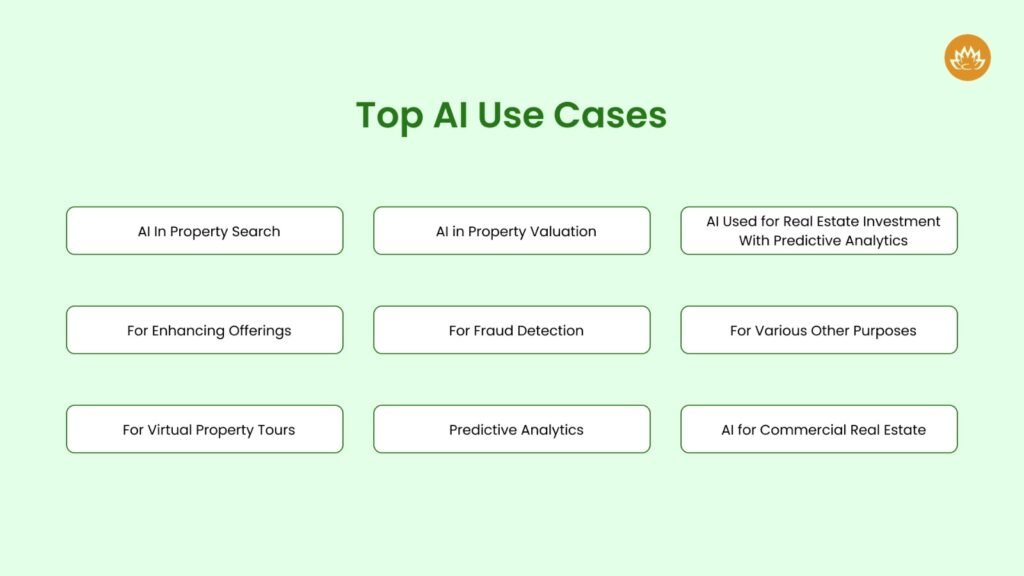
AI In Property Search
Location, price, and size are just a few of the basic filters that are no longer used in property searches. AI-powered platforms provide hyper-personalized property recommendations based on user preferences, browsing history, and behavioral tendencies.
Search results become increasingly relevant over time as machine learning algorithms continuously learn from human interactions. Natural language processing (NLP) greatly enhances the user experience by enabling users to search with conversational questions like “2BHK near IT parks with good schools nearby.”
AI-powered chatbots and virtual assistants are also available around the clock to assist users, answer questions, and even arrange property tours. By enabling consumers to search properties using photographs, visual recognition technology further improves the experience.
Beyond boosting customer satisfaction, this level of customization improves real estate platforms’ conversion rates.
AI in Property Valuation
Because market conditions keep shifting, accurate property appraisal has long been difficult. AI addresses this by simultaneously examining factors such as past sales data, local trends, infrastructure developments, and economic indicators.
AI-powered Automated Valuation Models (AVMs) provide highly accurate, real-time property estimates. By constantly updating with new data, these models keep valuations current.
AI, for instance, can identify minute details that traditional assessment techniques would miss, such as proximity to impending infrastructure projects, crime rates, and changes in local demand.
This enables sellers to set competitive prices, purchasers to avoid overspending, and lenders to make well-informed loan decisions.
AI Used for Real Estate Investment With Predictive Analytics
AI is changing real estate investing by making risk assessment and predictive analytics possible. Instead of considering only a property’s current value, investors can now consider its future potential.
To forecast long-term returns, AI systems examine rental yields, occupancy patterns, economic projections, and demographic changes. This helps investors spot high-growth regions before they become popular.
By detecting failing assets and recommending diversification measures, AI also supports portfolio optimization. It can also simulate different investment scenarios, helping investors make more confident choices.
Proptech firms and institutional investors already use AI to gain a competitive edge.
For Enhancing Offerings
Many of the top real estate websites already use AI to improve their services. To ensure visitors see properties that suit their tastes, property portals use recommendation engines similar to those on e-commerce sites.
For Fraud Detection
AI-powered techniques also detect fraud, flag questionable listings, and verify property legitimacy. AI is used in property management to automate tenant communications, maintenance scheduling, and rent collection.
For Various Other Purposes
By using AI to predict equipment breakdowns in buildings, predictive maintenance systems lower maintenance costs and downtime. Similarly, developers might choose where to build new projects based on demand patterns using AI-driven data.
These practical uses show that AI is a fundamental shift in the real estate industry, not just a fad.
For Virtual Property Tours
If you cannot travel to the location to view the property, AI in real estate can bring it home to your screen.
AI-powered virtual tours let you walk through properties on your phone or laptop. You can view rooms in 360 degrees and explore the neighborhood virtually. Moreover, you can even check the kind of furniture that will suit your space. In India, this service is much helpful when you stay in Delhi and want a property in Hyderabad.
Predictive Analytics
Here, AI in real estate gets more interesting as it can predict the value growth of particular neighborhoods. It will help you know the best time to buy or sell. In addition, you can anticipate future property prices and upcoming infrastructure developments.
AI for Commercial Real Estate
AI in commercial real estate is also booming at a rapid rate. If you’re looking for office space, warehouses, or any sort of retail shops, AI will help you find the best locations for your business type. It can also help you analyze the foot traffic and customer demographics. It can also automatically manage property maintenance.
How Can You Implement AI in Your Real Estate Business
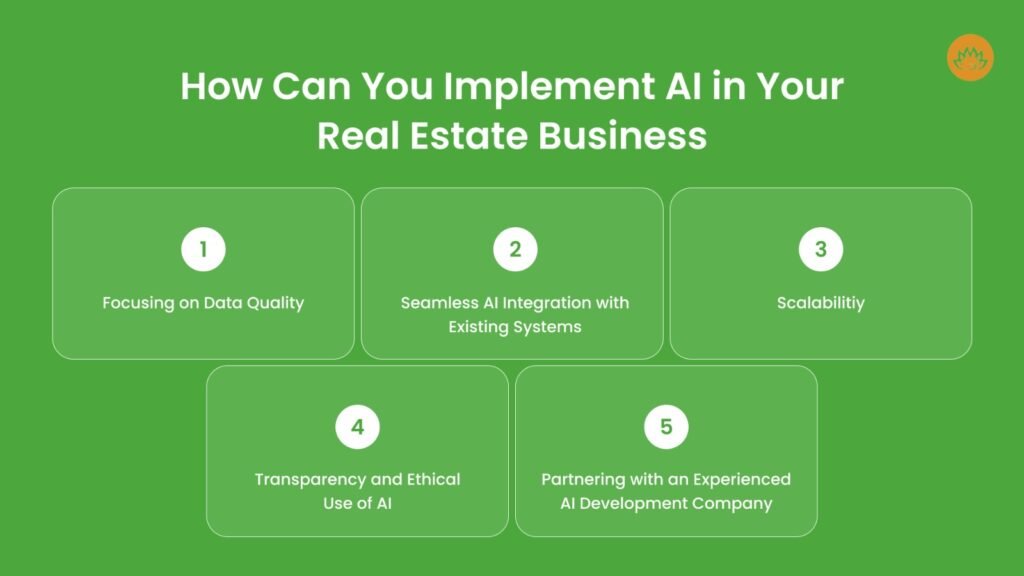
You can hire AI developers from a reputed software development company to successfully adopt AI in a real estate business. Some of the major aspects that you must consider are:
Focusing on Data Quality
Businesses must focus on data quality to use AI successfully in the real estate industry, since AI systems depend heavily on precise, comprehensive datasets. Poor data can lead to unreliable findings.
Seamless AI Integration with Existing Systems
To verify smooth operations, it’s also critical to incorporate AI solutions with current systems like CRM platforms and property management applications.
Scalabilitiy
Scalability, which enables systems to expand with the business, should be considered from the start.
Transparency and Ethical Use of AI
Building trust requires ethical AI use and transparency. Companies should make sure that decisions made by AI are understandable and adhere to data privacy laws.

Partnering with an Experienced AI Development Company
Organizations can create and implement specialized AI solutions suited to their unique requirements by partnering with a seasoned AI-mobile app development company like Whitelotus Corporation.
The Future of AI in Real Estate
AI in real estate appears to have a bright future because of new technologies like blockchain, augmented reality, and generative AI. Predictive analytics will grow even more accurate, and AI-powered virtual property tours will become more immersive.
AI will be crucial to building smarter cities, improving urban planning, and enhancing sustainability in real estate development.
Companies that use AI now will be better positioned to dominate the industry in the future.
Final Thoughts
To remain competitive, artificial intelligence (AI) is now required in the real estate sector. AI is changing every facet of the real estate industry, from data-driven investment strategies to precise appraisal and tailored property searches.
Adopting AI can open up new possibilities, enhance consumer experiences, and spur long-term growth for companies trying to innovate and grow. At Whitelotus Corporation, we provide the best AI development services for real estate developers and realtors. Contact us to learn more about our services.

Kirtan Thaker
Kirtan is CEO of Whitelotus Corporation, an emerging tech agency aimed to empower startups and enterprises around the world by its digital software solutions such as mobile and web applications. As a CEO, he plays key role in business development by bringing innovation through latest technical service offering, creating various strategic partnerships, and help build company's global reputation by delivering excellence to customers.