From the early adoption of mobile-friendly websites to speedy and simple checkout processes, e-commerce has always been at the forefront of technological advancements. The online shopping experience has evolved significantly since its inception, and AI will shape the sector’s development as e-commerce continues to expand. As an AI development company, we know your competitors do not operate in just one category. You are actually competing with players who can bring fresh perspectives and provide real-time customer experiences.
So, your perfect team of merchandisers, data analysts, or marketers won’t cope up doing A/B tests for more than a million of unique users. And that is where AI in eCommerce will rewrite the rules of user engagement and personalization.
AI e-commerce technologies have already been used by numerous companies to boost customer retention, increase conversions, and improve operational efficiency. This article will cover the many forms of AI for e-commerce, some real-world applications, best practices, and the advantages, dangers, and potential future developments as AI for e-commerce gains traction in the sector.
Different Types of AI in eCommerce
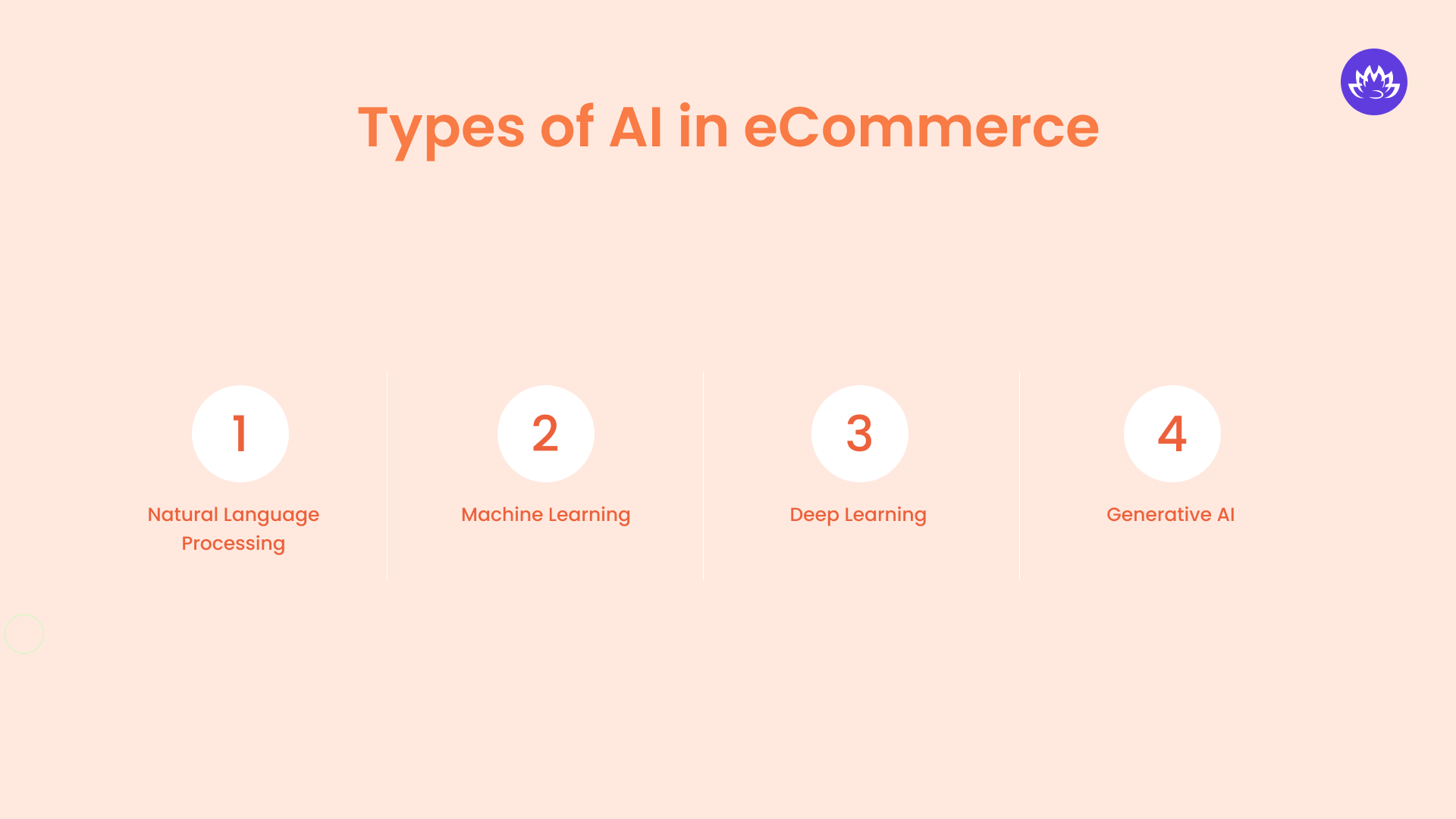
AI is not just all about one kind of technology. You will find several models. Some of the most commonly used are:
Natural Language Processing
The ability of computer software to comprehend human language as it is commonly spoken and written is known as natural language processing. This makes it possible for computers to understand inputs and provide human-language responses.
Machine Learning
Through the introduction of computers and machines to new data, machine learning (ML) enhances their performance and accuracy while also allowing them to mimic how people learn and complete jobs. When AI supplies the necessary structured data and input, traditional machine learning relies on human intervention and expertise to learn.
Deep Learning
A subset of machine learning called “deep learning” uses artificial neural networks to extract knowledge from data. Deep Learning algorithms, which draw inspiration from the human brain, can be used to tackle a wide range of issues and perform tasks such as feature learning and categorization.
Generative AI
Algorithms used to create new content—such as audio, code, images, text, simulations, and videos—are collectively referred to as generative AI. To generate replies based on the available data, these models are trained on big datasets.
- Automate repetitive workflows
- Personalize customer interactions
- Improve forecasting and planning
- Reduce operational costs
- Predict customer behavior
- Strengthen security
The Best Enterprise AI Use Cases in eCommerce
Hyper Personalization
- Hyper-personalization is one of the major uses of AI in e-commerce.
- It uses user-friendly website design and development to customize the whole digital experience. This is the best use case delivered by AI when you hire reliable software development services.
- The navigation, promotional banners, hero image, and product-sorting logic.
- Every modification is made in real time based on a particular user’s behavior, past actions, and anticipated intent.
- Some of the core use cases in hyper-personalization are:
- Providing personalized product suggestions. For example: “Recommended for you”. It is clearly based on what shoppers view or buy.
- Smart messages during browsing: For example, “Still thinking about this?” or “Your size is now in stock.”
- Individual offers and discounts: Provide special deals made just for shoppers.
Multimodal Search Options and Visual Discovery
- In reality, multimodal search is how people think. The user can combine inputs using it.
- The client can combine text (such as “find shoes like this”) with an image or upload a screenshot.
- To produce the ideal outcome, the AI recognizes the visual pattern in the picture and the intent in the text.
- It further improves long-tail item discoverability, reduces bounce rates from bad search experiences, and increases conversion in visually led categories (home decor, fashion).
Demand Forecasting and Inventory Management
- Predicting product demand and stock management are two other applications of AI in eCommerce.
- To forecast the amount of each product needed at each store or location, it considers variables such as weather, previous sales, events, and promotions.
- This helps companies prevent running out of or overstocking products, replenish supplies on schedule, and relocate items to areas where they are most required.
Upselling and Cross-Selling
- In the ecommerce industry, AI provides product suggestions to customers during checkout. For example, “Complete your look”, “Customers also bought,” or through dynamic in-app prompts, “Upgrade to premium bundle with 15% off”.
- By promoting the right product at the right time with contextual relevance, you can increase order size, margin per order, and client lifetime value.
Better Content with Generative AI
A lot of brands have incomplete product descriptions, or they are missing or duplicated from suppliers. With Generative AI for eCommerce, you get a trained brand voice that can rewrite all of them in a week. Moreover, it can also create copy, personalized social media posts, and email campaigns at scale. Some of the top use cases are:- Automated product descriptions
- In the app, these product descriptions are catchier, and product pages look more appealing. This will help save time and products become live faster.
- Marketing content localized
- The app will display text and headlines in shoppers’ local language. Marketing becomes more relevant and enhances customer experience.
- Product images AI-generated
- The system will generate better product photos or lifestyle shots through a single image.
Conversational Commerce with AI Agents
- AI-powered chatbots and voice assistants can help customers find what they’re looking for, answer their questions, and even walk them through the checkout process.
- AI agents in eCommerce can also operate on your social media platforms, mobile apps, and websites.
- With AI-powered mobile app development, customers transition from “I’m just looking” to “I found exactly what I need” by acting like welcoming in-store employees.
Fraud Detection and Prevention of Abuse
- Based on information such as device, location, and browsing habits, AI in eCommerce creates a profile for every user.
- By tracking transactions and behavior in real time, it can spot anything unusual, such as fake accounts, refund abuse, bot activity, or payment fraud.
- It further helps safeguard your earnings, maintain your business’s credibility, and prevent losses before they occur.
Optimising Margins and Dynamic Pricing
AI models consume variables such as past sales, weather trends, social media sentiment, local events, and even shipping lane delays that are impossible for humans to correlate. To see how eCommerce app development services are crucial to dynamic pricing, let’s look at the use cases below.- Price changes in real-time
- All prices are automatically updated based on demand, competitor activity, and season. As a result, prices remain competitive and revenue increases.
- Targeted discounts
- All the price-sensitive shoppers will start seeing special offers or limited-time deals. Shoppers get encouraged to make faster decisions without hurting the margins.
- Smart upselling
- Recommends high-end or profitable goods when consumers see less expensive ones.
Post-Purchase Automation
- At checkout, the sale isn’t over. Loyalty is won or lost during the post-purchase experience.
- It is fully automated by AI transformation for e-commerce.
- Self-serve return authorization, predictive routing options (such as “ship return to the fastest center”), and auto-approval for low-risk returns are among the features available in-store.
- It lowers waste, speeds up restocking, and lowers logistics expenses.
Customer Retention and Lifetime Value Prediction
- Maintaining a customer is less expensive than acquiring new ones.
- AI in eCommerce uses 24/7 churn-prediction models to find valuable clients who haven’t checked in for several days.
- A proactive retention workflow is automatically initiated by this behavioral shift. It also offers longer retention and lower acquisition cost.
Implementation of Artificial Intelligence into eCommerce
Frame a Strategic Plan
Craft a comprehensive AI strategy aligned with your business objectives. Make sure the plan focuses on the key outcomes that your business aims to achieve. It can be on enhancing customer personalization or aligning operational activities.Identify Targeted Use Cases
Keep a focus on practicing crucial use cases that will directly support business strategies. For example, you can implement AI-driven recommendation engines to boost sales or use predictive analytics to manage inventory.Third-Party Services Outsourcing
Take advantage of the expertise of a reputable eCommerce app development company that can support you and remain as a backbone throughout the entire implementation process. With their experience, you will choose the right technologies and avoid common pitfalls.Develop and Deploy a Comprehensive AI Model
With the strong partnership of an AI development company, you can develop a full-scale AI solution that will seamlessly integrate with existing eCommerce systems. Make sure your solution is scalable and capable of addressing identified use cases. Lastly, conduct testing and optimization to ensure you deliver desired outcomes.Final Thoughts
Although there are many advantages to employing AI in e-commerce, such as increased consumer satisfaction and revenue, organizations should also be aware of the disadvantages, which include potential job displacement, data biases, and security and ethical issues. E-commerce companies can significantly improve their marketing efforts to increase sales by implementing AI solutions for e-commerce in a safe and strategic way.
With Whitelotus Corporation, you will gain a strategic partnership as we harness the power of the most advanced technologies to drive substantial progress in adaptability, operational efficiency, and flexibility. We are an AI development company that believes in driving innovation and increasing operational efficiency to meet your brand expectations. We provide AI integration and implementation services to deliver lasting impact in the eCommerce sector, helping you stand out from your competitors. Contact us to learn more about our services.