Uncategorized

The Role of AI in Modern DevOps Automation and Application Performance

The Role of AI in Modern DevOps Automation and Application Performance (1)
Software development is advancing more quickly than before. Companies must protect sensitive data, maintain dependable apps, swiftly introduce new features, and provide seamless digital experiences. With cloud infrastructure, microservices, APIs, containers, and distributed systems collaborating behind the scenes, applications are growing increasingly complicated at the same time.
Teams hired from an established AI development company can now automate software development and deployment with the aid of traditional DevOps techniques. Conventional automation, however, still significantly relies on scripts, pre-established rules, and human judgment. Teams may spend hours figuring out the cause and getting things back to normal when an unexpected fault happens, a server gets overloaded, or a deployment results in performance problems.
And in such situations, Artificial Intelligence (AI) is transforming the way DevOps works. The combination of AI with DevOps is helping organizations analyze operational data with great efficiency. It can identify unusual behavioral patterns, estimate failures, make better deployment decisions, and optimize the performance of applications. So, not just by simply reacting to problems, AI is helping teams take a proactive approach to manage complete software environments. 
In the current year, 2026, AI with DevOps is taking a huge shift. AI-assisted development is becoming more important, including platform engineering, intelligent automation, and cloud-native technologies. According to the Cloud Native Computing Foundation survey in 2026, Kubernetes, GitOps, and observability are the most important foundations for managing modern applications.
But the question is: what exactly is there in AI-powered DevOps? What tasks are to be automated, and what kind of technologies make this possible? What are the ways in which businesses implement these technologies effectively?
To answer all these questions, let us explore how AI and DevOps work together to create faster and more reliable performance-based software delivery pipelines. 

Knowing AI-Powered DevOps

DevOps streamlines the software development lifecycle by combining development and IT operations. It encourages collaboration, continuous integration, continuous delivery, automated testing, infrastructure management, and continuous monitoring.
By incorporating machine learning, generative AI, intelligent agents, and data-driven decision-making into operational workflows, AI-powered DevOps expands upon these methods. AI-powered DevOps does not replace the fundamental DevOps methodology. It helps engineers concentrate on decisions that call for technical knowledge and improves the intelligence of current procedures.

How is AI different from traditional DevOps automation?
How AI Improves Application Monitoring and Performance
Traditional automation will always follow instructions that are written in advance. It is more preferable for tasks that are predictable and repetitive, like running tests, building containers, provisioning infrastructure, and restarting failed services.
AI can identify patterns, interpret unstructured information, generate recommendations, and adapt decisions based on available data. So the difference here is very clear:
  • Traditional automation
    will execute a predefined response when any sort of specified condition occurs.
  • AI-powered automation
    will analyze available content to identify patterns, estimate risk, and recommend an appropriate response. 
  • Creating AI Agents:
    They will perform a sequence of permitted tasks, use approved tools, and work toward a defined operational objective.
Combining all three creates the most successful strategy. AI facilitates sophisticated analysis, controlled agents help with multi-step workflows, and dependable scripts manage predictable activities.

Software Deployment Automation with AI
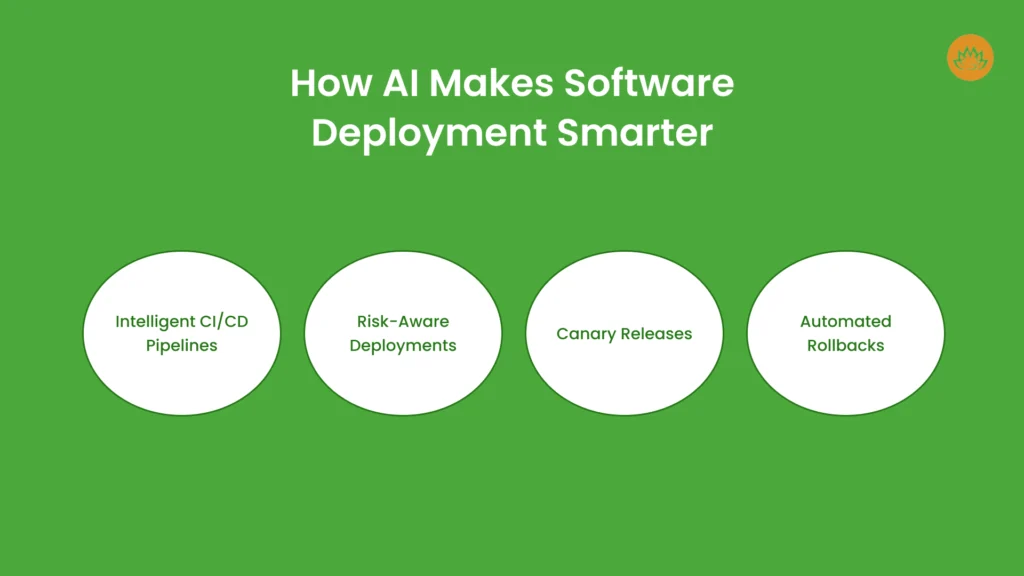
How AI Makes Software Deployment Smarter (1)
Software deployment is more than just moving code from a development environment to production infrastructure. In this phase, teams should validate changes, run tests, manage dependencies, and configure infrastructure to ensure new releases don’t disrupt existing services. Here, AI improves several stages of the software development process.

Intelligent CI/CD Pipelines

Software development, testing, and release are all automated using Continuous Integration and Continuous Delivery or Deployment (CI/CD) pipelines. AI can improve these pipelines’ responsiveness to the type and risk of each change. It can also help teams investigate any failed pipeline by summarizing logs, identifying likely causes, and suggesting corrections. 
Tools like the GitHub Copilot coding agent can help with pull requests, security checks, and assigned coding jobs. All these aspects will support DevOps workflows, but changes still need proper validation and review.

Risk-aware Deployments

Every software update does not carry same kind of risks. There is a lot of difference between a small text change and a modification in payment processing, authentication, etc. AI here helps in assessing deployment risk using the factors below:
  • Size and complexity of code
  • Historical production incidents having similar changes
  • Test coverage and failed test patterns
  • Dependency vulnerabilities and configuration changes
  • Recent application performance and infrastructure stability
Based on these indications, a pipeline can suggest distributing the modification to a smaller group of customers first, demand manual permission, or suggest additional tests.

Canary releases and automated rollbacks

A new version is first made available to a limited number of users through canary deployment before being made available to a larger audience. When the new version is ready, blue-green deployment maintains two production environments and transfers traffic between them.
By comparing error rates, latency, resource consumption, and business-critical transactions against predetermined baselines, AI can help assess the health of these releases.
Automated delivery systems can halt the rollout or start a rollback in accordance with predetermined policies if a new release significantly increases errors.

Smarter Application Monitoring with AIOps

How AI Improves Application Monitoring and Performance
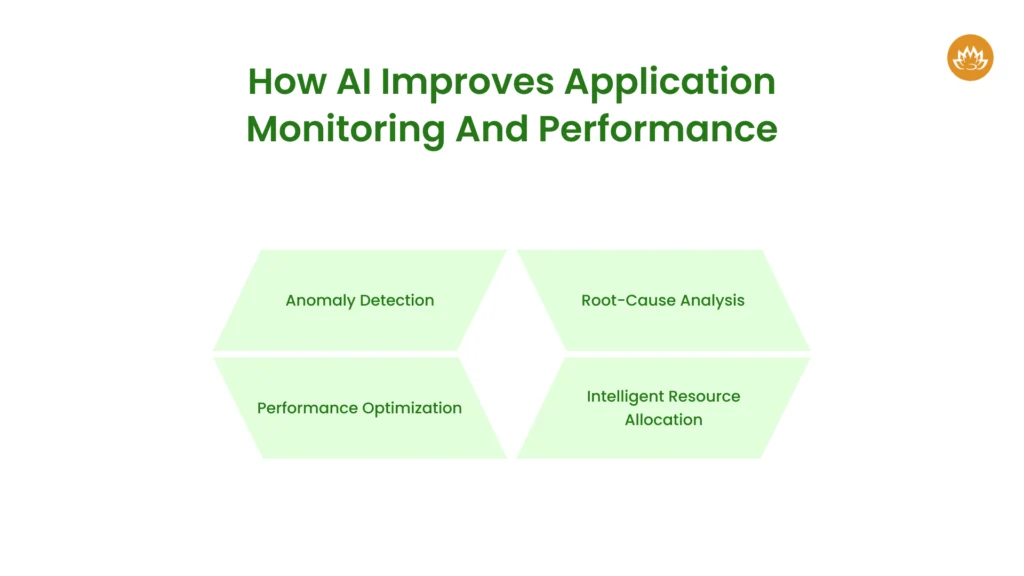
Monitoring is essential to keep applications responsive. Modern systems generate huge amounts of logs, traces, metrics, and alerts. Reviewing this kind of information is very difficult with the growing infrastructure. With AI for IT Operations, commonly known as AIOps, teams use AI and machine learning to analyze operational data, correlate related events, detect any sort of abnormal behavior, and investigate incidents. 

Detection of anomalies and intelligent alerts

Traditional monitoring most of the times rely on fixed thresholds. AI-based anomaly detection may recognize variations in response times, traffic, memory usage, request failures, and other operational signals by learning from past trends. Think about an e-commerce application that typically receives more traffic in the evening. An AI-enabled monitoring system can explain this recurring pattern and also spot an unexpected rise in checkout failures.

Root-cause analysis

When an application slows down, the cause may not always be apparent. To narrow down the possibilities, AI-assisted root-cause analysis reviews relevant telemetry and deployment events. A very useful investigation can connect the following observations:
  • Response times increase shortly after deployment
  • Database queries start taking longer than usual
  • Connection pool usage rises sharply
  • Several application services start generating timeout errors. 
When these signals are correlated, AI helps engineers focus on the database connection and its changes instead of investigating every service separately.

Moving toward proactive operations

Additionally, AIOps can assist in spotting early warning indicators before users experience a significant disruption. AI can also efficiently recognize these patterns and suggest countermeasures. Approved automation now have low-risk actions, such as restarting a known ill worker or scaling a service within defined boundaries, with th1e right controls.
As a result, monitoring becomes a system that helps teams anticipate and manage issues rather than just report them. 

Application Performance Optimization with AI

User experience, customer happiness, and business outcomes are all directly impacted by application performance. Reduced productivity and abandoned purchases might result from slow pages, unsuccessful API requests, and unresponsive services.
DevOps teams can better utilize computing resources, recognize optimization opportunities, and comprehend performance difficulties with the aid of AI. In particular, companies and businesses must ensure they partner with an AI-powered mobile app development company to conduct regular performance optimization.

Predictive Performance Analysis

To identify conditions that could cause performance degradation, AI models can analyze past application metrics, traffic trends, and infrastructure behavior.
An online learning platform, for instance, would see a significant spike in visitors before exams. An AI-enabled solution can assist in forecasting when more application capacity might be needed by examining past traffic patterns. 

Intelligent Resource Allocation

Cloud apps sometimes struggle to sustain performance during abrupt traffic surges and require more computational power than is necessary during quiet times.
By studying workload behavior and projecting future demand, AI can help optimize the allocation of CPU, memory, storage, and other cloud resources.
This can supplement built-in Kubernetes functionality like Horizontal Pod Autoscaling. What they do is adjust the number of active application instances based on defined parameters. AI might estimate capacity needs, identify inefficient workloads, or suggest improved scaling thresholds. 

Modern Technologies Powering AI + DevOps in 2026

DevOps driven by AI is not a single platform or product. It is a method that integrates many technologies to enhance application stability, infrastructure management, and software delivery. 

Some of the most renowned and successfully implemented technologies are listed below. You can hire AI developers from a well-established, reputable software development company to benefit from the latest technologies below. 

Kubernetes Container Orchestration

Containerized application deployment, scalability, and management are all automated by Kubernetes. With this technology, you have a framework for consistent operational policies and managing distributed workloads.

GitOps and declarative infrastructure

GitOps defines the intended state of infrastructure and apps using version-controlled repositories. Tools like Argo CD assist in resolving discrepancies by continuously comparing the intended configuration with the live environment.

By evaluating configuration changes, providing an explanation for deployment failures, and spotting potentially dangerous changes, AI can assist this procedure. 

OpenTelemetry and modern observability

For gathering and exporting telemetry, such as metrics, logs, and distributed traces, OpenTelemetry offers vendor-neutral tools and standards.

Teams can understand application activity across services with collectors, operators, and instrumentation tools. These tools are found in Kubernetes ecosystem. AI can correlate operational events and identify anomalies through information analysis. 

Generative AI and AI agents

Generative AI can help with troubleshooting, explain error logs, write scripts, and summarize incident reports. With authorized tools to complete multi-step tasks, AI agents expand their capabilities. 

Infrastructure as Code and platform engineering

Teams can now manage infrastructure using version-controlled definitions instead of manual configuration because of Infrastructure as Code (IaC) solutions like Terraform.

Teams can also integrate IaC, CI/CD, security policies, observability, and self-service workflows into internal development platforms to create a unified developer experience. AI can suggest authorized setups and assist users in understanding platform capabilities. 

Security and Governance In AI-Powered DevOps

Any AI-generated code contains vulnerabilities. An agent given excessive permissions can change production configurations, expose sensitive information, or execute an unsafe command. Therefore, organizations must integrate security into their entire DevOps lifecycle. Some of the most common and important practices are:

  • Give AI tools and agents limited permission according to the requirements of the assigned tasks.
  • Must include static application security testing, secret detection, and container image scanning in CI/CD pipelines using automated security testing
  • Should implement authorized review for high-risk deployments, destructive operations, and infrastructure changes.
  • Record all agent actions, deployment decisions, and tool calls
  • Apply appropriate access controls, redaction, retention policies, and restrictions to prevent sending sensitive data 
  • Use automated checks to prevent deployments that violate security and compliance requirements.
Hence, organizations must evaluate AI systems for unreliable recommendations, unsafe tool use, and prompt injection. 

How Can Any Business Implement AI+DevOps Successfully?

It is not necessary to replace the entire technological stack in order to use AI-powered DevOps. Teams can test benefits, identify dangers, and extend automation based on actual outcomes by implementing it gradually. 

Examine deployment delays, recurrent issues, sluggish troubleshooting, exorbitant cloud spending, and tedious manual operations first. Pick one issue where progress may be quantified.

Ensure version control, automated testing, infrastructure definitions, monitoring, and CI/CD pipelines are reliable. AI cannot make up for inconsistent procedures or subpar operational data.

Start with lower-risk use cases, like performance suggestions, deployment risk assessment, log summarizing, and incident classification. To assess the correctness of AI recommendations, compare them with engineer findings. 

Allow automation to handle specific activities under predetermined criteria once the outcomes are trustworthy. Examples include creating incident tickets, scaling within authorized bounds, and stopping a deployment when predetermined health checks fail. 

Monitor deployment frequency, change failure rates, recovery times, change lead times, service availability, performance, and cloud expenses. Examine ineffective suggestions, erroneous notifications, and unexpected automatic activities. 

Conclusion

Businesses can now develop, deploy, monitor, and optimize software more efficiently because of AI and DevOps. You need a solid foundationl for AI-powered DevOps to be successful. Clear governance, secure infrastructure, automated testing, dependable telemetry, and quantifiable performance objectives are still crucial. Instead of taking the place of technical judgment or circumventing existing precautions, AI should reinforce current processes.

Businesses should prioritize useful enhancements over automation for its own sake as they continue to use cloud-native architectures, generative AI, and intelligent agents. At Whitelotus Corporation, we recognize the need to develop software solutions that are scalable, dependable, and ready for changing company needs. We help businesses improve development workflows and deliver more robust digital experiences by combining AI capabilities, modern software engineering techniques, and intelligent automation. Contact us to learn more about our services.

Don't skip sharing this post!

Inquiry now

    MAKING IT EXTRAORDINARY