
Banking has been closely connected to technology for decades. But today, the pace of evolution is phenomenal. It is different in many ways, as customers expect instant services, faster payments, personalized financial advice, and stronger security systems. At the same time, banks must manage larger data volumes, rising risks, and increasing competition from fintech companies.
To meet growing customer needs, banks partner with an experienced AI development company. As AI is becoming a major part of transformation, banks need continuous assistance from technology experts and software developers to upgrade their current systems and workflow processes.
A 2026 report from the Cambridge Center for Alternative Finance (CCAF) says 81% of financial services surveyed are adopting AI at different stages. 40% have already scaled their operations with AI integration. Machine learning is used by 75% of industry respondents, and 71% are adopting generative AI.
Another banking survey done by EY in 2025 found 77% of banks launched generative AI applications, compared to 61% in 2023. These figures show a clear shift. It shows that AI is no longer just a technology that gets tested in labs for innovation. It is now used in everyday banking operations.
The blog covers all aspects that influence financial institutions and banks to adopt AI in their workflows and how customers benefit from this transformation.
Factors Driving AI Adoption in Banking and Financial Services.
Modern banking focuses more on meeting up with daily customer needs. Customers now want hassle-free banking that can solve simple problems in minutes. Activities like checking transactions, transferring money, and applying for a loan can now be done in seconds.
Banks also deal with lots of data through multiple transactions, applications, payments, customer interactions, and market movements. AI processes this data at scale and identifies patterns. It predicts possible outcomes and automates repetitive tasks. Employees can make better decisions, and in this manner, AI is used across every layer of financial services.
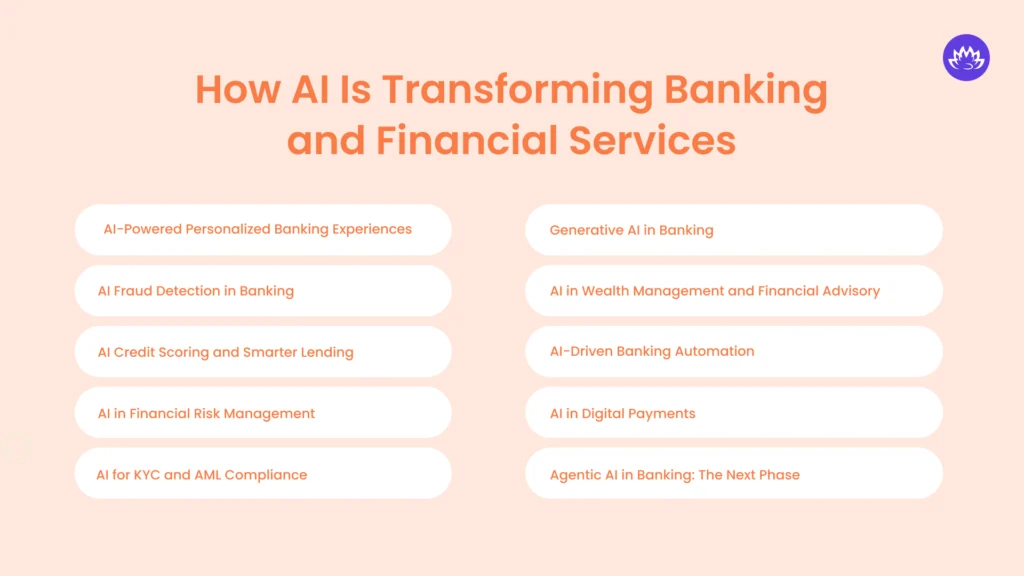
1. Smarter and Personalized Customer Experiences
They expect banks to recognize their needs and deliver relevant information promptly.
They expect banks to recognize their needs and deliver relevant information promptly.
AI can enable this to happen.
By examining spending habits, transaction records, financial objectives, and customer engagement, AI systems can uncover valuable insights into individual customers.
For instance, a frequent traveler might get tailored information on international payment services. Someone who consistently saves may receive recommendations for suitable savings or investment products.
AI can provide these recommendations without forcing customers to sift through numerous choices.
The next important key application is virtual assistants.
Banking assistants powered by AI can address typical inquiries, clarify transactions, share account details, and help customers navigate everyday tasks.
They can also run continuously, 24 hours a day. Banking institutions partner with AI-powered mobile app development companies that are experts in building powerful banking applications.
2. AI-Powered Fraud Detection
One of AI’s most compelling applications in financial services is fraud prevention.
Fraudsters are continually coming up with new techniques. They may use stolen login details, unusual payment behavior, fabricated identities, psychological manipulation, or advanced cyberattacks.
AI can adopt a more adaptable approach.
Machine learning models can analyze transaction behavior, device details, location trends, account usage, and other indicators. They can spot activity that seems out of character compared with a customer’s typical behavior.
The system may then mark the transaction for further verification or investigation. As a result, AI helps banks see beyond simply responding to fraud. It provides warning signs earlier and strengthens real-time financial protection.
3. Improved Credit Scoring and Lending
Machine learning systems can analyze vast quantities of financial data to detect patterns linked to credit risk. This helps financial institutions to evaluate applications faster and make more informed lending decisions.
AI can also help with continuous risk monitoring.
Instead of evaluating a customer only when they apply for a new financial product, banks can use AI to detect significant shifts in financial behavior over time.
Nevertheless, lending is also an area where responsible AI practices are crucial.
Credit decisions can significantly impact both individuals and businesses. Therefore, AI models must be carefully evaluated for fairness, accuracy, transparency, and possible bias.

4. Strengthened Financial Risk Management
Financial institutions must keep track of various types of risk. These are credit risk, market risk, operational risk, liquidity risk, and compliance risk.
AI enables banks to analyze these areas more efficiently.
Predictive models can analyze historical data and present indicators to detect possible risks. AI systems can also keep a constant watch on activity instead of depending solely on regular check-ins. In 2025, the global fintech market grew by nearly $400 billion and is projected to reach about $460 billion in 2026, according to Fortune Business Insights. As a result, banks can leverage fintech app development services to create smart, competitive banking applications.
This gives financial institutions more time to respond.
AI use in financial risk and compliance is already rising. Fraud detection, such as AML and KYC, ranks among the top application areas.
The value of AI here goes beyond just automation.
It enables financial institutions to detect patterns and possible issues sooner.
KYC and AML procedures involve extensive documentation and repetitive checks. Banks must verify customers and identify suspicious financial activity. AI simplifies this process at several points in the workflow.
5. Faster and Efficient KYC and AML Processes
Document-processing systems can extract information from forms and identification documents. AI can assist in various ways such as verifying information and spotting inconsistencies. Machine learning models can also analyze transaction patterns and flag activities that may need further investigation.
This can lessen the amount of manual labor required.
It can also let compliance teams spend more time investigating higher-risk cases rather than manually reviewing every transaction.
The goal is not to eliminate human judgment.
It aims to give compliance professionals better tools and more relevant information.
6. Impact of Generative AI in Banking
Generative AI has expanded artificial intelligence’s capabilities in banking.
Conventional AI is commonly employed to categorize information, recognize patterns, forecast outcomes, or spot anomalies.
Generative AI can also produce content and interact with users through natural language.
This creates numerous new opportunities.
Bank staff can use AI assistants to condense long documents, search internal data, generate reports, draft customer messages, and quickly locate relevant information.
Customer service teams can leverage GenAI to craft contextually appropriate responses.
Financial institutions are already heading in this direction.
7. Effective Wealth Management and Financial Advisory
It is also altering how customers handle their finances.
Financial advisors can leverage AI to evaluate portfolios, client goals, market data, and risk tolerances.
This can enable them to offer more informed recommendations.
AI-driven financial tools can also help individual customers gain better insight into their spending patterns. As a growing bank, you can hire AI developers from a reputable AI development company to leverage AI in day-to-day operations.
For instance, an intelligent financial assistant might review spending habits and pinpoint opportunities for the customer to cut costs. It could also arrange financial data and offer insights aligned with the customer’s objectives.
The human advisor still plays a significant role.
Emotions, personal priorities, and individual circumstances influence financial decisions many times. AI is the only tool that can offer data-driven analysis, whereas professionals can supply context, judgment, and personalized guidance.
8. Automation in Banking Operations
Much banking work happens behind the scenes.
Employees may spend hours filling out forms, inputting data, reviewing documents, compiling reports, handling routine inquiries, and moving information between different systems.
Automation driven by AI can lessen this workload.
An intelligent system could pull data from submitted documents, verify key details, sort the application, conduct preliminary reviews, and route it to the right team.
Employees can then concentrate on cases that demand human judgment.
This can boost productivity and reduce repetitive manual tasks. So the opportunity isn’t just about reducing costs; it is about letting employees spend more time on meaningful work.
9. Improved Digital Payments
Digital payments are now a standard part of daily life.
Customers rely on mobile banking apps, digital wallets, cards, instant payment systems, and online payment platforms for both minor and large transactions.
This generates a high volume of transactions that financial institutions must monitor.
AI enables real-time analysis of transactions.
It can detect abnormal spending patterns, flag potential fraud, help approve payments, and strengthen security measures.
AI can also help banks understand how customers use payment services.
These insights can help improve product design and offer more suitable financial services.
As digital payments keep expanding, smart payment systems will grow more critical.
10. Agentic AI is the Future
The next phase of AI adoption might extend beyond assistants and recommendation systems.
Agentic AI is designed to carry out several steps to achieve a specific goal.
Rather than just responding to a customer’s question, an AI agent might be able to comprehend the request, collect pertinent information, assess available choices, and then take approved actions.
For instance, a customer might ask an AI assistant to help manage a specific financial objective. The system can analyze the customer’s information, suggest appropriate options, and guide the customer through the necessary steps.
These systems are still under development. Banks need stronger control systems that allow AI agents to execute sensitive financial actions.
A 2026 Cambridge report also found that 52% of financial services firms surveyed actively adopted agentic AI. AI is moving from a tool to a supportive partner that helps employees run financial workflows.
Major Challenges Banks Experience Post AI Adoption
AI offers significant opportunities, but it has also brought serious challenges.
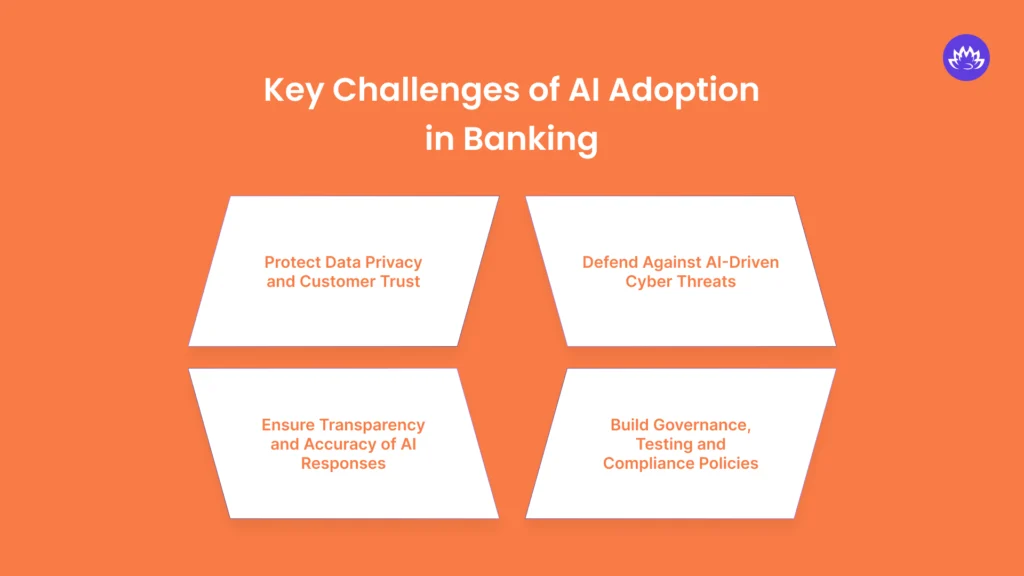
- Data privacy remains a priority, as banks handle customers’ most sensitive information.
- Cybersecurity is important. AI cannot stop attackers from using AI to create high-level threats. Cyberattacks are the biggest threat nowadays.
- Transparency and accuracy are also major concerns. Therefore, banks need stronger governance, as Generative AI systems can provide information that sounds convincing but isn’t accurate.
- Banks also need clear policies for model testing, data management, human oversight, and regulatory compliance.
Future of AI-Powered Banking
The future of banking doesn’t have to mean replacing humans with machines.
It is more likely to involve building a partnership between financial experts and advanced technologies.
Customers will likely engage more often with AI-driven financial assistants through their banking apps. Employees can use AI to handle complex research and administrative tasks. Fraud detection systems may become better at predicting incidents. Compliance teams could get more accurate risk indicators. Loan processing might become quicker and more tailored to individual needs.
Proactive banking is also on the rise, as customers can instantly identify issues such as unusual spending, cash-flow concerns, or cross-selling opportunities. Hence, adopting AI is inevitable for those banking and financial institutions that are looking to modernize and stay competitive.
Final Thoughts
AI is expanding banking beyond conventional transactions. It is enabling financial services that are faster, smarter, tailored to individual needs, and increasingly anticipatory.
It helps banks detect fraud, automate routine tasks, improve lending processes, strengthen compliance, gain insights into customer behavior, and deliver faster support. Generative AI and agentic AI are pushing these possibilities even further.
However, the future of AI-powered banking goes beyond merely adopting the latest technology. It’s about applying technology appropriately. Banks must strike a balance between innovation and security, transparency, data privacy, regulatory compliance, and human oversight. Customers will adopt AI only if they believe their financial data is secure and their decisions are managed responsibly.
This is where choosing the right technology partner creates a remarkable difference. Financial institutions require AI solutions tailored to their business processes, customer expectations, security needs, and enduring digital objectives. From intelligent automation and fraud detection to AI-driven customer interactions, predictive analytics, and generative AI tools, the appropriate solution can transform complicated financial operations into streamlined, more efficient workflows.
At Whitelotus Corporation, we assist businesses in discovering and deploy AI-driven solutions tailored to their unique technological and operational needs. Our AI development expertise helps financial institutions build intelligent applications, automate repetitive tasks, embed AI into existing systems, and deliver more tailored digital experiences. Contact us to learn more about our services.