Remote working has now become an integral part of the new working ecosystem worldwide. Post-pandemic, all traditional workspaces are transforming phenomenally. Most well-known and reputed companies in domains such as technology, marketing, accounting and finance, medical and health, and customer service have introduced remote working policies. One major factor that promotes remote hiring is talent shortages and the quest to win in the talent market.
Middle Eastern IT companies recently are confronting some critical challenges in talent acquisition. Lack of qualified candidates with the right skill sets and experiences, gender disparities, inefficient hiring processes, and lengthy recruitment cycles pose significant hurdles in hiring manpower. On the contrary, the tech industry in Middle Eastern regions is observing considerable growth. IT companies from the Middle East require skilled professionals who are proficient in cybersecurity, data analytics, cloud computing, and quality software development. In tune with this, these companies seek remote expertise from worldwide, especially in India.
Some of the significant trends that dominate remote working are the rising use of remote access tools, improved cybersecurity measures, the impact of Artificial intelligence, the adoption of cloud computing technologies, and the demand for employee well-being leading to work-life balance. According to Forbes, 60 to 90 million Indians are expected to choose remote working by 2025. This leads to the rising demand for Indian IT talent—mastering technology and services. India has now become a top source for outsourcing. It is emerging as an active talent pool thriving with new ideas and computer programs.
The blog sheds light on how remote hiring from India transforms Middle Eastern IT companies.
Remote Hiring: A Global Trend Shaping The Future of Work
The global pandemic pushed companies worldwide to go remote. Fast forward four years and remote work is now a culture that has disrupted so many organizations. Now, hiring is not just confined to the limits of cities or countries. The impact of technology in promoting remote hiring is huge. Remote-friendly tools such as Loom, Google Docs, and Asana keep everyone connected from any part of the world. Such tools ensure smooth collaboration, and team members can work together with their own schedules without any interruptions. Remote hiring has a profound impact on the global human resource ecosystem as well. It is reshaping the work culture and provides some promising benefits to both companies and employees. Some of the significant benefits are:
- Remote hiring is an environmentally friendly and sustainable choice for companies. It saves conventional resources, time, and cost.
- Companies get wider access to a diverse talent pool, allowing people to work in different time zones.
- Remote hiring encourages individual productivity and enables employees to work with freedom and flexibility.
- It also saves company costs in very many ways.
- Remote hiring enables employee retention and saves the replacement costs for recruiting new employees.
- With remote hiring, companies can build agile teams to create innovative projects.
- Companies get employees with improved engagement, striking a work-life balance.
- Through the detailed communication online via emails or skype chats, remote hiring improves written communication between employer and employee.
Current Scenario: IT Industry in the Middle East
Middle Eastern countries are quickly picking up the pace and have now become world tech leaders. The latest reports showcase that 74% of jobs in the Middle East and North Africa region are for Software Engineers. In addition, by 2025, the Middle East cybersecurity market is expected to develop up to $30 bn. Across the entire region, AI contribution on a yearly basis is also anticipated upto 30%, with UAE and Saudi Arabia experiencing the biggest growth. Liberal government initiatives from Middle Eastern countries, the burgeoning startup ecosystem, rising industry verticals, and the rapid development of industries such as fintech, e-commerce, and logistics are promoting remote hiring to the next level. Another latest report shows the growing SaaS industry in the Middle East with a valuation expected to rise upto $22.7 bn by 2030.
On the other hand, the shortage of qualified IT professionals having the right skill sets and inefficient hiring processes has led to the demand of remote hiring, especially from India. Hence, UAE and Saudi Arabia currently recruit foreign tech workers, partner with global staffing firms, and invest in continuous learning and development programs for their workforce. However, companies from these countries are also struggling to find adequate qualified candidates to fill open job roles. The following reasons influence them to hire remote IT professionals from countries like India and the USA.
- Students from the UAE do not have adequate technical skills that can match the current market needs.
- All over the world, there are tech giants and startups that are looking for similar talent, which is scarce.
- Middle East tech industry is relatively young and have fewer years of work experience compared to established tech hubs like India.
How Remote Hiring From India Benefits Middle Eastern IT Companies
The rising demand for top IT professionals who can create innovative tech projects is shifting more towards India. Well, there are several reasons. Some of the major reasons why we are the chosen ones are:
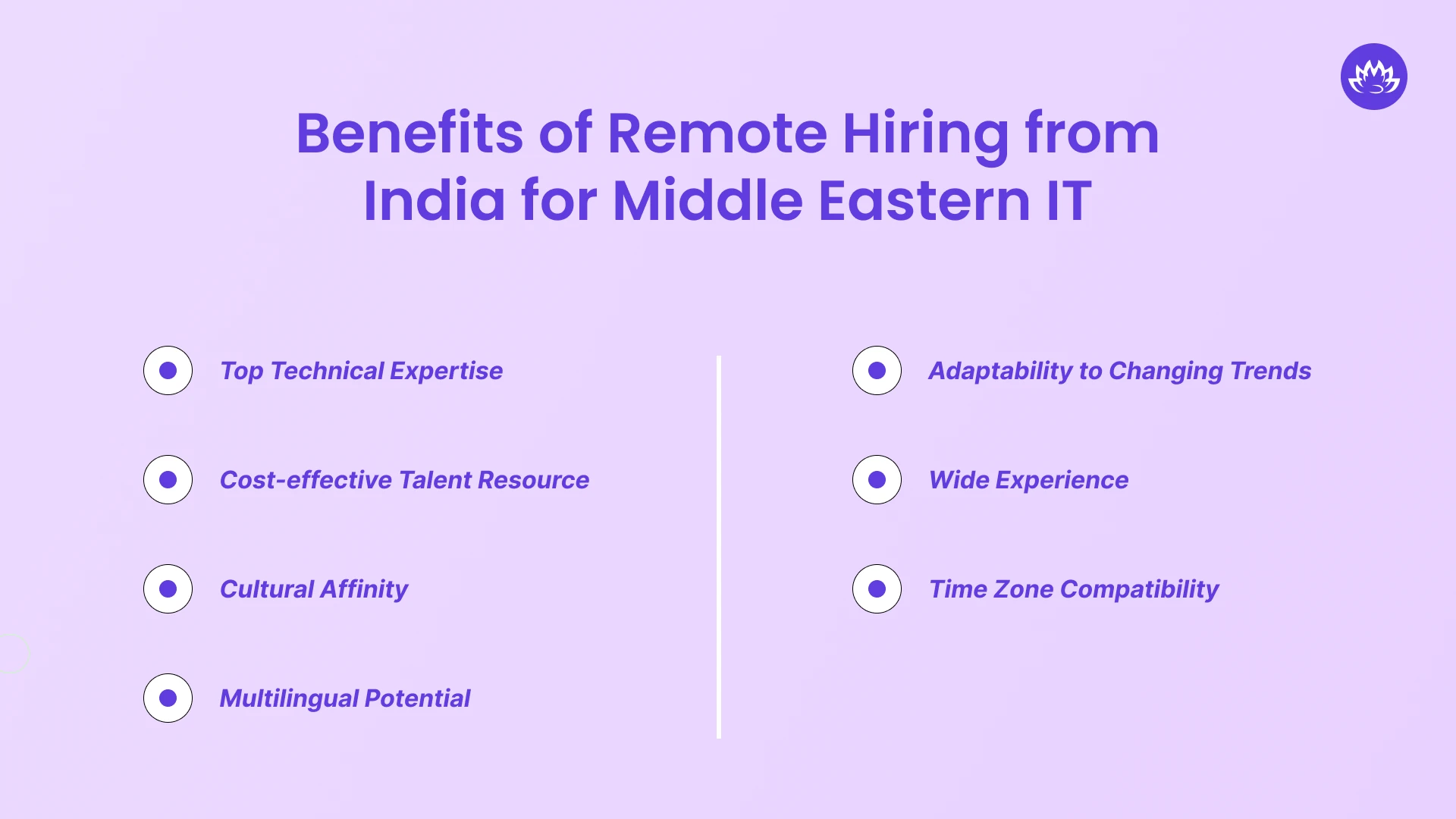
Top Technical Expertise
India has the most significant number of IT graduates. They acquire top technical qualifications from reputable institutions that provide the highly skillful workforce for AI, software development, cloud computing, and cybersecurity. It gives them global IT expertise to work for diverse projects from the Middle Eastern market.
Cost-effective Talent Resource
Indian IT professionals provide a balance between quality and affordability. Middle Eastern companies need quality and talented resources at affordable rates due to their rising operational costs.
Cultural Affinity
There is a deep cultural understanding and collaboration between India and the Middle East. Hence, many Indian professionals work with similar culture, customs, and values. Also, there is a large Indian community expatriates out there to make a smoother transition for professionals.
Multilingual Potential
Indian professionals have multilingual proficiency, which is commonly needed by the Middle Eastern IT sector. This results in increased collaboration and smoother operations.
Wide Experience
The Indian IT professionals have vast experience in various sectors, such as banking, telecom, healthcare, and logistics. With this expertise, they can help the key industries in the Middle East grow and expand.
Adaptability to Changing Trends
India’s IT professionals are well known for being highly adaptable and exhibiting a continuous learning approach. They stay updated with emerging technologies such as blockchain, AI, IoT, and cloud computing.
Time Zone Compatibility
The time zone difference between India and Middle East is minimal. Therefore, it is very much easy to maintain real-time communication and seamless collaboration for developing complex projects that need constant interaction.
The Impact of Remote Hiring on the Business Performance of Middle Eastern Companies
There are many Middle Eastern IT companies that are experiencing exceptional success by integrating Indian talent into operations. For example, TruKKer is a prominent digital freight platform in the Middle East. They use the skills of Indian developers and tech specialists to streamline their logistics operations. They use IT talent to scale rapidly and develop advanced algorithms for fleet optimization. Another example is Emirates—a large enterprise that invests in cross-functional global teams from India. They have utilized several aviation solutions and have developed collaboration with Indian engineers to expand their aviation business.
UAE and Saudi Arabian companies trust and rely on the skills of Indian IT professionals. They get access to a broader global talent pool that is cost-efficient and productive. Moreover, it helps them enhance their operational agility and scalability, meeting the growing demands without investing heavily in infrastructure.
Key Technology Trends and Skills for Senior Developers in India
Middle Eastern companies need top technologies to build their large projects. They look for IT professionals who are proficient in using the most trending technologies. The world of software development is dynamic, and organizations need to stay current with current trends. That is why the top senior developers from India always seek to learn new technologies and remain updated in their profession. Emerging technologies and trends bring new opportunities in software development and help developers find better opportunities.
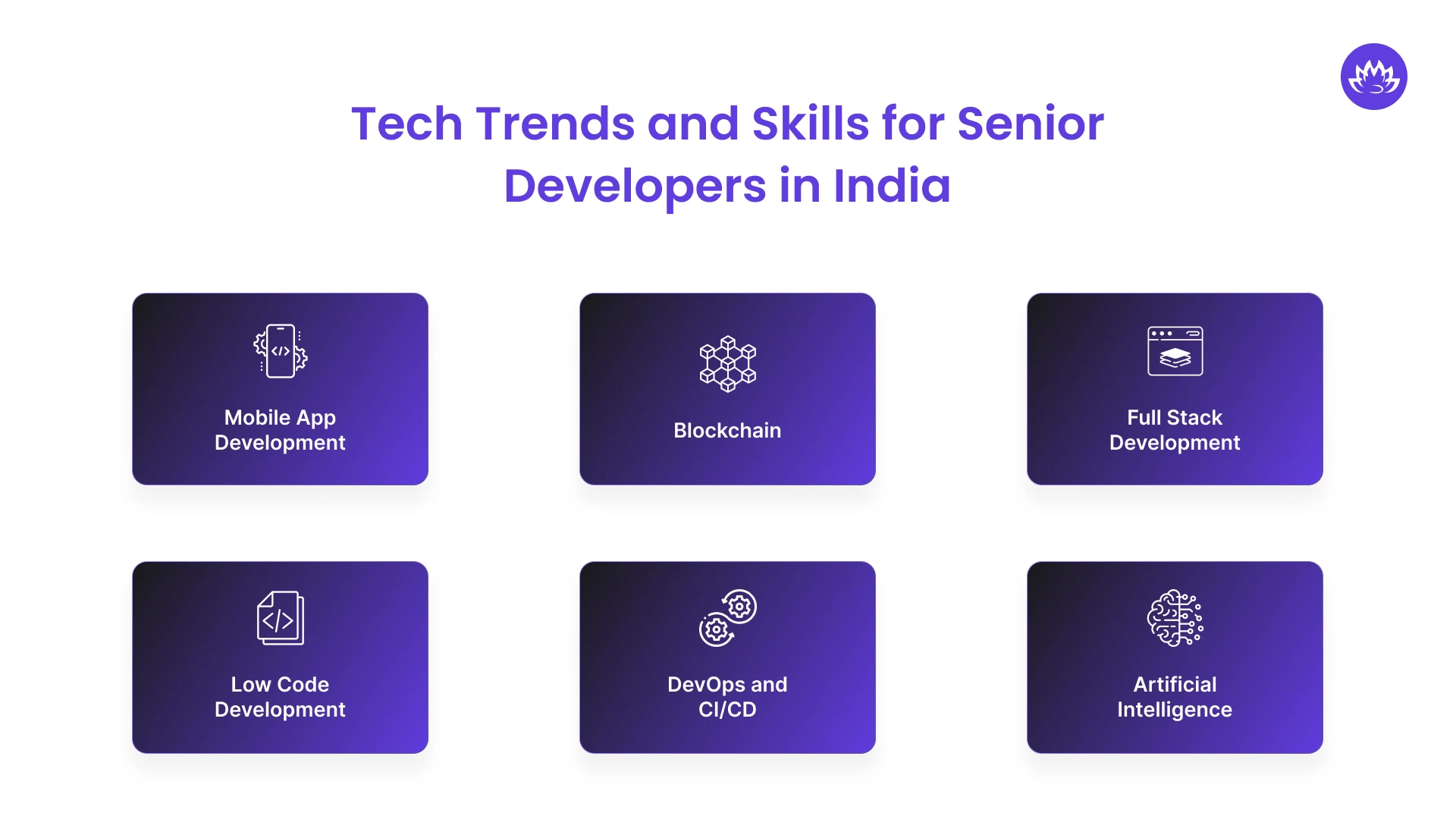
Some of the key skills that Middle Eastern Companies are looking for to build their innovative projects are:
Mobile App Development
Indian developers are seasoned experts in developing exceptional mobile applications using diverse native and cross-platform technologies like Flutter, React Native, Node.js, etc. Middle Eastern companies need such technologies to develop user-friendly apps.
Blockchain
Saudi Arabian companies need technologies like Blockchain to create fintech and healthcare projects. Developers know how to organize data into distributed and decentralized systems to eliminate hacking or alteration.
Full Stack Development
Middle Eastern companies need full-stack developers who are well-qualified and proficient in building large and small apps using front-end and back-end technologies. Developers in India have the exact skills and expertise needed by such companies.
Low Code Development
With the growing SaaS work culture, Middle Eastern countries and businesses also seek projects that can be developed with low code. In India, there is a huge pool of well-experienced SaaS developers who know how to modernize legal applications, build complex apps with low code from scratch, create full-stack web apps combining several features, and leverage SaaS infrastructure to build powerful web apps.
DevOps and CI/CD
To streamline software developemnt processes, companies adopt DevOps practices. With software engineers from India having this skill in abundance, they help Middle Eastern companies build projects with continuous integration and continuous delivery.
Artificial Intelligence
Artificial Intelligence and Machine Learning are the top technologies that every growing business needs. And companies from Middle Eastern regions is not an exception. They need to automate tasks, streamline operational workflows, need predictive analytics to make informed business decisions for the future. Indian senior developers have mastered in using AI and ML technologies efficiently. With their skills, they can give solutions to various industries effectively.
Harnessing Technological Infrastructure For Seamless Communication
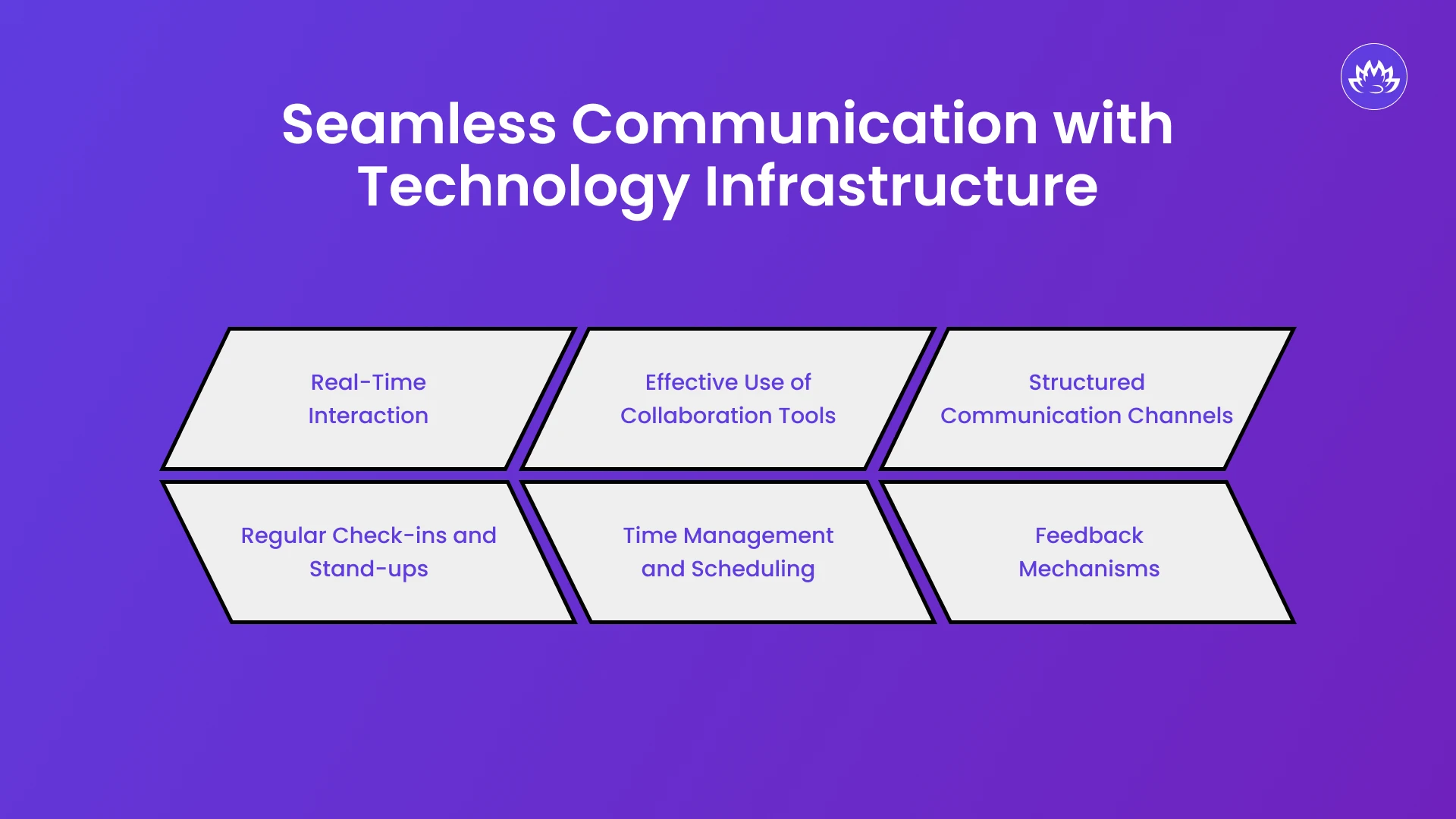
The time zone between Middle Eastern countries and India is minimal. Hence, developers from India have the leverage to communicate in real-time and provide ongoing support and maintenance to diverse businesses in all countries.
Real-Time Interaction
Indian developers can use overlapping working hours to provide instant feedback and continue with further discussions. With the power of communication technologies they can indirect with regular video conferences, enhancing face to face communication.
Effective Use of Collaboration Tools
Indian developers can put their technological infrastructure to the maximum use. They can implement various tools for effective communication and collaboration such as Slack, Zoom, Trello, Microsoft Team, etc. for instant messaging and video calls. With such IT infrastructure, the team can enhance communication and collaboration. These tools can ensure effective project managment and workflow optimization, enabling efficient remote working. Moreover, it also improves productivity and accountability, ensuring on-time delivery of the project. With a secured IT infrastructure, senior developers from India can give several benefits to businesses, such as the integration of various tools and services like Google Workspace, etc.
Structured Communication Channels
Companies from Middle East can establish clear communication protocols through various effective communication channels. They can get project updates from the developers and can ask for status reports in real time. Furthermore, it also helps the team to discuss the technical aspects seamlessly and provide general updates to the companies.
Regular Check-ins and Stand-ups
Through a solid technological infrastructure that Indian developers can easily provide, companies can participate in daily or weekly meetings, share progress, and address challenges. Team members can easily raise their concerns and ask for a supportive environment.
Time Management and Scheduling
Developers from India can optimize meeting schedules to balance the working hours of both the countries. By using scheduling tools like Doodle, Google Calendar, etc they can find suitable meeting times for further discussions.
Feedback Mechanisms
The geographical locations of Middle Eastern countries and India also give the leverage to provide feedback in real time and check the communication effectiveness and team dynamics. This encourages open communication, and team members have the choice of providing valid suggestions.
Future Outlook: Remote Work and Middle Eastern IT Companies
With the immense IT talent pool available in India to explore, the future of remote working in Middle Eastern IT companies is promising. With the increased adoption and flexibility of digital transformation and innovation, the government is introducing new policies and initiatives that encourage remote work. This shift embraces digital solutions. In addition, remote work has permitted Middle Eastern IT companies to hire skilled professionals from countries like India who have strong IT expertise. With the adoption of the latest technologies, remote work is becoming more integrated by using top collaboration tools such as Slack, Trello, and Zoom.
However, there will always be the need to build more robust cybersecurity measures. With developers from India, these countries can build robust security frameworks that will protect their data and operations. Lastly, with remote work, there will be no need to make large office spades or travel. Altogether, it will promote sustainable working practices that are cost-effective and productive. All these funds will be redirected to developing core IT projects.
Conclusion
Remote work in Middle Eastern IT companies observes steady growth. The increasing digitalization and more focus on global collaboration fosters the need to adopt remote working practices. As we see the revolutionary impact of hiring remote workers from India in Middle Eastern countries, the future of working in the global environment is bright and full of opportunities. Tapping into India’s IT talent is helping companies to grow, expand, excel, and stand out successfully in the global competition. The contribution of IT professionals from India to Saudi Arabian and other Middle Eastern countries is exceptional and phenomenal.