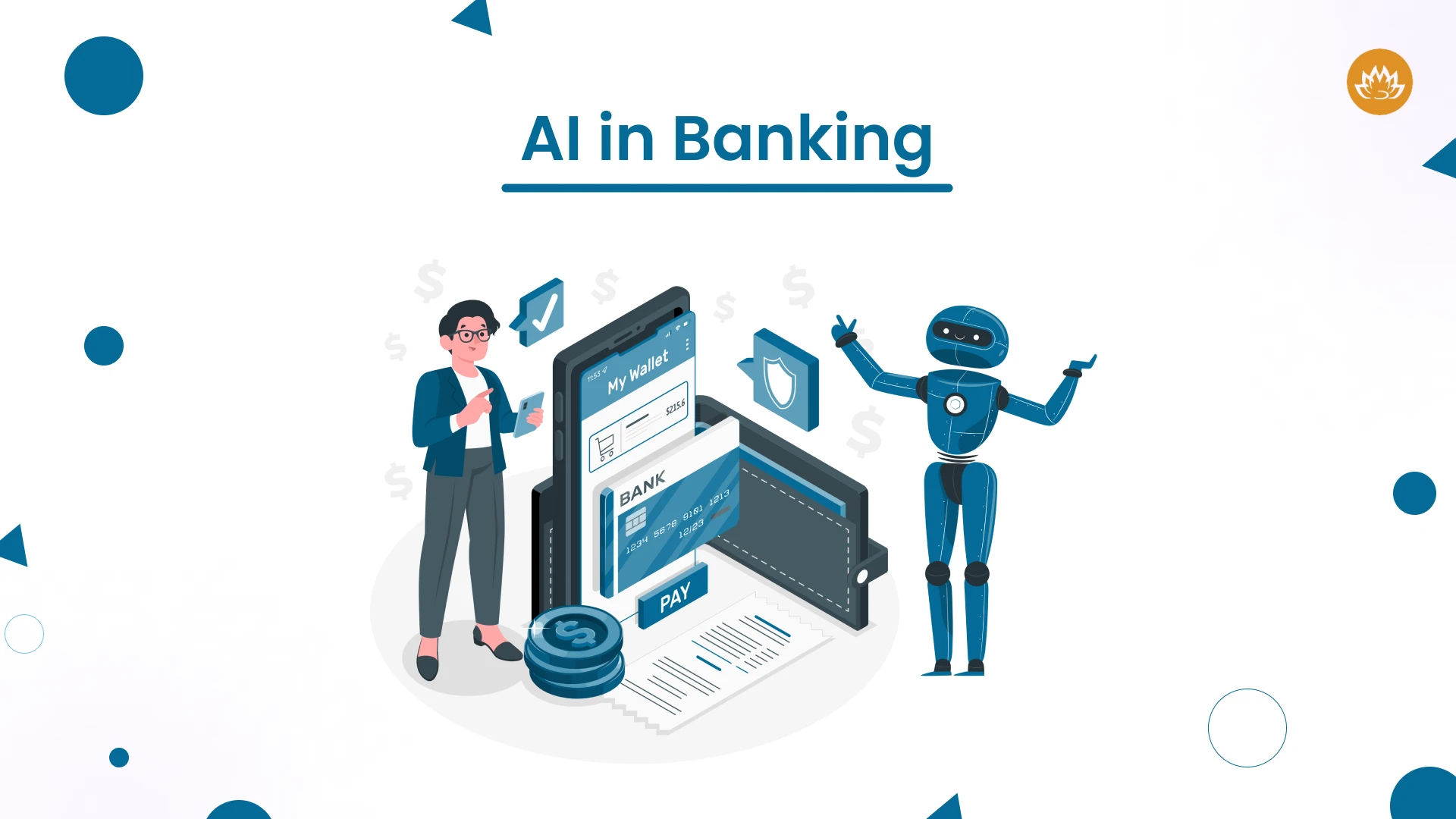
AI has become an intricate part of banking and financial institutions for the last five years. Each business area of finance uses AI capabilities in diverse ways. As a banking customer, you must have obtained personalized banking experiences and tighter fraud detection and security measures. It happens with AI and AI-based decision-making abilities. The reason why AI is gradually taking over is the rising need to sabotage fraudulent transactions that occur rampantly across the globe, frustrating call center experiences, and long wait times for customers.
So here comes AI, which enables the banking and finance sectors to enhance their reputations and provide excellent customer experiences. The global market for generative AI in finance is expected to expand from 1.09 billion USD in 2023 to 9.48 billion USD in 2032 at a compound annual growth rate of 28.1 percent (CAGR). At Whitelotus Corporation, we provide fintech app development services backed by our deep AI experts, helping banks deliver improved banking experiences.
Let us understand how AI can be implemented in various areas of the banking and finance sector.
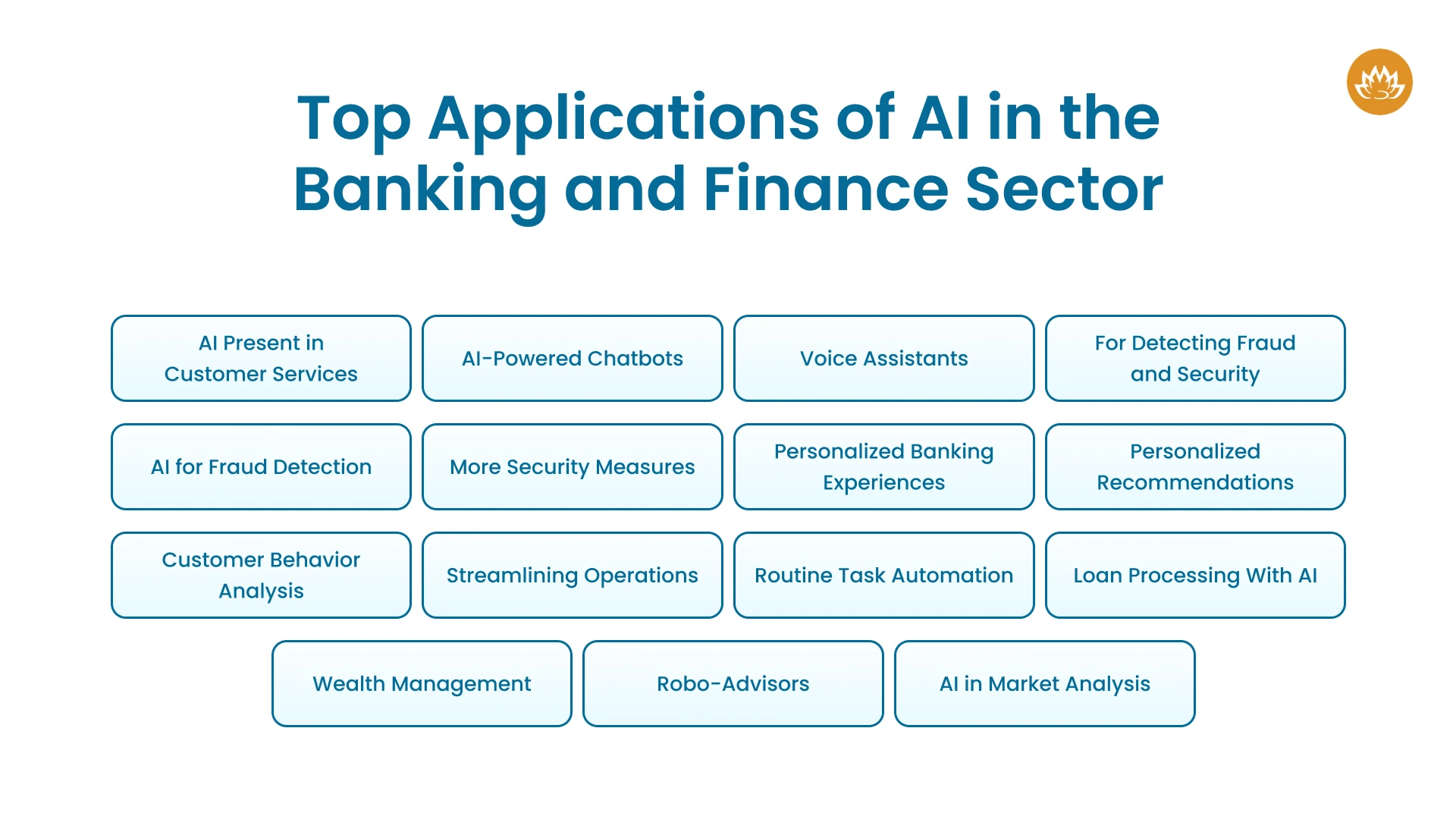
Top Applications of AI in the Banking and Finance Sector
AI in banking performs tasks that call for human intellect by utilizing a variety of sophisticated computing algorithms and machine learning technologies. Data analysis, pattern recognition, decision-making, and process automation are among these. AI in banking encompasses both essential automation tools and sophisticated systems. With further learning and development, these systems offer more precise and practical answers to various banking tasks. Some of the key applications of AI in the banking sector that lead to innovation are:
AI Present in Customer Services
When you use chatbots and voice assistants to incorporate AI into customer care, what you find is improved banking service delivery models and establishing new benchmarks for user interaction. As a software development company, we share some key examples:
AI-Powered Chatbots
Chatbots driven by AI are revolutionizing banking by providing round-the-clock chat assistance. It uses natural language processing (NLP) to comprehend and reply to consumer questions and requests, carry out repetitive duties, and assist customers with banking procedures.
- Response times are shortened when chatbots are used.
- Evaluating client information and customizing responses provide individualized support.
- Businesses save a lot of money when they deploy chatbots.
Voice Assistants
AI-powered voice assistants use voice commands to handle consumer questions and streamline transactions. These assistants are driven by technology such as Google Assistant and Alexa from Amazon, so customers can carry out a range of banking chores.
- Customers can use voice assistants to access financial services without using their hands.
- Voice-driven banking's accessibility improves the user experience.
- They provide a more enjoyable and convenient experience.
For Detecting Fraud and Security
Banks need to protect and safeguard their assets and customer data effectively. They can use AI to detect fraud and ensure security. They can use various methods, such as:
AI for Fraud Detection
Malicious activity in the banking industry is detected and stopped with the aid of AI systems. AI finds abnormalities that point to possible fraud problems by examining vast volumes of transaction data and identifying trends.
- Banks can quickly identify and address fraudulent activity thanks to real-time surveillance.
- By preventing the incorrect flagging of genuine transactions, AI lowers false positives.
- Fintech's use of AI dramatically improves security and secures banking.
More Security Measures
AI in banking offers security features like anomaly detection and sophisticated biometric authentication. AI is used by biometric systems like voice recognition, facial recognition, and fingerprint scanning to swiftly and precisely confirm identities.
- The application of AI in biometric authentication improves security by making it impossible for unauthorized users to access accounts.
- Anomaly detection further improves security by spotting and fixing possible problems before they can do severe damage.
- Together, these steps lower the possibility of breaches and give institutions and consumers a safer financial environment.
Personalized Banking Experiences
As software development experts, we know how to harness AI and ML technologies to transform the banking experience. Through tailored suggestions and consumer behavior analysis, AI is making the banking industry more specialized and customer-focused. Examine the following notable instances of AI in banking:
Personalized Recommendations
Customer data, including transaction history, spending trends, and financial objectives, is analyzed by AI algorithms. Banks can provide individualized financial advice and product suggestions based on the needs of each consumer.
- By delivering specialized product offerings, banks may significantly increase client satisfaction.
- Clients receive answers and guidance tailored to their particular financial circumstances.
- In addition to meeting customers' urgent requirements, this customized strategy fosters enduring loyalty and trust.
Customer Behavior Analysis
AI uses predictive analytics to comprehend and foresee the wants and preferences of its customers. AI can predict what services or goods a consumer could need in the future by looking at various data sources, including historical behavior and industry trends.
- Banks can interact with clients more successfully if they can anticipate their demands.
- Customers feel appreciated and understood due to this proactive interaction, which increases customer loyalty.
- A deeper bond between the bank and its customers and higher retention rates result from improved customer loyalty.
Streamlining Operations
By using AI to streamline operations, banks are increasing process accuracy, cutting costs, and increasing efficiency. These developments provide customized solutions that greatly enhance financial management for commercial banking workers. In addition, you can also reduce the cost of developing an app with AI and ML implementation in operations.
Routine Task Automation
AI in banking and finance automates regular chores and back-office procedures typically completed by people. Data entry, transaction processing, compliance verification, and report creation are all included in this.
- Increased operational efficiency results from automating repetitive operations.
- As a result, banks save a lot of money because they don't need as many employees.
- Automation guarantees greater process accuracy and reduces the possibility of human error.
- Human workers can concentrate on more complex tasks as a result of this operational simplification.
Loan Processing With AI
Artificial intelligence is revolutionizing the loan processing industry by evaluating creditworthiness and expediting loan approvals. AI algorithms analyze large volumes of data from many sources, such as social media activity, transaction histories, job records, and credit scores.
- Faster loan approvals result from the application of AI in loan processing.
- This speeds up the decision-making process and enables institutions to respond more quickly. With AI-driven credit evaluations, credit evaluations are more accurate.
- In addition to improving the loan approval process's equity and openness, this aids in determining whether applicants are creditworthy.
Wealth Management
Through the integration of AI into wealth management and investing, the banking sector is providing more individualized, cost-effective, and efficient financial services. Here are some notable instances of AI in banking:
Robo-Advisors
Through the provision of automated and algorithm-based financial planning services, AI-driven robo-advisors are revolutionizing the investment management industry. These online tools examine a customer’s economic status, objectives, and risk tolerance to build and manage a customized investment portfolio.
A more extensive range of people, including those who might not have the funds to retain traditional financial advisors, can now receive financial planning through robo-advisors.
- Investment management is now more accessible thanks to these platforms' generally cheaper fees than human advisors.
- By using data-driven decision-making, robo-advisors reduce emotional biases and increase the consistency and dependability of investing methods.
- This results in better financial results for clients and optimized portfolio performance.
AI in Market Analysis
AI in banking examines data and market patterns to create profitable investment plans. AI systems process large volumes of financial data from various sources, such as news articles, social media, economic reports, and historical market data.
- AI-driven market analysis improves investment insights by delivering precise, timely, and thorough information.
- As a result, better and more informed decisions are made, and market possibilities can be swiftly taken advantage of.
- By spotting possible dangers and offering risk-reduction techniques, artificial intelligence (AI) in banking assists in managing investment risks.
- A data-driven approach to investing is ensured by applying AI in market analysis, which can enhance portfolio performance and lessen exposure to market volatility.
Challenges in AI Implementation in the Banking and Finance Industry
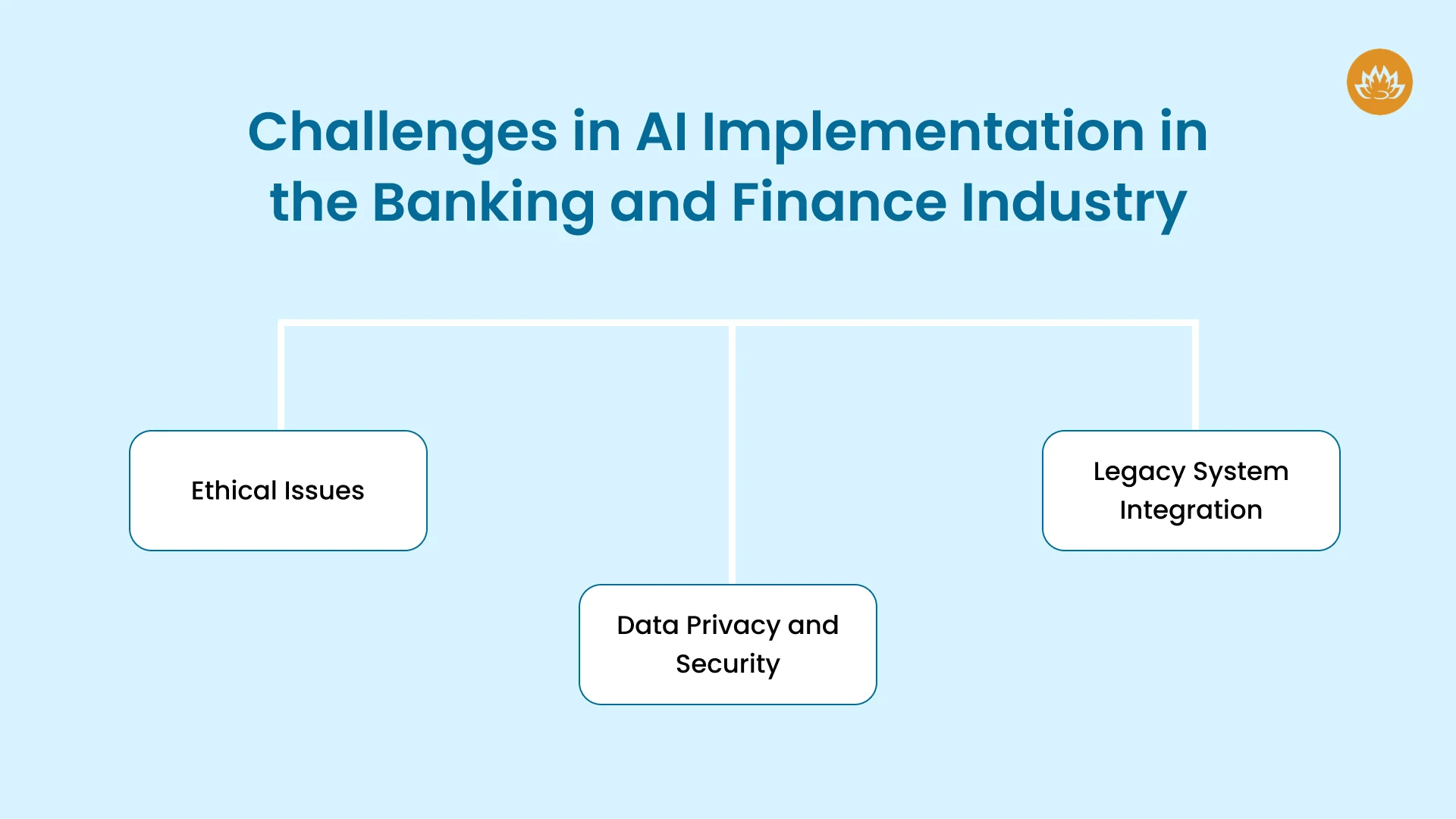
Although banks are efficiently using AI-powered strategies for their operational effectiveness, there are specific challenges that customers face when using AI and ML in banking:
Ethical Issues
Using AI in banking raises some ethical concerns, one of which is the possibility of biased algorithms that might discriminate against particular demographics.
- Fairness and preserving client trust are two benefits of transparency in AI decision-making processes.
- Regulative agencies are increasingly scrutinizing the use of AI in financial services. To guarantee compliance, banks must manage complicated rules.
Data Privacy and Security
Banks are managing enormous volumes of sensitive consumer data due to the growing use of AI in banking. However, it is crucial to guarantee the security and privacy of this data.
- Strong cybersecurity defenses guard against illegal access and data breaches.
- Banks must abide by data protection laws like the CCPA and GDPR, which guarantee that AI systems are built with privacy by default.
Legacy System Integration
There are major integration issues because many banks use outdated systems that might not be compatible with cutting-edge AI technologies.
- Updating IT infrastructure to accommodate AI ambitions can be expensive and time-consuming.
- Banks must create plans for smooth integration, which could involve investing in scalable technology, gradually implementing changes, and building strong API frameworks.
Future of AI in Banking
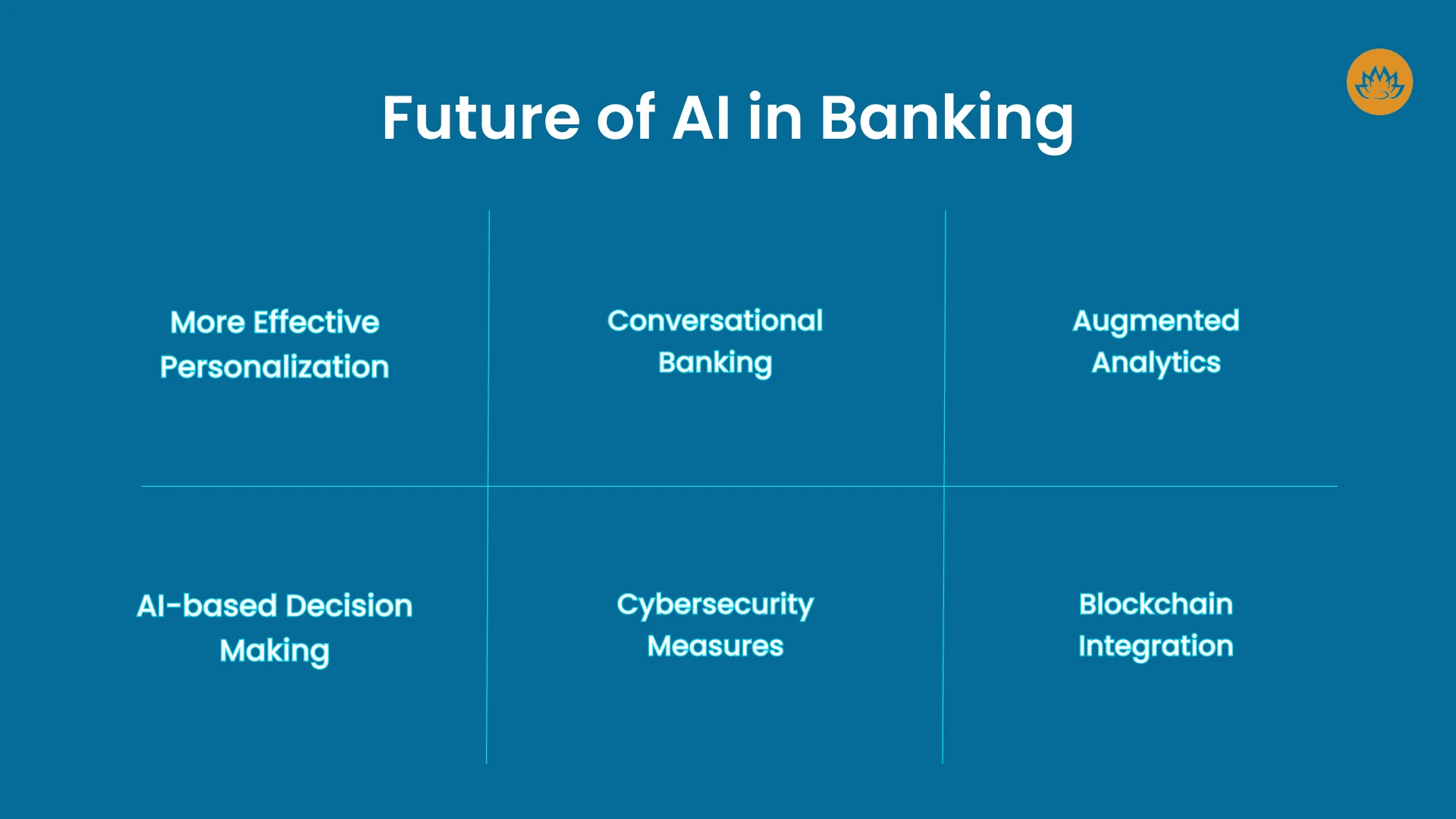
AI in banking offers improved productivity, tailored client experiences, and strong security, setting banks up for success in a world that is becoming increasingly digital. Banks are using AI technology to develop and revolutionize their offerings. Examine the following important AI use cases:
More Effective Personalization
AI in banking, AI uses individual consumer data and behavior to provide highly customized services and products. AI customizes financial advice, product recommendations, and marketing messages for every consumer by examining transaction histories, spending trends, and individual preferences.
The result is that it offers relevant and on-time solutions, improving customer satisfaction and loyalty. Also, it can make marketing campaigns better and excel in conversion ratios.
Conversational Banking
Chatbots and virtual assistants driven by AI are used in conversational banking to provide smooth communication between banks and their clients. AI engineers who provide mobile app development services will know how to use these systems to complete transactions, respond to inquiries, etc., are available for hire.
As a result, you can provide 24/7 customer experiences, reduce operational costs, and engage customers more effectively with personalized services.
Augmented Analytics
AI and machine learning are used in augmented analytics to automate data preparation, insight production, and visualization. This gives bank staff members—from data analysts to business users—the ability to find useful insights without requiring a great deal of data science knowledge.
What you get out of it is rapid data analytics, easy access to advanced analytic tools, and better decision making process for your organization.
AI-based Decision Making
AI provides predictive analytics and data-driven insights to improve banking decision-making. From risk management and investment strategies to loan approvals and credit scoring, AI can evaluate enormous datasets to spot patterns and make wise choices.
The benefit is improved accuracy and efficiency, less human biases, and more risk management.
Cybersecurity Measures
AI is transforming banking cybersecurity through real-time threat detection and prevention. Compared to conventional techniques, AI systems are able to analyze network data, spot odd patterns, and react to possible security breaches faster.
With this, banks can protect customer data and can reduce cyberattacks. It can also ensure compliance with tough security regulations and can protect bank reputation.
Blockchain Integration
Blockchain and artificial intelligence are frequently used to improve productivity, security, and transparency. When paired with AI analytical powers, blockchain’s decentralized ledger simplifies procedures like fraud detection and international payments.
What you obtain is a secured and transparent platform for transactions, less chances of fraud, and better regulatory compliance.
Conclusion
As more and more financial services companies are implementing AI capabilities into their organization, we cannot ignore its influence in this sector. AI’s future is bright and promising, and it is all set to transform the banking sector in so many ways. We are the leading fintech app development company providing artificial intelligence services to small and large financial institutions. Whitelotus Corporation and its team of developers work with banks and finance companies to create robust AI and ML models to improve revenue, reduce costs and prevent risks in the entire company. Contact our tech experts today and learn more about our services.