Today’s businesses face the same obstacles in their digital transformation: data silos that prevent insights, legacy processes that hamper execution, and technology investments that don’t grow with business objectives. Workflow automation alone is no longer sufficient.
What is Full Stack AI Development?
- Frontend interface
- Backend systems
- Databases and vector stores
- APIs and integrations
- Cloud infrastructure
- Machine learning models
- Security and monitoring systems
- AI orchestration frameworks
- For intelligent customer support
- AI-powered mobile app development
- Autonomous workflows
- Predictive analysis
- Fraud detection
- Real-time personalization
- Recommendation systems
What is the Importance of full-stack AI Development in 2026
- Scalability
- Security
- Autonomous
- Multimodal
- Real-time capability
- Cross-platform compatibility
- Context-awareness
- Speed up automation
- Deliver hyper-personalized services
- Increasing revenue opportunities
- Improvement in scalability
- Enhancement of customer experiences
- Reducing operational costs
Technologies Empowering Full Stack AI Development
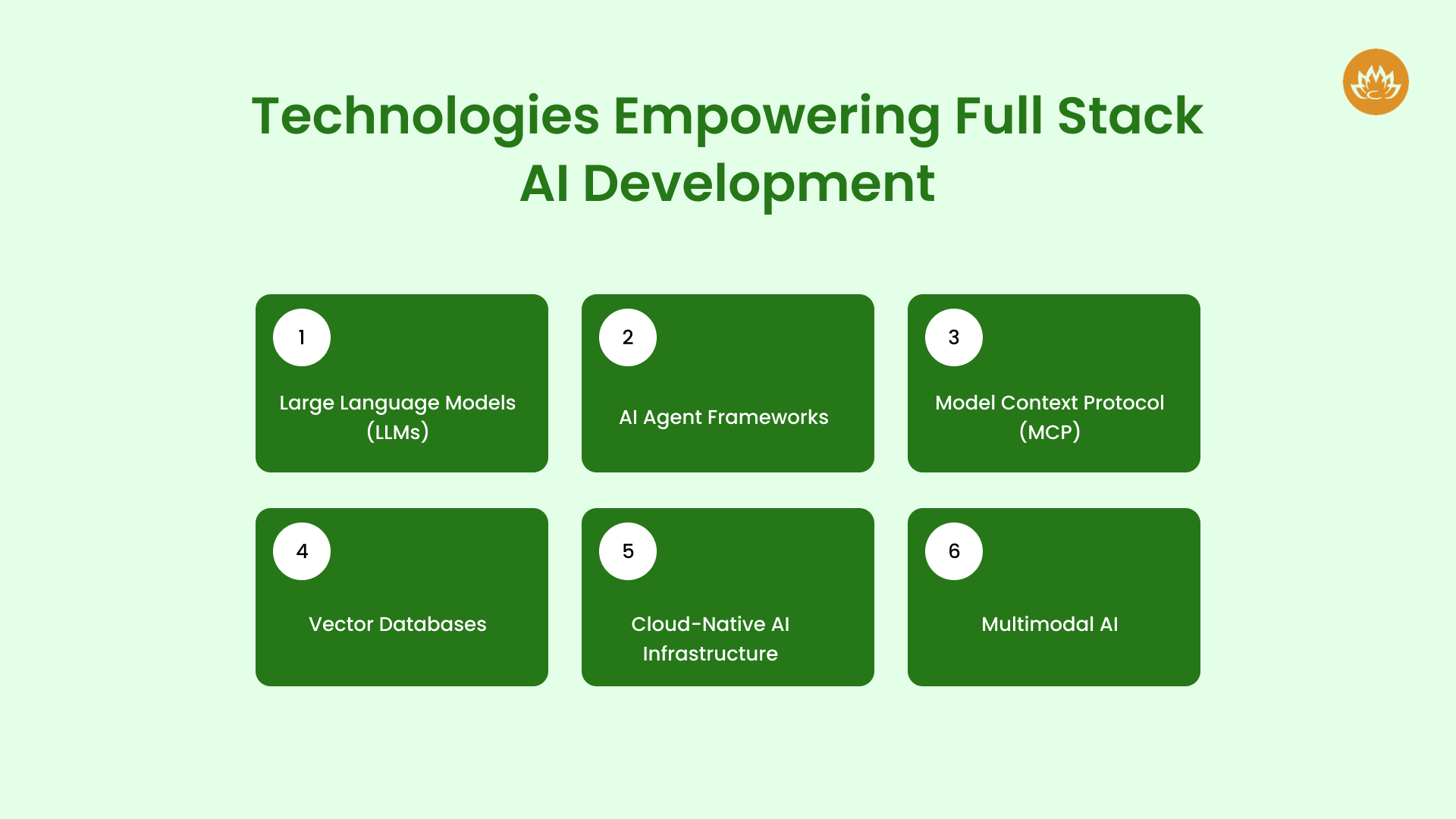
Large Language Models (LLMs)
LLMs are the foundation of modern AI applications. They can empower:
- Content generation tools
- AI research engines
- Coding assistants
- Workflow automation systems
- Enterprise copilots
Enterprises integrate LLMs into customer support platforms, HR systems, CRM, and enterprise dashboards. Some of the most popular LLM ecosystems are:
- Anthropic
- OpenAI
- Google Gemini
- Meta Llama
- Mistral AI
- DeepSeek
The demand for reasoning-based AI models is increasing rapidly to improve businesses’ problem-solving and decision-making capabilities.
AI Agent Frameworks
One of the biggest transformations we see in AI right now is the increasing demand for AI agents. In the early stage, systems responded to prompts. However, AI agents can actually perform tasks, interact with tools, make decisions, and complete workflows with very little human involvement. They are digital workers, actually. Technically, an AI agent can:
- Extract important information
- Generate reports
- Trigger automated workflows
- Coordinate with other systems
- Schedule meetings
- Update CRM records
- Analyze incoming emails.
And that is why businesses invest heavily in autonomous AI systems. There are several popular frameworks, such as LangChain, CrewAI, AutoGen, and Semantic Kernel, that help developers build stunning AI applications capable of handling complex business processes.
Model Context Protocol (MCP)
MCP is an emerging technology considered very important for AI infrastructure standards. MCP can standardize the way AI systems connect with:
- Databases
- APIs
- External software
- Enterprise tools
- Cloud services
According to industry sources, MCP is becoming the universal connector for AI native systems. Without having to create unique connectors for each application, the protocol assists developers in building scalable AI ecosystems. For companies deploying extensive enterprise AI platforms, this is especially crucial.
Vector Databases
Vector databases are used to enhance advanced memory and semantic search capabilities in AI systems. They help AI systems for:
- Store embeddings
- Improving AI accuracy
- To activate personalized experiences
- To retrieve contextual information
Some of the most popular vector databases are Pinecone, Milvus, Qdrant, Chroma, and Weaviate. As enterprises continue to create AI-powered mobile applications, vector databases are important for delivering smarter, context-aware user experiences.
Cloud-Native AI Infrastructure
For any quality AI-powered mobile app development, you need massive computing power. You need this while processing large datasets or running advanced machine learning models. Here, cloud-native infrastructure has become the core element of AI development. Now companies do not rely on local servers. Instead, they build AI systems on scalable cloud environments that grow with needs. Some of the top cloud providers, such as Google Cloud, Microsoft Azure, AWS, and NVIDIA AI infrastructure, provide business access to several places. Some of them are GPU computing, real-time interface, distributed workloads, AI training environments, and AI model deployment. Flexibility offered by cloud-native AI infrastructure enables rapid scalability without heavy investment in physical hardware. It is a hybrid approach and is essential for several industries such as healthcare, manufacturing, finance, and automotive.Multimodal AI
In todays times, one of the most effective developments in AI is multimodal intelligence. In earlier times, AI systems handled text-based processes. The recently updated AI systems can process multiple forms of data simultaneously, including text, audio, images, video, documents, and voice commands.
Now users interact with software systems more effectively and can perform the following tasks with efficiency:
- Analyze uploaded images
- Process documents instantly
- Combine text and visual understanding at the same time
- Generate visual content
- Decode voice instructions
Multimodal AI is already changing E-commerce platforms, smart assistants, education platforms, healthcare systems, and AI-powered mobile app development.
Most Important Tools Used in Full Stack AI Development
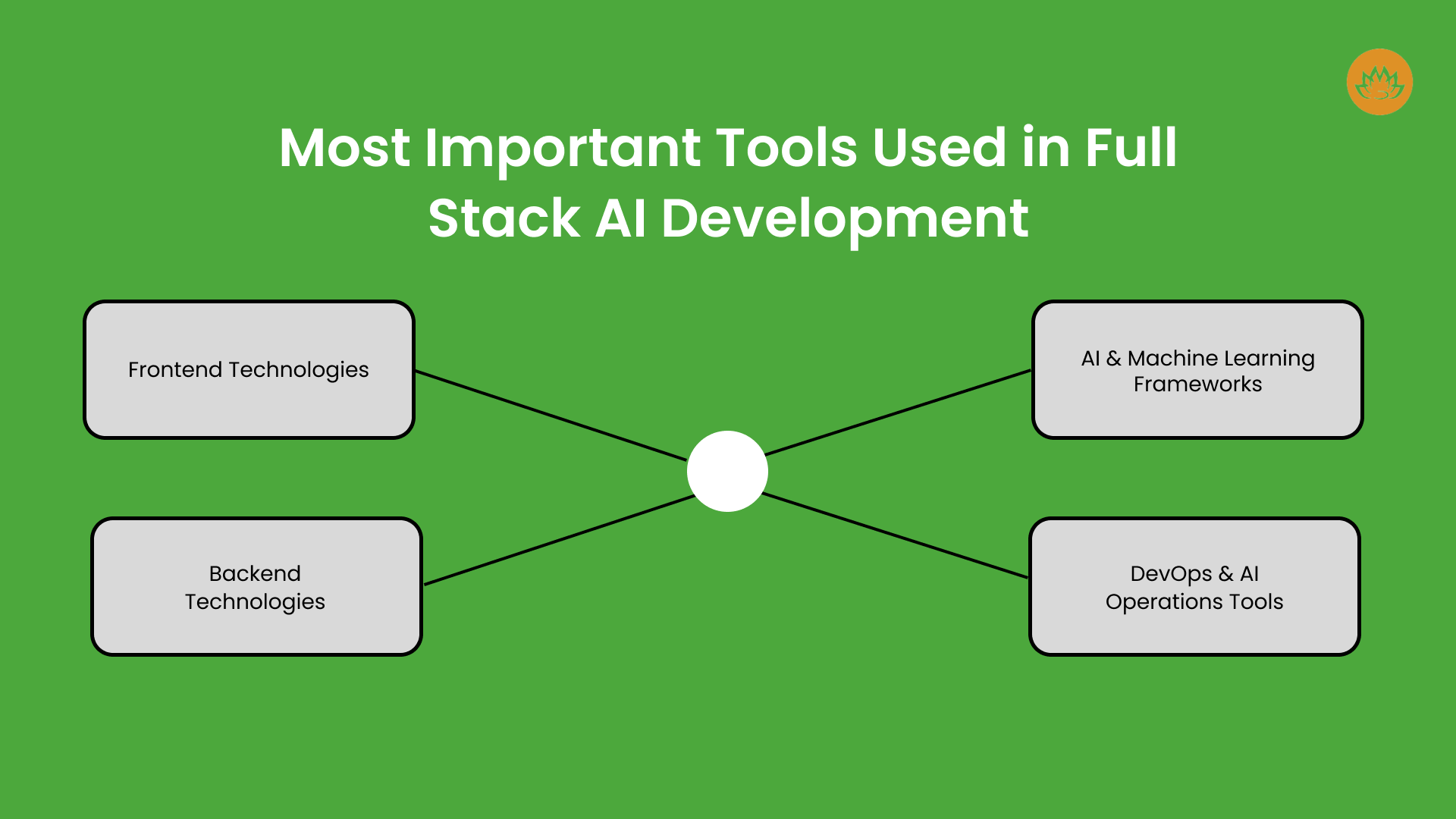
Frontend Technologies
Backend Technologies
AI & Machine Learning Frameworks
- Recognize patterns
- Data learning
- Make predictions
- Automate decisions
- Process languages
DevOps & AI Operations Tools
Key Trends Seen in Full Stack AI Development
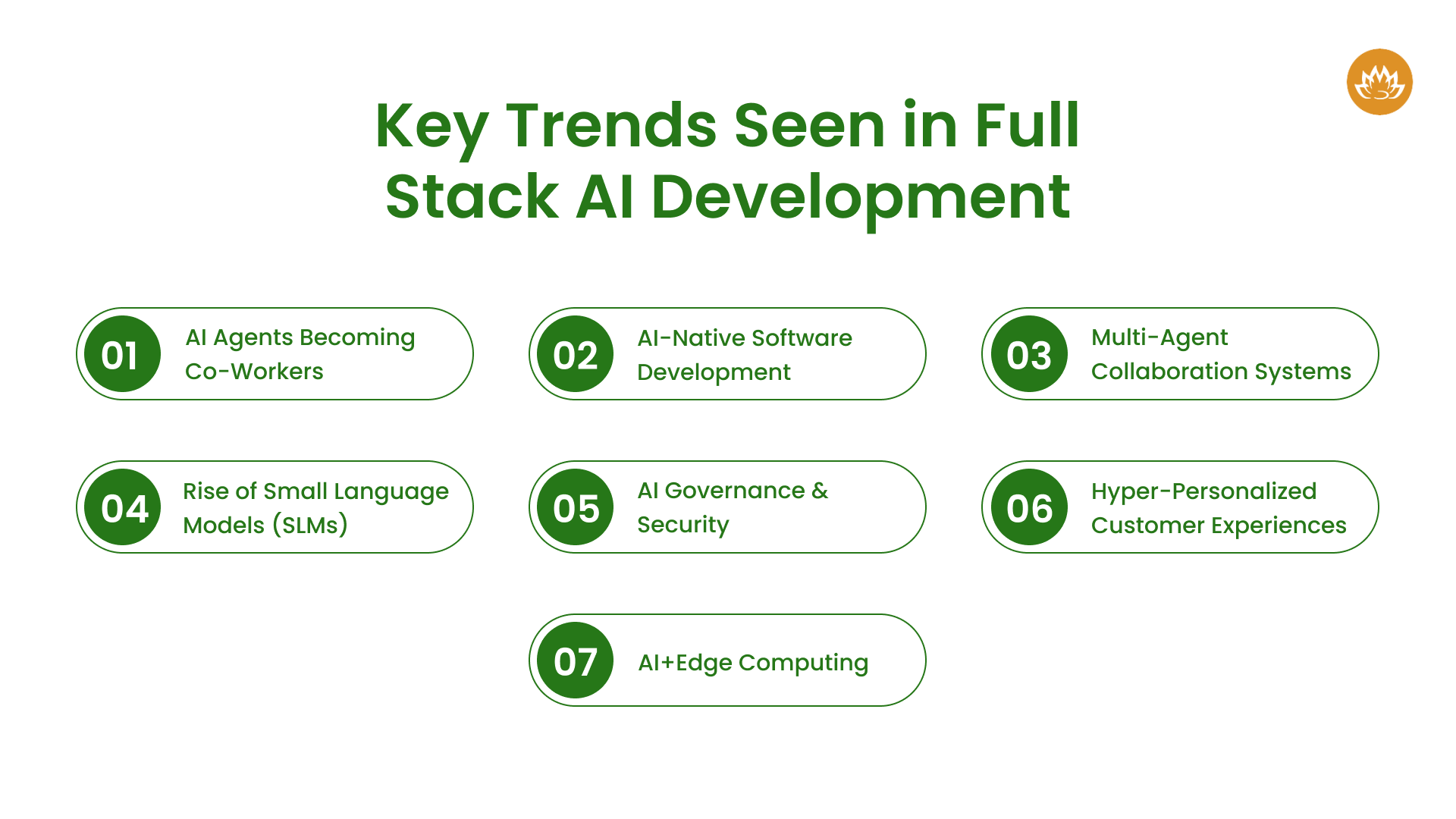
AI Agents Becoming Co-Workers
AI agents have evolved to become efficient co-workers for businesses. They work and act like business operators. These AI agents are used for so many purposes, like:
- Data analysis
- Software testing
- Workflow automation
- Project management
- Customer support
- Sales automation
Businesses are now shifting from AI assistants to AI systems that can execute tasks independently and redefine productivity.
AI-Native Software Development
Companies are rapidly creating AI-first products rather than adding AI at a later stage. And that is why, AI-native software services basically include:
- Autonomous SaaS platforms
- AI-driven analytics dashboards
- Smart enterprise applications
- Intelligent CRMs
The entire approach has transformed several gaps by enhancing automation, scalability, real-time insights, and customer experiences.
Multi-Agent Collaboration Systems
Most of the AI ecosystems are now shifting towards multi-agent orchestration. AI agents can now do a lot of things at the same time:
- Share tasks
- Communicate with each other
- Solve complex problems
- Coordinate various workflows.
Rise of Small Language Models (SLMs)
Now, every business needs massive AI models. So unlike for large enterprises, small businesses use small language models. These models offer:
- Lower infrastructure costs
- Better privacy
- Faster interface
- On-device AI processing
This trend is very important for all AI-powered mobile app development projects as well.
AI Governance & Security
All autonomous AI systems need AI Governance and Security. Hence, these systems always prioritize:
- AI safety
- Observability
- Audit trails
- Human oversight
- Data governance
- Compliance.
Any company adopting enterprise AI systems must integrate strong governance frameworks to reduce audit trails, ensure data governance, and ensure human oversight.
Hyper-Personalized Customer Experiences
Contextual awareness is the key element of any AI system. Enterprises will require AI to provide services like:
- Real-time support
- Dynamic interfaces
- Personalized recommendations
- Predictive engagement
Providing hyper-personalized customer experiences is mostly found in industries like banking, retail, healthcare, media, and e-learning.
AI+Edge Computing
The growth of edge AI is the upcoming trend in shaping full stack AI development. Most AI processing occurs in centralized cloud environments. However, now AI capabilities are moving closer to the devices themselves, known as edge computing. Edge AI provides data processing directly on devices like:
- Smartphones
- Medical devices
- IoT systems
- Smart vehicles
- Industrial equipment.
AI+Edge computing provides so many benefits, such as:
- Speedier processing
- Better privacy
- Reduced latency
- Offline functionality
- Real-time decision making
Top Benefits Industries Get from Full Stack AI Development
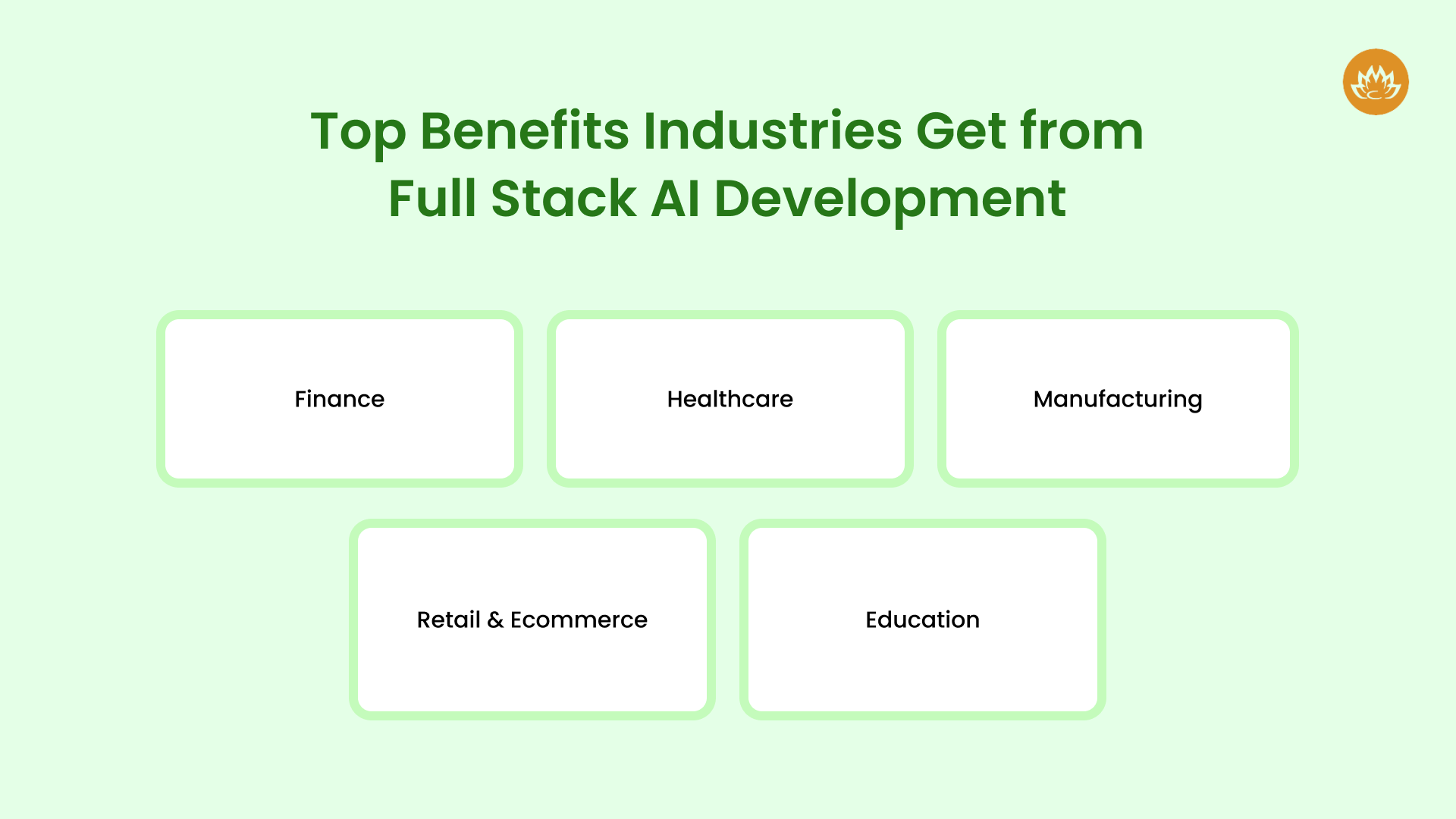
Finance
- Fraud detection
- Customer support
- Risk analysis
- Compliance monitoring
- Automated trading
Healthcare
- Medical imaging
- Drug discovery
- Virtual healthcare assistants
- Patient monitoring
- diagnostics
Manufacturing
- Robotics
- Quality control
- Predictive maintenance
- Supply chains
Retail & Ecommerce
- Inventory optimization
- Customer personalization
- Visual search
- Dynamic pricing
Education
- Adaptive learning systems
- Intelligent assessments
- Personalized learning
- AI tutors
Challenges Businesses Must Confront During Full Stack AI Development
AI offers several opportunities; however, companies and enterprises may face challenges during implementation.
Data Quality Issues
AI systems have to rely heavily on clean, structured data. Poor data quality may lead to:
- Hallucinations
- Weak performance
- Inaccurate predictions
Infrastructure Costs
Businesses must optimize infrastructure with great care as AI systems require lot of other support systems such as:
- Cloud computing
- Scalable shortage
- GPUs
- High-performance networking
AI Talent Shortage
The need to hire AI developers will continue to grow worldwide. The talent shortage will remain as companies will need:
- Machine learning experts
- AI engineering
- AI security
- AI orchestration
- Cloud infrastructure
Security & Compliance
AI systems will process sensitive data, and companies must ensure the following aspects:
- Secured AI access
- Data privacy
- Ethical AI practices
- Regulatory compliance
The Future of Full Stack AI Development
The future of full-stack AI development is turning towards AI-native. In the coming years, businesses will see:
- AI-generated software systems
- Real-time intelligent infrastructure
- Human-AI collaboration workplace
- Advanced multimodal experiences
- Full autonomous AI workflows
AI is no longer a futuristic concept. Companies that adopt full-stack AI development will always acquire a significant competitive advantage in operational efficiency, innovation, and customer engagement. AI ecosystems will continue to evolve, and hence businesses will focus on security, scalability, and future-ready AI architectures that can adapt to rapidly changing technological scenarios.