Today’s businesses face the same obstacles in their digital transformation: data silos that prevent insights, legacy processes that hamper execution, and technology investments that don’t grow with business objectives. Workflow automation alone is no longer sufficient.
What Businesses Should Know About AI-Powered Digital Transformation?
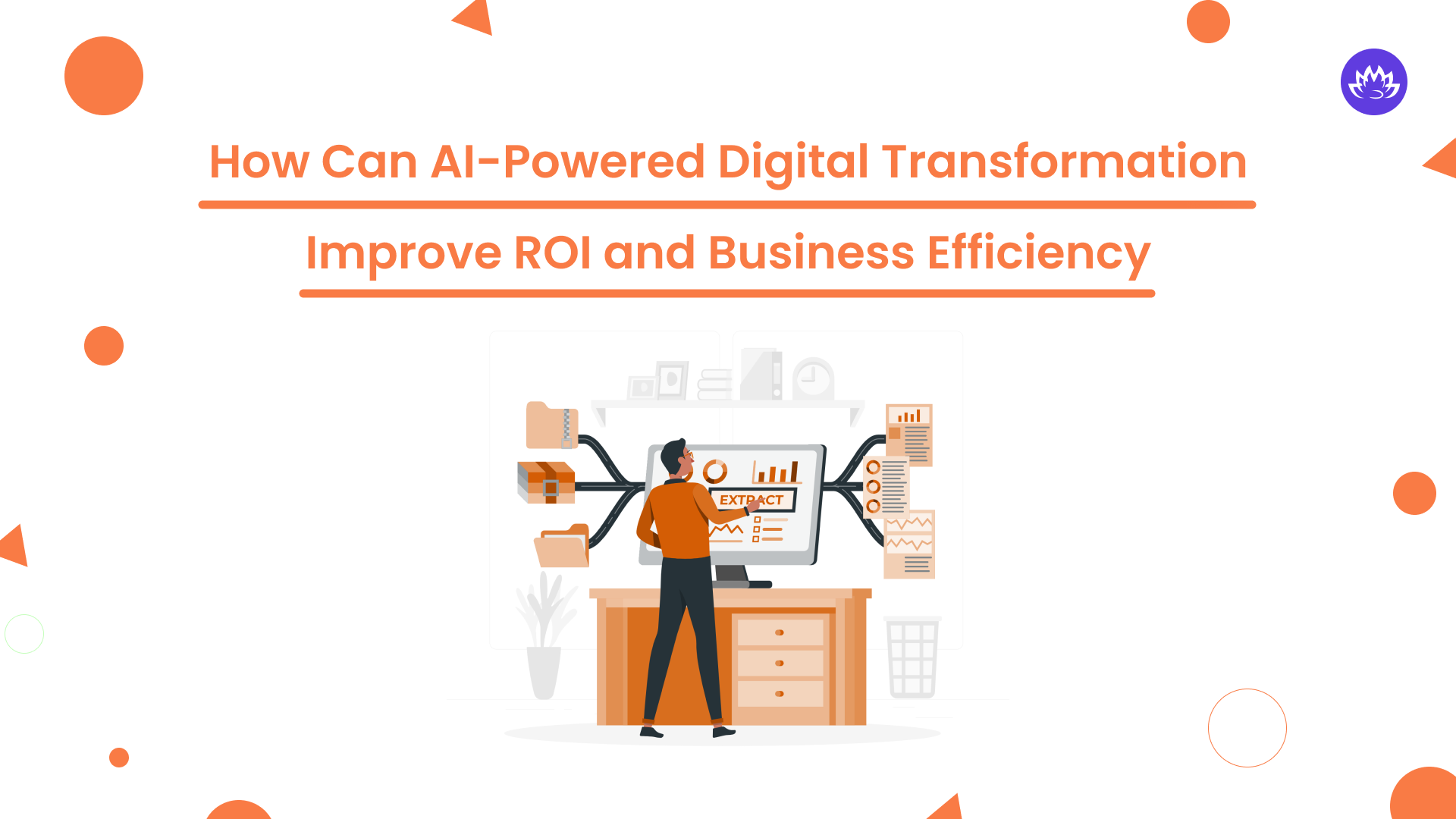
The incorporation of machine learning, generative AI, and intelligent automation into fundamental business operations is known as AI-powered digital transformation. Instead of just digitizing current workflows, this transformation technique radically changes operations.
In a world where more than 70% of businesses have adopted AI across multiple business functions, the role of AI-driven digital transformation is revolutionary. What is mostly applied beyond automation is predictive analytics, intelligent decision-making systems, and providing personalized customer experiences.
AI integration is inevitable and mandatory in today’s world if any business needs a revolutionary digital transformation. Companies that leverage Generative AI for digital transformation have found considerable operational improvements.
Key Considerations for Successful AI-Powered Digital Transformation in Your Business
| Considerations | Reasons For The Same | Ways to Consider | |
|---|---|---|---|
Aligning business objectives strategically |
|
| |
Adapting the workforce and managing changes |
|
| |
Data Management and Governance |
|
| |
ROI measurement and long-term sustainability |
|
|
Aligning business objectives strategically
Top Benefits of Strategic Alignment of AI with Business
- Decision-making with speed. With AI analytics, there is less decision latency, which gets reduced from weeks to hours. It gives faster market responses.
- Accelerates revenue growth. Aligned AI projects boost customer satisfaction and operational effectiveness, giving businesses a competitive edge.
- Mitigates risks. All the predictive models help in tracking operational bottlenecks prior to ruining customer satisfaction.
- Optimizes resources through automated workflow. Relieves strategic workforces from repetitive tasks and redirects them to innovative projects.
- Competitive bifurcation through AI adoption to identify market barriers and the struggle to overcome competitors.
Adapting the workforce and managing changes
Best Change Management Practices While Adopting AI
- To build structural management frameworks for speedier ROI realization.
- Begin with pilot programs for early adopters in various departments.
- An experienced team will demonstrate practical benefits to the new team members and help identify workflow friction points.
- To create role-driven training programs rather than creating generic AI courses.
- Build feedback loops for gathering real-time user experience data.
- To address concerns related to transparency and explain things that can be fixed, along with limitations.
- Find out and reward AI proficiency with performance metrics and career advancement opportunities.
- Provide tangible benefits to employees by developing AI skills in them and developing more enthusiasm.
Data Management and Governance
Private data, typically gathered from users and other stakeholders, powers custom AI models and workflows. Upgrading operational operations with AI requires building strong, long-lasting frameworks that effectively handle this data.
That structure is referred to as data governance. It is a set of standardized principles and practices within an organization that determines how data is collected, stored, processed, and archived through the entire lifecycle.
This management and governance system assists businesses in building data pipelines that bring trustworthy information from various sources, store it safely, use bespoke AI models to evaluate it for insights, and then archive or remove it.
In addition to providing value from real-world data, data governance and management help businesses comply with laws like the CCPA and GDPR while lowering the risk of security breaches and data misuse.
The multidimensional nature of each process necessitates cross-departmental cooperation and, in certain situations, engagement with accredited AI consulting businesses.
Keep in mind that when company teams gradually gain more knowledge about their AI needs, an internal regulatory framework frequently evolves over time. To expedite workflows, this might be delegated to the AI consulting partner.
ROI measurement and long-term sustainability
It takes much more than just implementing the newest model you can afford and “automating” as many tasks as you can to transform an organization through the use of AI tools. Instead, it’s about systematically accelerating different processes to accomplish corporate objectives.
Furthermore, it can be expensive to use AI to improve business processes. Digital transformation may be costly and time-consuming, from recruiting qualified experts to educating staff while managing small work disruptions.
This calls for a system that continuously assesses the effectiveness of recently installed customized AI systems and tracks their long-term effects. Businesses need to be aware of numerous factors, including:
- Measurable increases in operational effectiveness (job quality, completion time, etc.)
- The organization’s costs for implementing and maintaining the AI systems
- The team’s perception of how simple it was to switch from the previous process to the new one
- AI upgrades’ scalability and resilience to maintain a competitive advantage in the future
Businesses should concentrate on determining the critical key performance indicators (KPIs) and developing dashboards to monitor them over time as soon as they begin their AI transformation journey. To fully profit from AI, it is also essential to cultivate an open culture of ongoing learning.
Real Use Cases of AI-Powered Digital Transformation
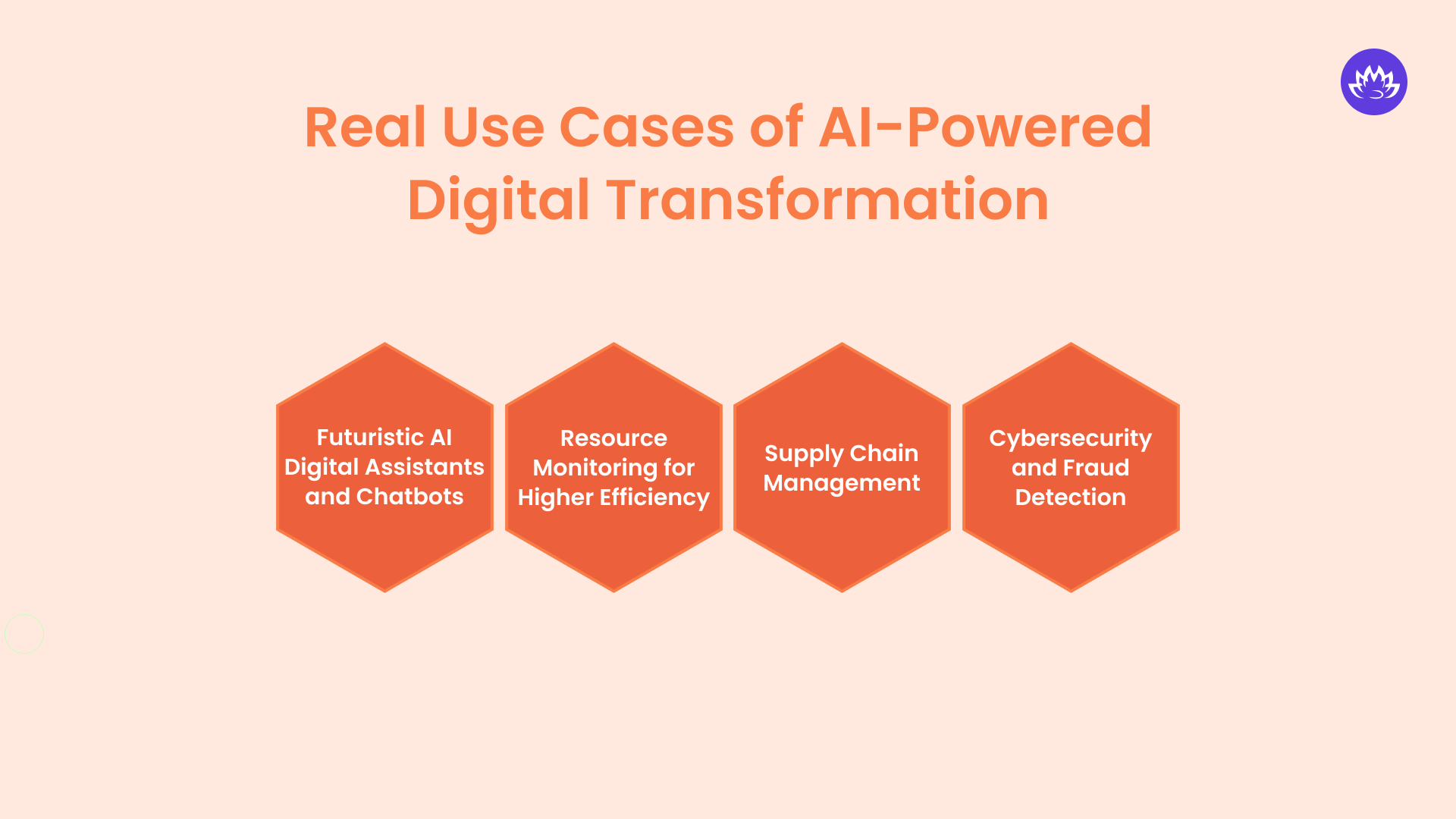
Futuristic AI Digital Assistants and Chatbots
Resource Monitoring for Higher Efficiency
Supply Chain Management
Cybersecurity and Fraud Detection
Most Common AI Implementation Challenges and Practical Solutions
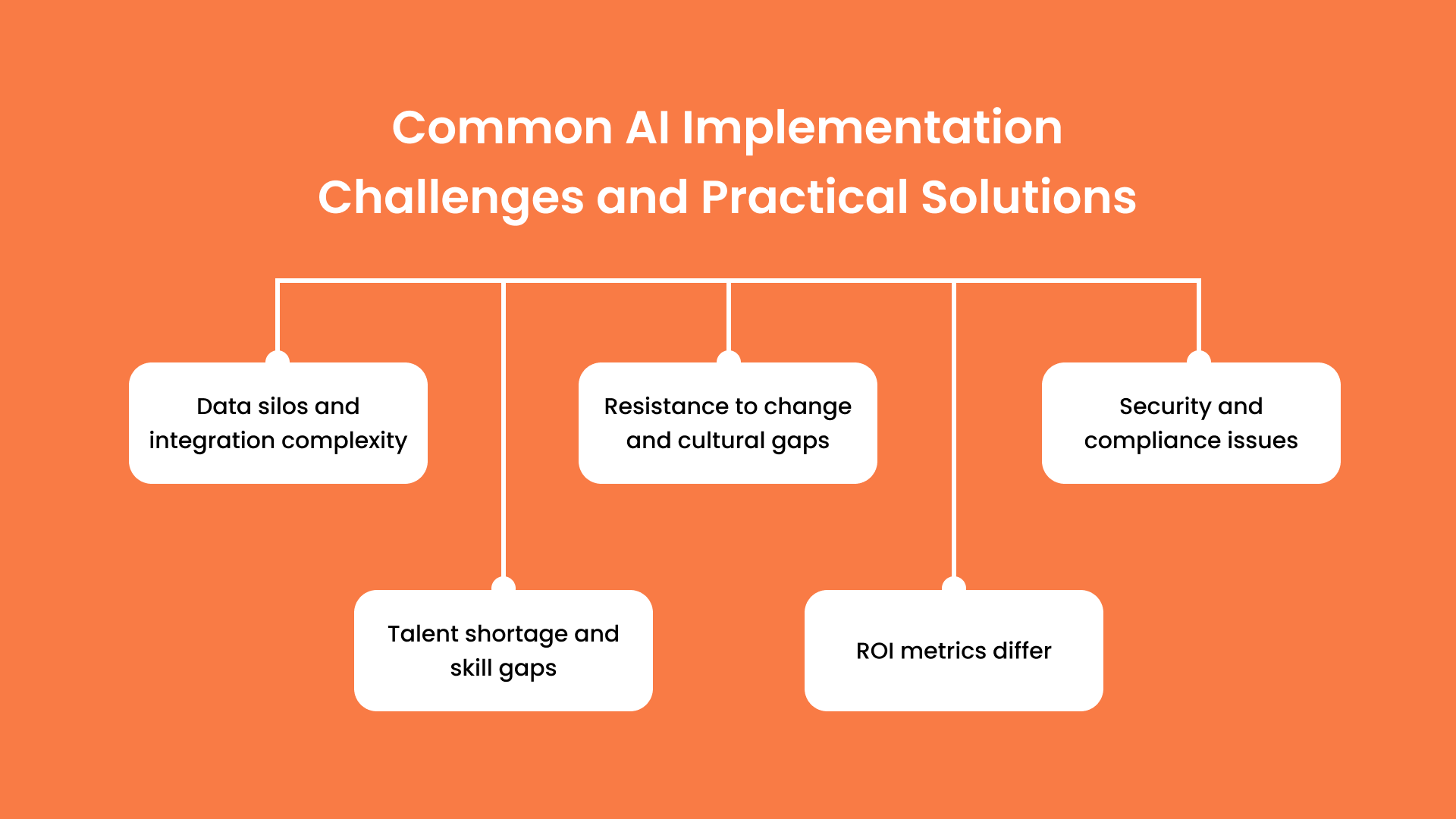
Data silos and integration complexity
Information is stored across departments in incompatible forms by legacy systems.
Way out: Use data fabric architectures to enable uniform access without having to overhaul the entire system.
Talent shortage and skill gaps
Businesses find it difficult to locate AI specialists in cutthroat markets.
Solution: Collaborate with companies that offer implementation and knowledge transfer services for digital transformation.
Resistance to change and cultural gaps
AI-driven workflows are resisted by teams accustomed to their current procedures.
Solution: Prior to an enterprise-wide launch, show rapid results through department-specific pilot initiatives.
ROI metrics differ
Leadership lacks frameworks for AI valuation but needs quantifiable rewards.
Solution: Prior to deployment, establish baseline measurements and monitor leading indicators such as process time reduction.
Security and compliance issues
Implementing AI technologies presents governance problems for organizations.
Solution: From the beginning of the project, create privacy-by-design frameworks that comply with local laws.
How Businesses Can Leverage AI-Powered Digital Transformation
Strategic alignment with business goals, strong data management and governance, efficient workforce adaptability, and a laser-like focus on ROI and sustainability are all necessary for successful AI integration.
Even though each of these factors is important, many businesses may find it daunting to address them all at once. Errors and oversights have the potential to interfere with work and quickly accumulate costs without yielding any results.
This is where working with a seasoned AI consulting firm may have a big impact. Choosing a professional AI development company with a proven track record of providing custom AI solutions to enterprises can drive the best results. They can provide strategic planning, and through the entire process, they can also provide continuous support post-implementation.
As a well-established AI development company, Whitelotus Corporation has a stellar team of seasoned AI developers who can help your business transform into a successful AI-powered enterprise through intelligent, scalable, and futuristic solutions. Contact us to know more about our services.