


What is Generative AI
A subfield of artificial intelligence known as “generative AI” is capable of producing original material from data that has already been learned. Generative AI can produce completely original content, such as text, images, audio, videos, and code (programming languages), unlike classical AI, which is only capable of evaluating and forecasting results.
How Generative AI Works?
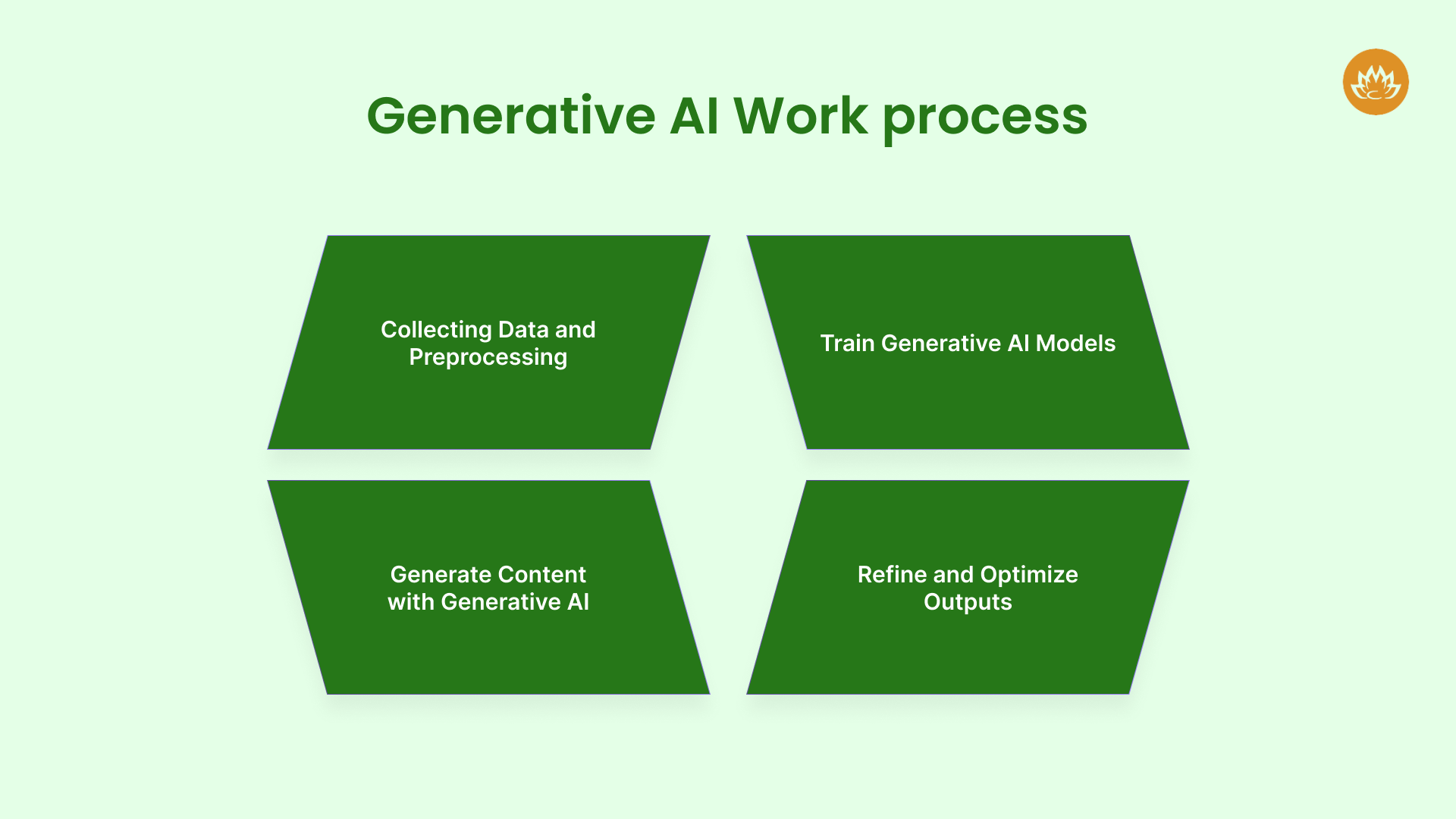
Generative AI is supported by powerful deep learning models such as artificial neural networks. They analyze input data and generate creative inputs. Generative AI operates through a specific process. The four main steps are:
Collecting Data and Preprocessing
Data Input
Generative AI needs a huge amount of training data that includes images, text, video, audio, or code.
Data Preprocessing
Prior to training AI, data gets filtered, normalized, and converted into numerical formats. Some examples are:
- Encoding text data into numerical representations
- Converting images into pixel metrics
- Transforming audio into waveforms
Train Generative AI Models
Deep learning techniques are used to train generative AI models. The learning pattern is either supervised learning or semi-supervised learning.
Supervised Learning
- AI uses labeled datasets such as images with descriptive captions.
- Well suited for tasks that need control and specific outputs
Semi-supervised Learning
- AI will identify patterns in data without the need for pre-labeled tags
- Such a kind of learning is required for automatic content generation, like GPT
Reinforcement Learning From Human Feedback
- AI will enhance its outputs according to human feedback.
Generate Content with Generative AI
Once a Generative AI model is trained, it can generate new content. It will predict and synthesize data with some of the most commonly used techniques, like:
Transformer Models
- It is used in Natural Language Processing and helps AI write text, translate, and summarize content.
- Transformer models will generate context via self-attention mechanisms. AI determines the kind of words used and will write content that sounds most relevant and highly meaningful.
Generative Adversarial Networks (GANs)
- Used for video, image, and audio generation
- Has two competing neural networks, namely the generator and discriminator. The generator will create new data, and the discriminator will evaluate the generated data.
Diffusion Models
- It is used to generate top-quality images from text descriptions
- Works by progressively denoising images
Refine and Optimize Outputs
Fine Tuning for Particular Needs
- Retraining AI models on smaller datasets for some specific tasks.
- For example, a company can optimize GPT-4 for generating marketing content that aligns with the brand image.
Reinforcement Learning from Human Feedback
- AI will learn from user feedback and will improve future responses
- In case AI generated result is inaccurate, users can rate it and tell AI to refine the content
Generative AI is transforming many industries and providing relentless creative ideas and possibilities. It also raises ethical concerns regarding transparency and misuse. So, way ahead, people need to make responsible use of AI.
Top Models in Generative AI
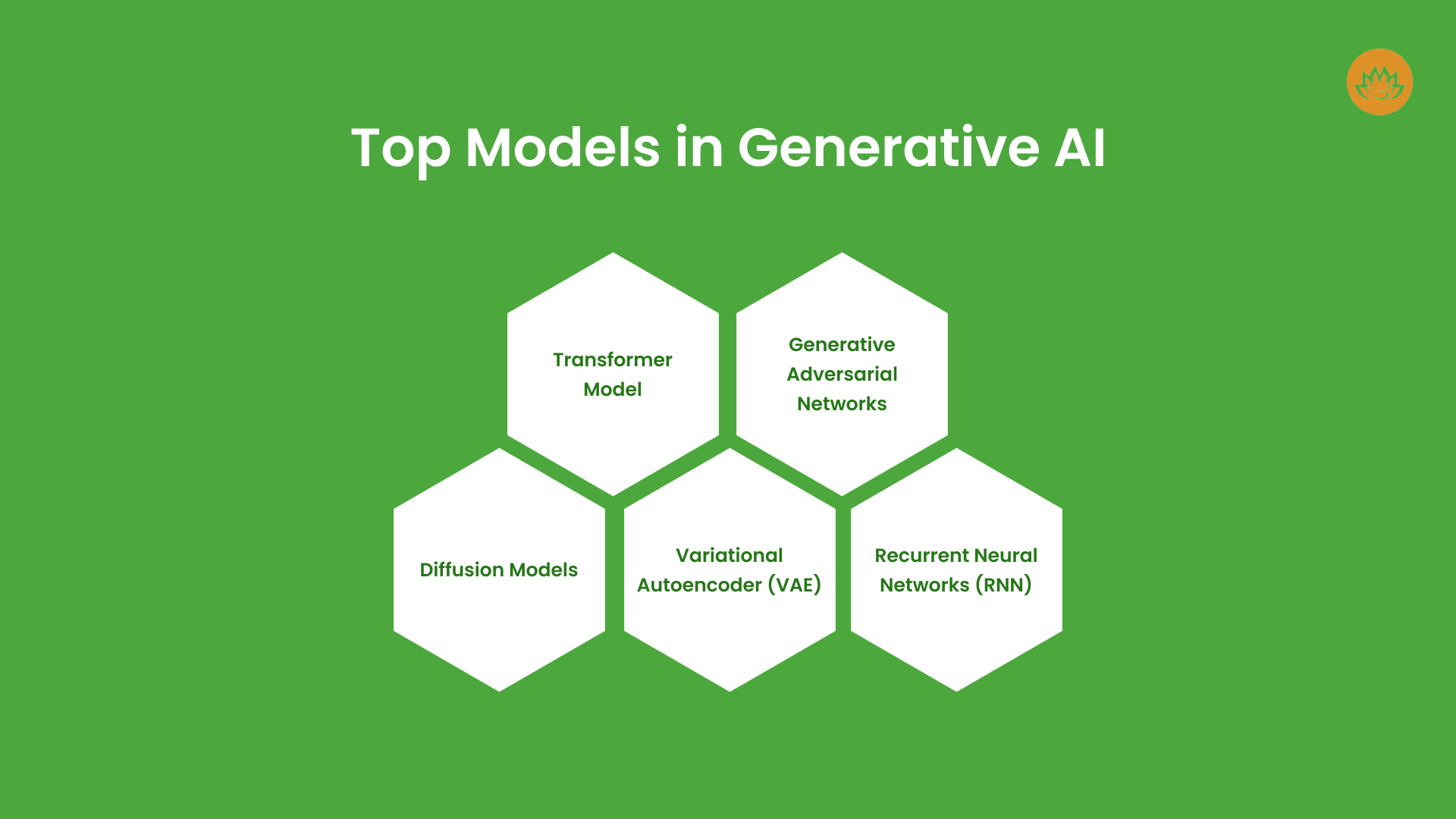
Generative AI has stirred the dynamics of several industries and fields. In the world of content creation, image designs, and audio production, generative AI has taken over so many facets. Also, for software development, it has brought unprecedented changes. All this is possible because Generative AI is heavily dependent on advanced models and each of these models has its own working principles.
Transformer Model
In 2017, Google’s well-known publication “Attention is All You Need” revealed the Transformer, a deep neural network architecture. Many strong Generative AI models, especially in Natural Language Processing (NLP), are built on top of it.
How does it work
- Transformers improve AI’s comprehension of context by analyzing the links between words in a sentence using the Self-Attention Mechanism.
- This design enhances training speed and content synthesis capabilities by processing input in parallel.
- Some examples are GPT, BERT, T5, and LLaMA
Generative Adversarial Networks
GANs have two competing neural networks
- Generator: Produces fresh data, like manipulated sounds or pictures.
- Discriminator: Assesses and separates authentic data from fraudulent data produced by the Generator.
How GANs Work
- The Generator keeps becoming better to produce data that is more realistic.
- Fake data is evaluated and identified by the discriminator.
- Until the Generator generates data that is almost identical to real-world samples, this adversarial process is repeated.
- Some of the notable GAN-based models are StyleGAN, BigGAN, and DeepFake
- Real-world applications are creating virtual characters such as games and movies, generating deepfake videos, etc.
Diffusion Models
In order to generate a clear and realistic output, text-to-image generation frequently uses diffusion models, which gradually eliminate noise from an image.
How Diffusion Models Work
- The model starts by introducing random noise into an image. After learning to gradually eliminate noise, it uses text input to recreate a realistic image.
- Some of the top diffusion-based models are DALL.E 3, Stable Diffusion, and Imagen
- Real world applications are creating illustrations for books, blogs, and ads.
Variational Autoencoder (VAE)
A generative AI model called VAE (Variational Autoencoder) creates new content by utilizing encoding and decoding techniques.
How VAE works
- Data is compressed into an abstract representation by an encoder.
- Decoder: Creates new data by reconstructing and regenerating it.
- Some of the notable VAE models are Beta-VAE and Conditional VAE
- Real world applications are compressing and reconstructing images and audio and facial recognition technology
Recurrent Neural Networks (RNN)
Text, speech, and music are examples of sequential data that RNNs, a form of neural network, can process. Applications for AI-generated audio are built on this approach.
How RNN Works
- RNNs save data from a sequence’s earlier steps.
- They are very good at producing and interpreting continuous data, including music and speech.
- Some of the notable RNN based models are WaveNet and Jukebox.
- Real world applications are creating artificial voices for virtual assistants and composing music and voice dubbing for AI characters.
Top Applications of Generative AI in Real Life
Generative AI is used in different fields. As mentioned earlier, it is used for content creation, graphic design, education, scientific research, and more. Some of the most critical applications of this technology are:
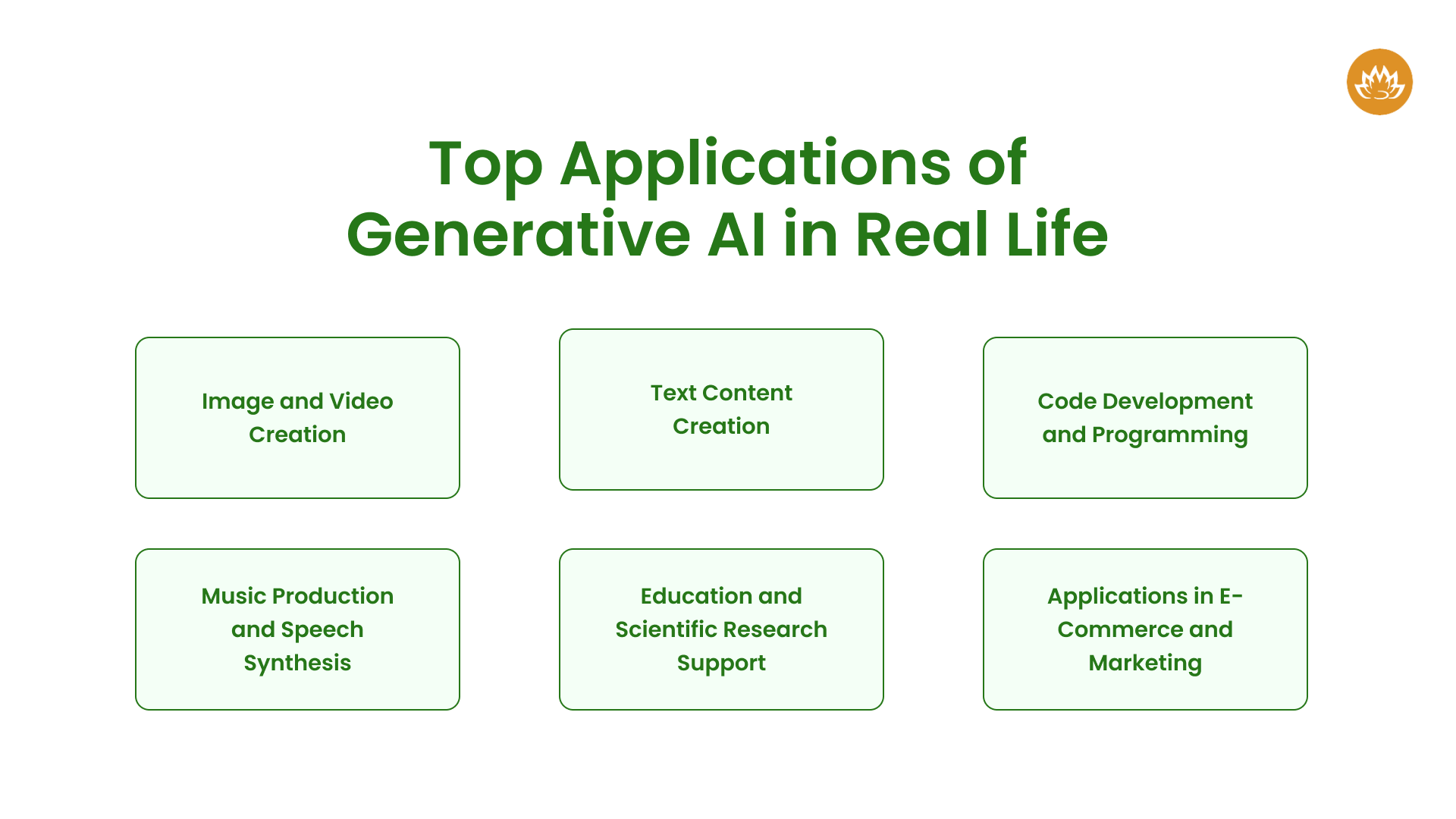
Image and Video Creation
Graphic design, advertising, and the entertainment sector stand to gain a great deal from generative AI’s ability to produce high-quality images and films from text descriptions. Designers can save time and work by creating graphics from text using tools like DALL-E, MidJourney, and Stable Diffusion. Furthermore, users may now produce videos using AI alone because of platforms like Runway ML, creating new opportunities for content creation without the need for sophisticated video editing abilities.
Text Content Creation
High-quality text material can be automatically produced by generative AI for a variety of businesses, such as communications, marketing, and journalism. Product descriptions, blog posts, commercial content, and even movie scripts can be produced using programs like ChatGPT, Jasper AI, and content.ai.
Code Development and Programming
Generative AI helps programmers write code more quickly, optimize it, and debug it more effectively. Software development time can be decreased by using tools like GitHub Copilot, which can create code from simple descriptions.
Music Production and Speech Synthesis
Generative AI is capable of producing tunes, music, and even vocal imitation. Tools like AIVA and Amper Music provide background music for films, games, or ads. Also, AI powered TTS technology is helping to produce natural sounding voice synthesis via platforms like Google WaveNet, ElevenLabs, and Voicify.
Education and Scientific Research Support
Through the development of intelligent lectures, scientific simulations, and virtual study helpers, generative AI improves individualized learning experiences. Students can access content that is appropriate for their skill levels with the use of platforms such as Khan Academy AI Tutor.
Applications in E-Commerce and Marketing
Through improved chatbot support, search engine optimization, and content personalization, generative AI is revolutionizing how companies interact with their clientele. AI-powered systems, such as ChatGPT, Drift AI, and ManyChat, can help clients with intelligent chatbots, recommend products based on shopping behavior, and produce customized advertisements. Businesses benefit from higher conversion rates and an enhanced buying experience.
Advantages of Generative AI
Cost and Time Savings
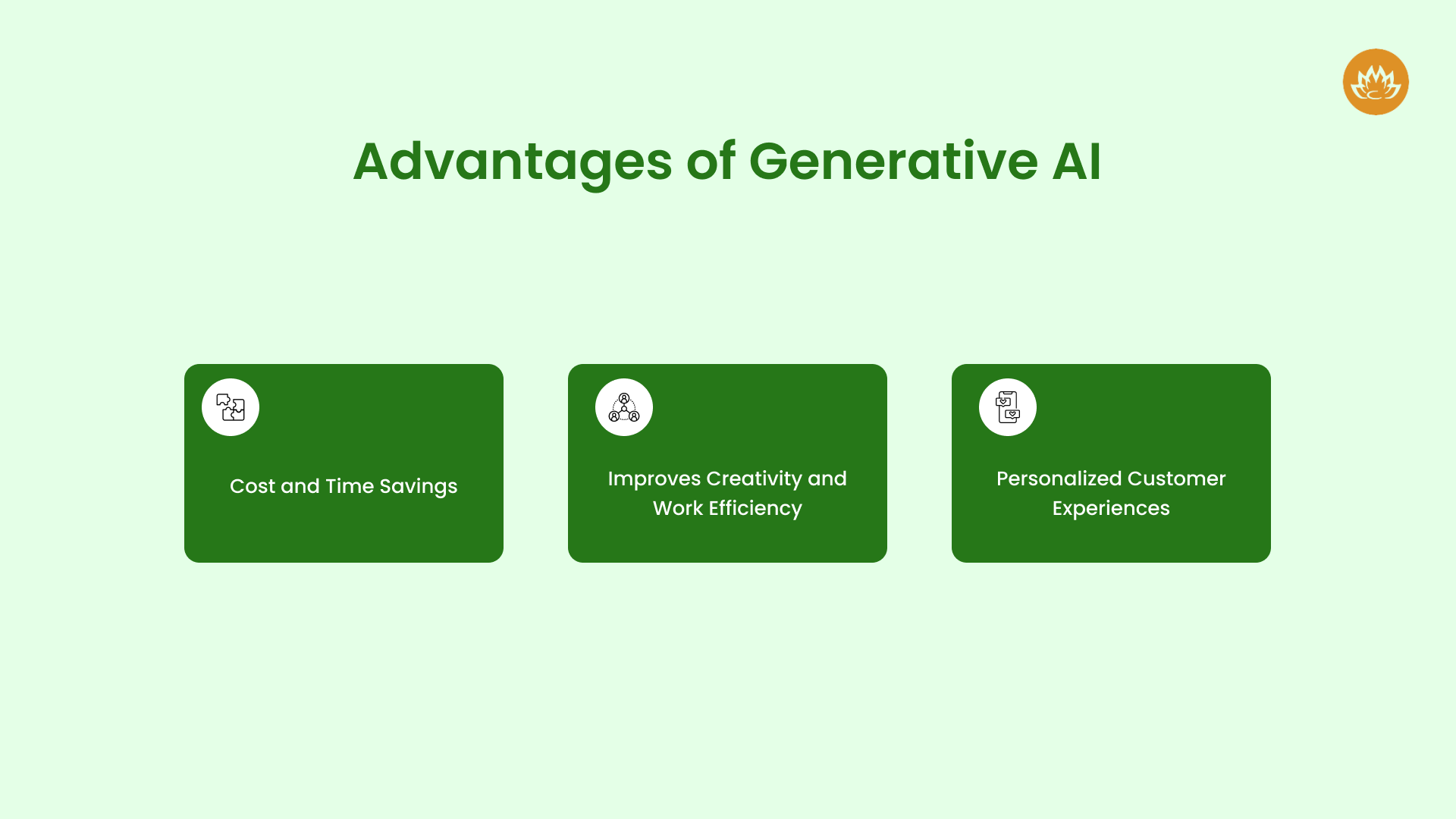
In the past, creating excellent content took a lot of time and work. It could take hours to finish a blog piece, weeks to edit a film, and days to perfect a design project. However, these jobs can be completed in a matter of minutes with the help of generative AI. With this there will less operational costs and small businesses and startups can compete more efficiently with this tool.
Improves Creativity and Work Efficiency
In addition to helping, generative AI stimulates creativity by producing original ideas, original content, and ground-breaking designs.
AI can provide novel concepts for content development that humans might overlook. AI may inspire authors, musicians, and artists by producing first drafts and then honing them into finished works.
Personalized Customer Experiences
Generative AI is giving amazing personalized experiences to users. Businesses can efficiently interact with customers in fields like e-commerce, customer service, and marketing. Some of the top examples are Netflix, Amazon, and various AI chatbots.
Challenges of Generative AI
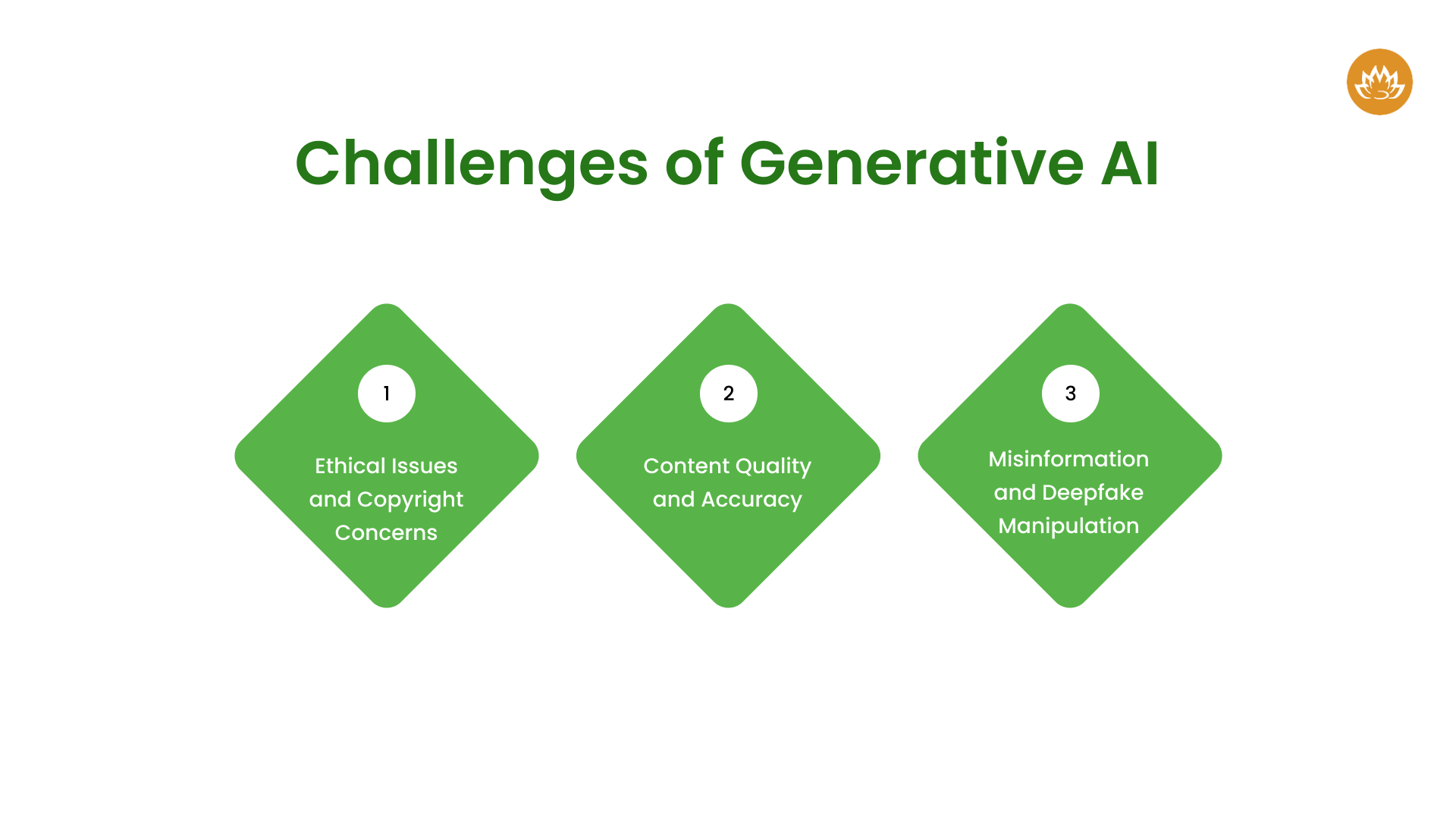
In spite of various benefits, Generative AI is facing some major challenges. It is all about ethics, content accuracy, and risk of misuse.
Ethical Issues and Copyright Concerns
The ethical use of data and copyright are two of the main issues facing generative AI.
Large volumes of online data, such as copyrighted articles, photos, videos, and creative works, are used to train AI. This poses a crucial query: Who is the owner of the content produced by AI? A lot of artists and journalists are concerned about the way AI has replicated their styles without permission. It is reducing the value of original work and has infringed various other rights.
Content Quality and Accuracy
Although generative AI can produce information quickly, it is not necessarily precise or trustworthy. AI does not fully comprehend the context or meaning of the data it generates; it only synthesizes knowledge from preexisting data. Because of this, AI may unknowingly create false or misleading content.
Misinformation and Deepfake Manipulation
Generative AI is misused for creating fake content, such as generating false news articles and deepfake videos. It can generate various fake videos of politicians or celebrities and potentially influence the public. Cybercriminals can use AI to impersonate individuals and commit fraud.
Conclusion
Generative AI offers exclusive benefits and improves productivity in multiple ways. From creating flawless content to delivering the best user experiences, it can just work wonders. But it also has some challenges like breach of ethics, accuracy issues, and risk of misuse. The power of Generative AI is phenomenal, but it also needs the implementation of responsible government policies to ensure AI is used with transparency, ethics, and no harm to society.
At Whitelotus Corporation, we are an AI development company with a team of the best AI experts and developers who can help you create AI applications for your business. Contact us to know more about our services.
Author

Sunil is a result-orientated Chief Technology Officer with over a decade of deep technical experience delivering solutions to startups, entrepreneurs, and enterprises across the globe. Have led large-scale projects in mobile and web applications using technologies such as React Native, Flutter, Laravel, MEAN and MERN stack development.
View all posts