


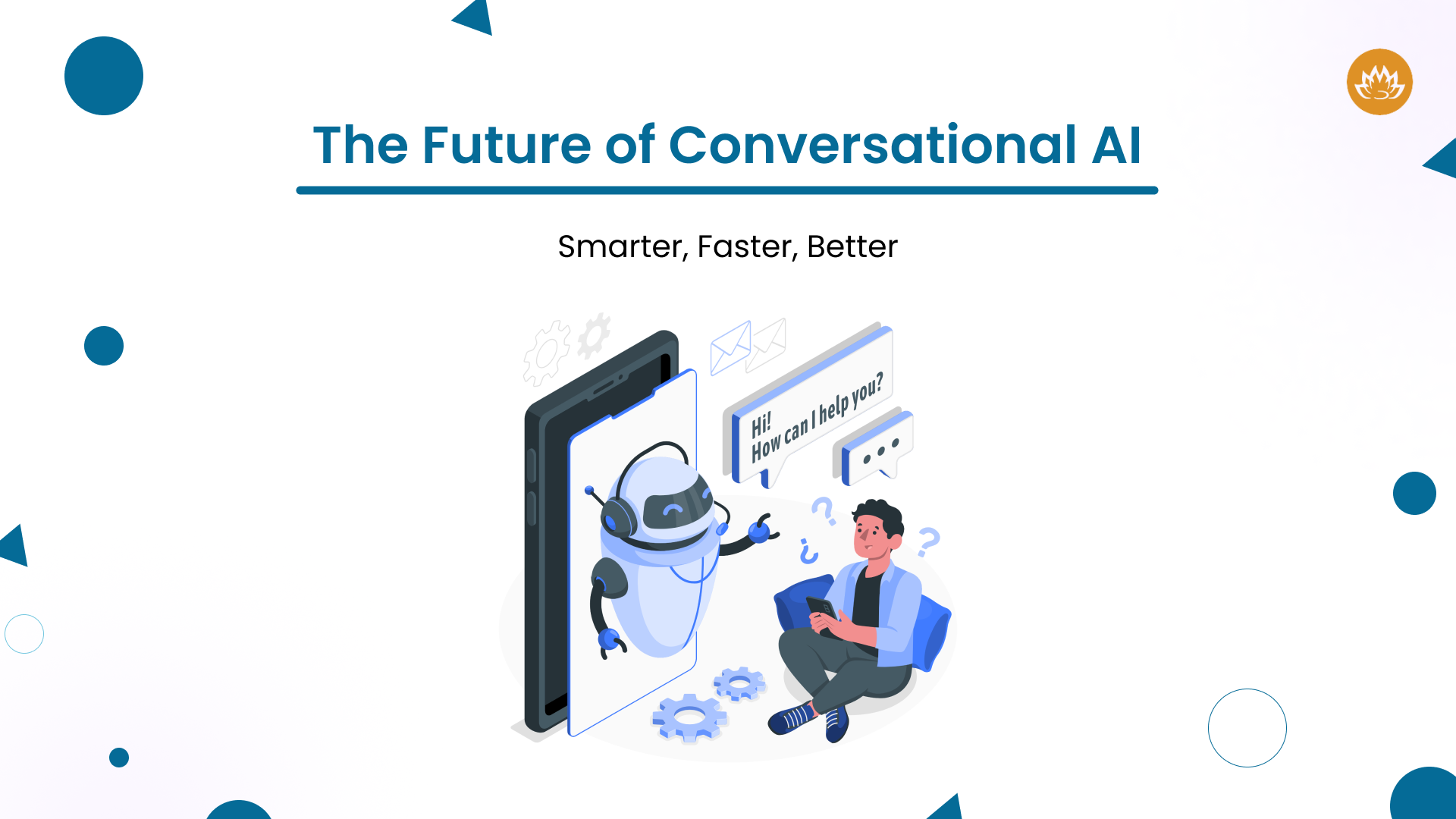
Just a decade ago, chatbots were considered those annoying pop-ups offering robotic replies. And now in 2025, it has become the most wanted feature on any online platform. It can solve basic customer queries, track orders, and make appointments. It can interact as a typical personality without involving any humans!
As customers demand quick results to their queries, conversational AI leaves no stone unturned in providing solutions. It can be about delayed delivery, managing finances, or inquiring about the product; users get clear and helpful answers.
Here in this guide, we will discuss some of the most important conversational AI trends that have ushered in 2025 and will stay for a very long time in the future. We shall see what works best and how these trends will help various businesses in keeping up with their performance.
What is Conversational AI?
Conversational AI is a technology that uses artificial intelligence tools, including data processing, machine learning, and natural language processing, to automate communication between a company and its clients.
Businesses can use chatbots, speech bots, or any other conversational agent to mimic human-like discussions thanks to conversational AI. Professional chatbots are similar to the virtual assistants (Alexa, Siri) we use in our daily lives.
Businesses use conversational AI for various purposes. The three main purposes are:
- Chatbots that address customer queries and provide information about products and services.
- AI agent assistants that are guided by chatbots to effectively interact with customers in solving their queries.
- Chatbots that enable internal employee engagement to help solve simple to complex customer queries. It also helps share important documents and other routine tasks.
Conversational AI Trends Guiding Business in 2025
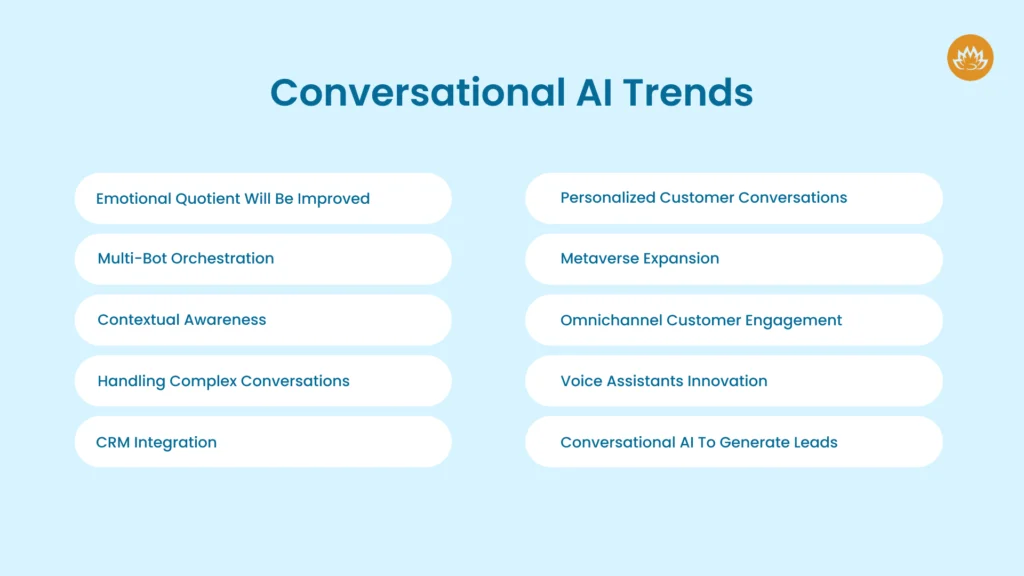
Emotional Quotient Will Be Improved
In the near future, EQ will be the primary differentiation for chatbots. Chatbots must be able to convey human emotions, such as empathy and inclusivity, and their interactions with clients and staff should reflect this.
Cathy Pearl, Google Assistant Design Manager, said, ” In order to satisfy customer expectations, Google would like to see a variety of voices and identities collaborating with conversational AI.
Personalized Customer Conversations
To maximize and customize the talks, data must be used wisely. A voice or chatbot needs to be fully aware of every detail of a customer’s interactions with the company across all platforms.
With conversational AI, personalization must be expanded. The name, order information, and a few other details can now be used by chatbots. In the future, it must remember the consumers’ choices and preferences in order to personalize the talks.
Multi-Bot Orchestration
Organizations are now using multiple chatbots to handle various business operations. For instance, a bank can employ distinct chatbots for its insurance, mortgage, and loan operations as well as account-related tasks.
Depending on their needs and questions, a master chatbot will refer clients to various chatbots.
Metaverse Expansion
Conversational AI will be integrated with new technologies. In the metaverse era, chatbots must be highly focused and outcome-oriented.
Voice AI will continue to improve and develop, ultimately eradicating the current problems that consumers encounter. Conversational AI would have to grow along with the metaverse as the digital realm does.
Contextual Awareness
Machine learning and conversational AI must become more contextually aware. During interactions, chatbots must be aware of the device being used, the customer’s history, and other information.
AI assistants will be able to respond more effectively as the interactions get more relevant, which will benefit the company.
Omnichannel Customer Engagement
In the present marketplace, omnichannel consumer involvement is essential. Your company must dismantle the barriers and conduct cohesive discussions across all platforms.
An omnichannel customer experience is crucial for the future of conversational AI, which will be more strategic and results-driven.
Handling Complex Conversations
Future chatbots will be able to manage intricate discussions thanks to machine learning and data training. Conversations will be smarter, and technology will be more sophisticated.
To eliminate wait times and reduce the possibility of mistakes during interactions, customer service in the future will require minimal human intervention.
Voice Assistants Innovation
Voice assistants currently face several challenges, including background noise, variations in dialects and pronunciations, and others.
Experts in conversational AI are working to eliminate these difficulties and inconsistencies and create voice assistants that are completely error-free and dependable for use in professional settings.
CRM Integration
AI agents nowadays don’t operate in a vacuum. They provide a more integrated experience for agents and clients by syncing with internal booking systems, calendars, and CRMs.
In 2025, expect tighter omnichannel synchronization and CRM integration to provide your team with a perspective and customer continuity.
Conversational AI To Generate Leads
Conversational AI is being utilized for lead generation and qualification in addition to assistance. Bots are always available to schedule demos, make tailored recommendations, and pose intelligent queries.
In 2025, expect more integration with marketing automation technologies and deeper funnel intelligence.
Future of Conversational AI: Trends That Will Reshape the Impact of Chatbots
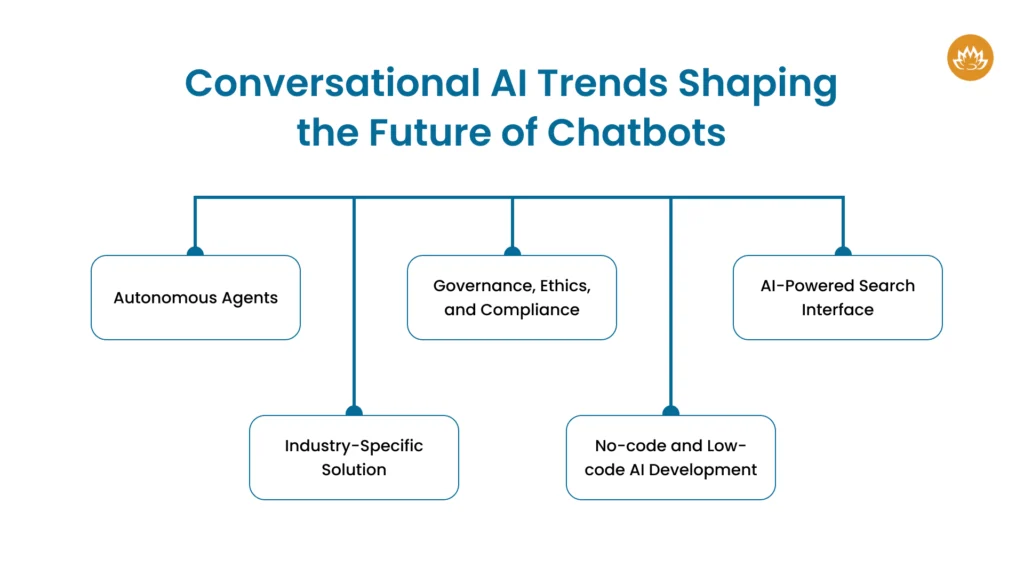
Autonomous Agents
Autonomous AI agents have been supporting organizations in various operational processes, including insurance claims, customer onboarding, and order management. They can help companies make decisions for tools, schedule actions, and learn like humans for better outcomes. They become self-drivers and can make decisions like humans.
Governance, Ethics, and Compliance
As regulations tighten and applications get more complicated, businesses are formalizing their governance of AI ethics. According to IAPP, more than half of companies include IT, security, privacy, and legal teams in AI supervision, signaling a move away from compartmentalized compliance and toward multidisciplinary governance.
AI-Powered Search Interface
Industry-Specific Solution
Retailers now use conversational AI to offer better chatbot experiences to their customers. Moreover, they are finding a major drop in costs as product guidance is getting replaced by generic responses in real-time. Such services are also now available in finance, telecom, and healthcare. The bots get trained for compliance and decision-making.
No-code and Low-code AI Development
The teams now prefer no-code and low-code AI platforms. The majority of enterprises use tools to close IT gaps and improve the speed of the deployment cycle. With this in place, non-technical roles get a boost.
Major Challenges in Conversational AI Adoption
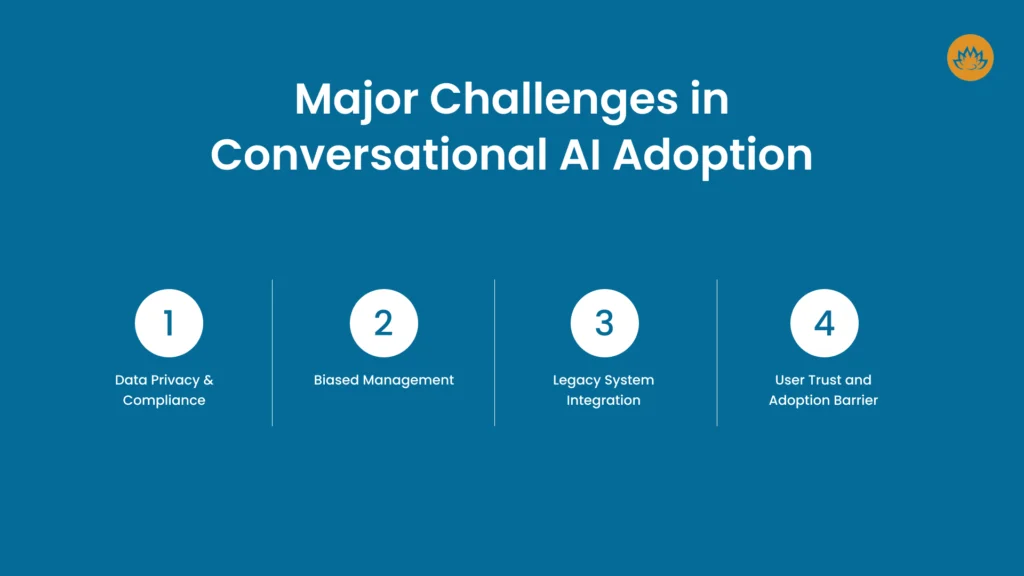
Data Privacy & Compliance
So adopting AI is not a cakewalk at all. There are a few challenges. Some organizations have reportedly experienced AI-related privacy breaches. Also, customers have experienced a privacy threat. With the increasing need for regulation and public scrutiny, businesses need to implement strict data governance and transparency in their policies.
Biased Management
The majority of clients are bothered about the discrimination in algorithms and decision-making. AI does that too. Therefore, it is always recommended that businesses conduct fairness checks and ensure transparency in intent handling. Very few companies at present do audits and adjust their training data.
Legacy System Integration
IT experts find trapped data in systems that cannot be migrated. They struggle with undocumented processes, which create hurdles in implementing real-time integration. The teams then need to invest their time in data modernization.
User Trust and Adoption Barrier
Struggling to gain that confidence in handling AI sometimes feels pressurizing. Customers find AI as a privacy threat many times, and some of them cannot trust at all. Therefore, for companies, it is essential to demonstrate transparency and clearly show the value of their data.
Conversational AI Supporting Industries in 2025
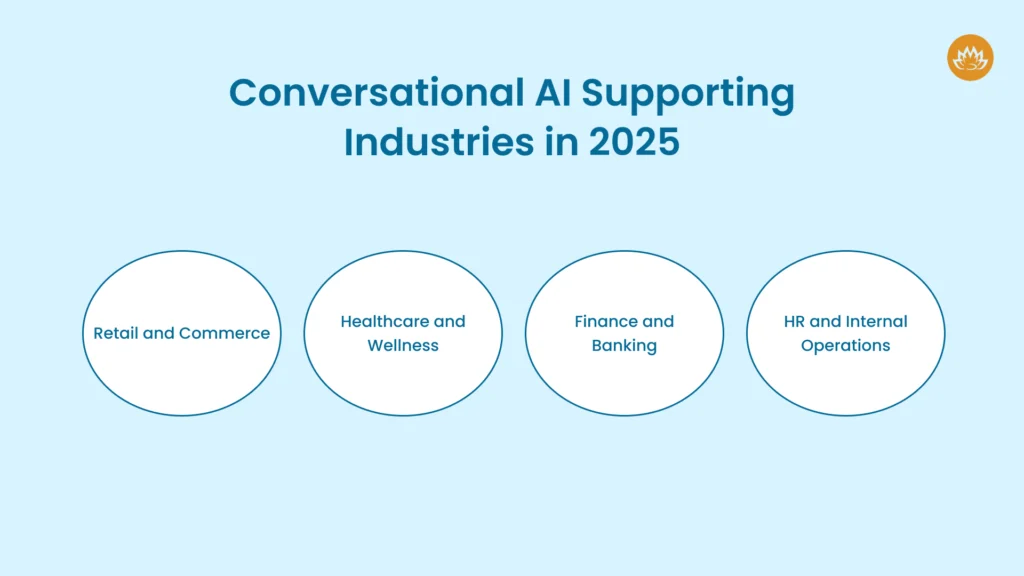
Retail and Commerce
- AI-driven product discovery
- Voice based and multimodal commerce
- Smart personalization
- Proactive notifications such as delivery updates
Healthcare and Wellness
- Virtual health assistants
- Emotionally supportive algorithms
- Remote patient monitoring
- HIPAA compliant tools
- Patient education and follow-up engagement
Finance and Banking
- Financial coaching supported by AI
- Regulatory compliant conversational app
- Hyper-personalized digital bots
- Predictive financial support tools
- Trust-building AI tone and transparency
HR and Internal Operations
- Audit-ready tools for enterprises
- Employee facing copilots for assistance on daily workflow
- Smart onboarding with conversational walkthrough
- Pulse survey automation and morale tracking
- AI-native knowledge bases
Choose the Right AI Development Company for Implementing Conversational AI
Conclusion
The future of conversational AI is bright and promising. Companies will use AI solutions to improve their complex decision making. They will use AI for financial forecasting, coordinating in healthcare, and much more. Conversational AI will redefine customer care scenarios and will improve retention ratios. As it helps address current challenges in customer experiences, conversational AI will be the best solution for providing enhanced customer interaction and driving business growth.
Author

Kirtan is CEO of Whitelotus Corporation, an emerging tech agency aimed to empower startups and enterprises around the world by its digital software solutions such as mobile and web applications. As a CEO, he plays key role in business development by bringing innovation through latest technical service offering, creating various strategic partnerships, and help build company's global reputation by delivering excellence to customers.
View all posts