



Enterprises in 2025 prefer AI adoption for making quick and accurate decisions. The increasing usage of AI is pushing the level of expectations to give faster results than ever before. Also, businesses want these decisions to be completely explainable, in compliance, and aligned with their company objectives. Especially, the implementation of AI in mobile app development has evolved the way enterprises use mobile apps to improve their business.
Companies now find the need to rework their AI-decision-making strategies. Because, the story is not just about process automation, but it is also about the way AI drives logic in making decisions with transparency, agility, and perfection. And so, enterprises are now changing their approach in making AI-powered decisions that blend with business goals and are derived from real-time data and machine learning capabilities. Businesses want accountable results and not gimmicks. This year, enterprises are expected to spend on AI upto 6%, which is a significant shift across industries.
The blog talks about some of the newest standards that are getting adopted by enterprises in 2025. Some of the key trends that are shaping enterprises in decision-making and designing processes are explained below.
Newest Standards Adopted by Enterprises in 2025 Through AI-Powered Decision Making
Integration of Business Standards, Machine Learning, and GenAI
Businesses’ approach to automated decision-making has fundamentally changed as a result of the convergence of generative AI, machine learning, and business rules engines. In order to create systems that are both agile and accountable, organizations are increasingly combining probabilistic machine learning modeling, generative inference of large language models, and deterministic execution of a business rules engine into unified decisioning platforms rather than depending on a single mode of intelligence.
This convergence implies that rules and models are in line with business objectives and lessen the possibility of logical gaps. Generative AI increases the quality of decisions and suggests best practices, powerful logic, and plain-language explanations. Hence, decision-making becomes clearer and less complex for business users. The following components play a complementary yet very important role:
- Business rules use clear, organized logic to enforce regulations and standards.
- Patterns and forecasts that rules alone are unable to identify are revealed by machine learning.
- Contextual reasoning is added by generative AI to facilitate explainability, quick refining, and teamwork.
When combined, they allow for decision systems that are not just rapid enough for real-time execution and accountable enough for audit and compliance, but also accurate, consistent, adaptive, and explicable.
AI-Assisted Tools with Low/No Code for Business Empowerment
AI-assisted, low-code systems are revolutionizing decision logic management and scaling by enabling business users to design, test, and implement rules without the need for engineers. Subject matter specialists like underwriters, claims analysts, and operations managers may now take direct action in response to insights and policy changes thanks to the move toward business-led automation, which speeds up responsiveness while maintaining accountability.
These platforms also enhance the quality and uniformity of rules by lowering technical obstacles. Here, artificial intelligence (AI) is crucial. Generative copilots support users in creating rules in clear language, make recommendations for logic enhancements based on previous choices, and illustrate how logic paths fit into compliance frameworks or corporate objectives. This lowers the possibility of adding new problems during edits or corrections in addition to minimizing rule-building faults and inconsistencies. Additionally, resolution times significantly decrease due to business users’ ability to handle problems on their own, promoting more nimble and trustworthy decision-making.
Crucially, low/no-code decisioning is about regulated speed at scale, not merely accessibility. With the help of modern platforms’ organized deployment workflows, version control, and audit trails, teams may implement rule changes more quickly while lowering the risk of uncontrolled releases or production failures. Technical users can intervene as necessary to enhance functionality, link external systems, or refine logic, guaranteeing flexibility without compromising control, leading to a collaborative decision-making environment.
AI Governance, Security, and Transparency
Transparency and governance are becoming more and more important as AI decision-making shapes results that impact people’s lives. In order to satisfy the increasing needs of internal audit teams and regulators, businesses are integrating explainability, traceability, and control directly into their platforms.
Version control, role-based permissions, and explainability tools are examples of built-in governance elements that help decrease rule design errors and lower the chance of putting faulty logic into production. By identifying problems early in the development lifecycle, these same controls facilitate traceability and lessen the need for emergency rollbacks.
Explainable AI (XAI) makes it easier to improve logic paths and guarantee that results are defendable in the face of regulatory review by allowing internal teams and stakeholders to understand not just what a model determined, but also why it made that conclusion. Businesses can proactively manage risk by preventing unanticipated security flaws or the slow collapse of decision logic by having real-time visibility into rule and model revisions.
Governance will be viewed less as a bottleneck and more as a strategic enabler as this trend picks up speed. It enables businesses to confidently grow AI decision-making, striking a balance between innovation and responsibility, and creating automation that the public and business can rely on.
Real-Time and Context-Aware Decisioning
Real-time decision-making systems of today must use up-to-date information and real-time signals to make prompt, accurate, and situation-responsive decisions. Acting in milliseconds reduces the possibility of making decisions based on outdated, inaccurate, or incomplete data inputs.
Organizations may act not just swiftly but also sensibly with the help of real-time, context-aware decision-making, producing results that are both instantaneous and in line with corporate objectives. The top benefits are:
- Better data integrity with real-time validation
- Smooth deployments with the ability to test decisions, lessening post-deployment troubleshooting.
- Fewer rollbacks with live monitoring and rapid remediation
These real-time capabilities are not merely hypothetical. They are already changing how different industries react to quick, complicated decisions. In order to increase accuracy, lower risk, and obtain a competitive edge, businesses are integrating real-time decision-making into key processes for everything from adaptive consumer experiences to fast fraud detection.
Outcome Driven Decision Intelligence
Organizations are shifting their attention from rule and model execution to quantifiable outcomes as AI decisioning platforms advance. In addition to determining whether a rule worked, they also want to know if it had the desired effect and was in line with strategic objectives and KPIs.
Teams are motivated by this outcome-centric perspective to improve their decision-making process by using performance feedback. For instance, root cause analysis can show what reasoning needs to be changed if a rule produces less-than-ideal claim results. In a similar vein, testing and deployment metrics assist in locating logic that introduces mistakes or needs quick repairs.
Maintaining optimization and relevance over time is ensured by ongoing performance monitoring. Teams can more easily modify reasoning without jeopardizing dependability or raising production risks when the effects of every choice are evident and measurable.
In the end, outcome-driven decision intelligence helps teams to make decisions in real time, which reduces the time it takes to identify problems, lowers the possibility of expensive mistakes, and guarantees that decision automation keeps producing tangible benefits.
6-Step Enterprise AI Implementation Process
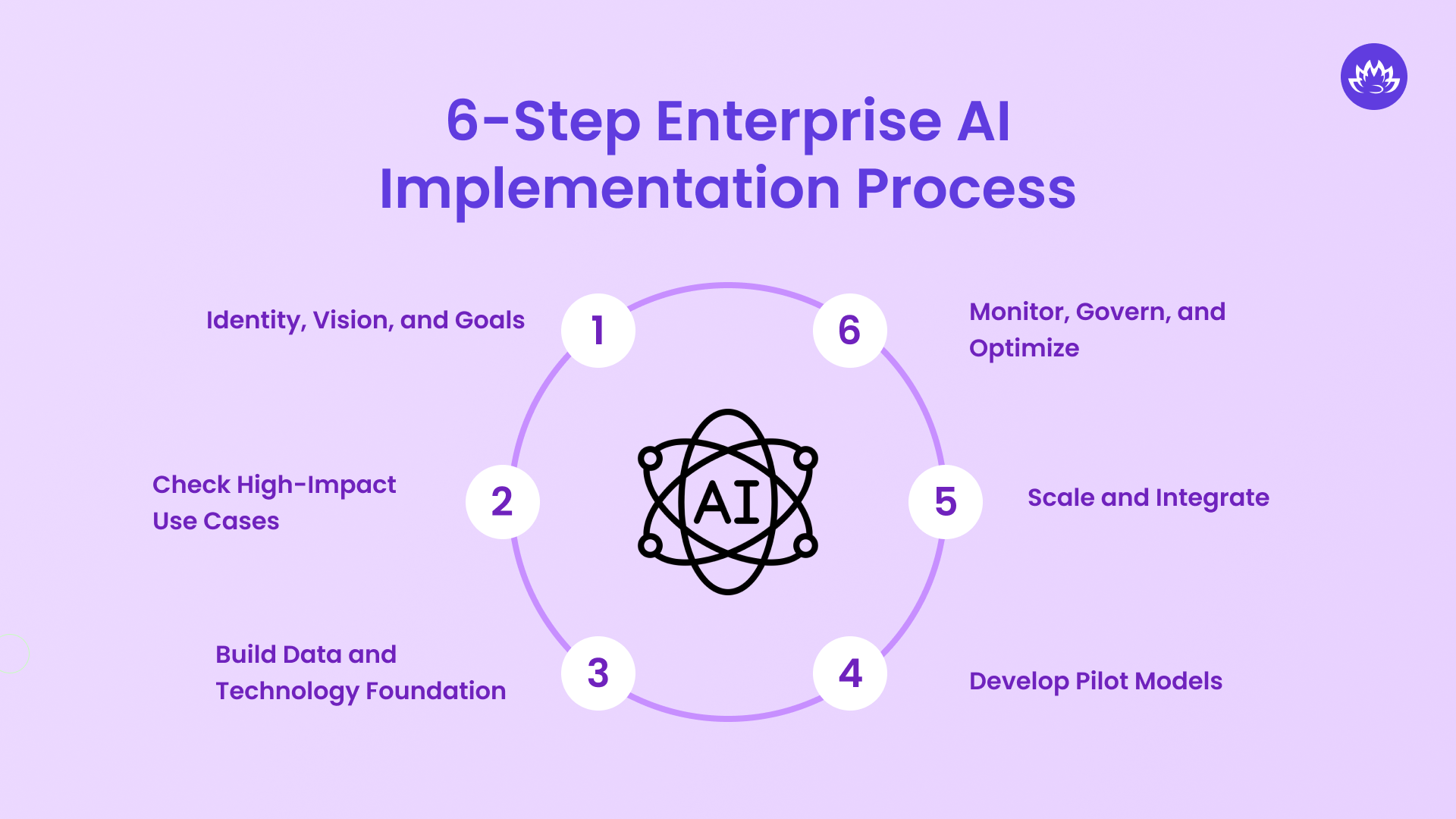
To get the real value of AI, enterprises need to follow a structured roadmap. You can hire dedicated developers from a reputed mobile app development company to implement the below six steps in a comprehensive manner.
Creating an online persona via the mobile app can help you maintain your competitive edge and boost user engagement over time. The app’s life cycle undergoes numerous stages before launch. The process of development is improved and made more possible by working in small phases.
Identity, Vision, and Goals
- Outline clear business objectives for AI
- Get executive sponsorship
- Gather a cross-functional team
- Define KPIs
- Create AI principles
Check High-Impact Use Cases
- Look closely at all your operations and survey them to capture the basic processes where AI can be implemented.
- Find out the feasibility through data analysis and check the ROI potential
- Conduct an AI readiness assessment of current workflows
Build Data and Technology Foundation
- Prepare data and infrastructure of AI
- Select a perfect AI platform that can support your needs like GPU servers and data lakes.
- Identify your technology stack, talent plan, inventory, and skills needed
- Hire dedicated developers, ML engineers, and AI project managers
Develop Pilot Models
- Tackle the selected use cases and small-scale pilots
- Build prototype models and AI services quickly
- Reach a proof of concept phase and measure and document results
- Gather feedback and implement what works, handling the obstacles such as data quality and change resistance.
Scale and Integrate
- AI expansion through the company
- AI solutions integration into production systems and workflows
- Standardize implementation procedures
- Train end users how to use these systems
- Set up dashboards and KPIs
Monitor, Govern, and Optimize
- Post-deployment, do robust monitoring and govern AI systems
- Track AI impact on business outcomes and the overall technical health
- Audit models periodically
- Collect new data and retrain models whenever needed
- Maintain an active governance loop
- Review ethical and security implications
- Gather feedback and do monthly KPI reviews
- Schedule model performance checks and plan for upgrades
Conclusion
Enterprise AI is developing quickly. The majority of businesses are now producing something, and the need to demonstrate tangible outcomes is only increasing. Expectations are high, budgets are increasing, and there is less room for error.
The teams that are making headway are maintaining their composure. They are concentrating on important use cases, developing scalable platforms, and maintaining strict data procedures. Despite their rapid pace, they adhere to the principles.
If you want AI implementation and AI-powered decision-making systems in your company, or if you need to automate your data workflows to get a faster and cleaner setup, contact us today. We can help you create smarter and more accurate AI-powered mobile apps that will help your enterprise grow and enhance overall performance.
Author

Kirtan is CEO of Whitelotus Corporation, an emerging tech agency aimed to empower startups and enterprises around the world by its digital software solutions such as mobile and web applications. As a CEO, he plays key role in business development by bringing innovation through latest technical service offering, creating various strategic partnerships, and help build company's global reputation by delivering excellence to customers.
View all posts