

AI

AI Integration vs. Traditional Automation: Choosing the Most Cost-Effective Solution

AI Integration vs Traditional Automation
Given two options — Invest millions in an outdated business automation approach or choose AI-powered systems to accomplish all your tasks, which one would you prefer? After working with more than 100 founders across different industries, we noticed a fundamental gap about what modern automation will be in 2025.
Using machine learning and advanced algorithms to handle complex decision-making through AI automation is inevitable now. Implementing AI in mobile app development has enabled process optimization, personalized customer interactions, fraud detection, and predictive maintenance. Whereas, this won’t be completely possible with traditional automation. You may need to adhere to predefined rules and scripts, follow structured tasks, and obtain workflow approvals.
The blog will help you understand the importance of choosing the proper automation method. Because it is not just about the cost and technical capability, but it is also about improving efficiency and productivity in less time. We will provide you with a detailed breakdown of both options. Through this guide, you will understand the business impact of opting for any one of these and how it will make sense for your organization.

Knowing the Automation Ideology

First things first: automation isn’t a binary process. It is a continuum, and strategic decision-making requires an awareness of where various options sit on this spectrum.
At one end of the spectrum is basic process automation, which involves using templates, digitizing paper forms, and implementing predictive workflows. On the opposite end of the spectrum, autonomous AI agents can handle complex tasks with minimal assistance from humans.
The majority of businesses end up in the center, putting in place what I refer to as “partial automation”—systems that eliminate some manual labor but still necessitate a great deal of human supervision and involvement.
Not simply automating is important, but intelligent automation that takes into account what contemporary technology is truly capable of.

What is Traditional Automation?

Traditional automation is effective but rigid. It is like the digital counterpart of an assembly line. It has well-defined outputs and can excel at performing repetitive, rule-based tasks.
Main Features of Traditional Automation:
  • Based on rules and follows predefined instructions
  • Uses linear workflows and process steps in a proper sequence.
  • Need a required format and structured data only
  • Operates through binary decision making
  • It has very limited capability and can be modified through manual reprogramming.
One such example is robotic process automation, or RPA. Routine processes, such as data entry, form processing, and report generation, can be accelerated with these technologies. Traditional automation may be adequate if your process can be represented as an unambiguous flowchart.
Companies make the mistake of attempting to impose intricate, subtle procedures onto inflexible, conventional systems.
We spoke with a data insights firm that has made significant investments in manual procedures to extract information from images of retail products. They employed a group of fifteen individuals to carry out monotonous data extraction duties that were equivalent to human OCR systems. They were able to analyze regular product photographs quickly, but anything even slightly out of the ordinary caused them to collapse utterly, resulting in both financial losses and a loss of customer trust.

What is AI Integration or AI Automation?

AI Automation signifies a significant change in strategy. These systems are capable of learning, adapting, and making judgments under uncertain circumstances rather than merely following preset rules. Being a reputed mobile app development company in India and the USA, we have provided AI automation solutions to many of our clients over the years.
Main Features of AI Automation
  • Developed with a learning based methodology. It keeps improving from examples and feedback.
  • Has flexible workflows with adaptive pathways that are contextual
  • Can handle unstructured data, as it works with images, text, and natural language
  • It can make decisions with incomplete information, quoting as probable results
  • Improves continuously with any explicit reprogramming.
Where traditional automation falters, such as in procedures involving natural language, judgment calls, or unpredictable inputs, AI automation works well and at its best.
There are various types of modern AI automation:

AI workflows are organized procedures that have been improved using AI. They are particularly adept at performing repetitive tasks that require some degree of intelligence, such as managing support tickets or processing documents.

AI agents: More sophisticated than workflows, agents can manage complex situations that typically call for human intervention, make decisions on their own, and adjust to changing circumstances.
Knowing the difference between workflows and AI agents is essential to comprehending the potential of contemporary automation technology.

Significant Differences Between AI Integration vs. Traditional Automation

The differences between both sorts of approaches cannot be just described in technical terms. There are various other fundamental changes that happen, impacting the entire business after adopting any of these choices.
Feature Traditional Automation AI Integration
Learning Ability
Needs manual updates
It can learn from data and can improve over time
Decision Complexity
Can make simple rule-based decisions
Can manage new choices based on context
Data Needs
Can provide structured and clean data
Can work with both structured and unstructured data
Handling Errors
Breaks down while facing disruptions or exceptions
Can easily adapt to disruptions, exceptions, and unusual cases
Scope of Implementation
Specific to tasks. Has a narrow approach
Has end-to-end process capability
Need for maintenance
Needs constant rule updates
Can improve itself with new data
Human oversight
Can manage exceptions and edge cases
Can handle exceptions autonomously
Scalability
Limited as per the complexity
It is highly scalable with various processes
Successful businesses do not choose any one of these. Rather, they practice a hybrid approach by implementing both. For stability, they utilize traditional automation, while AI automation handles complexities and heavy workflows.

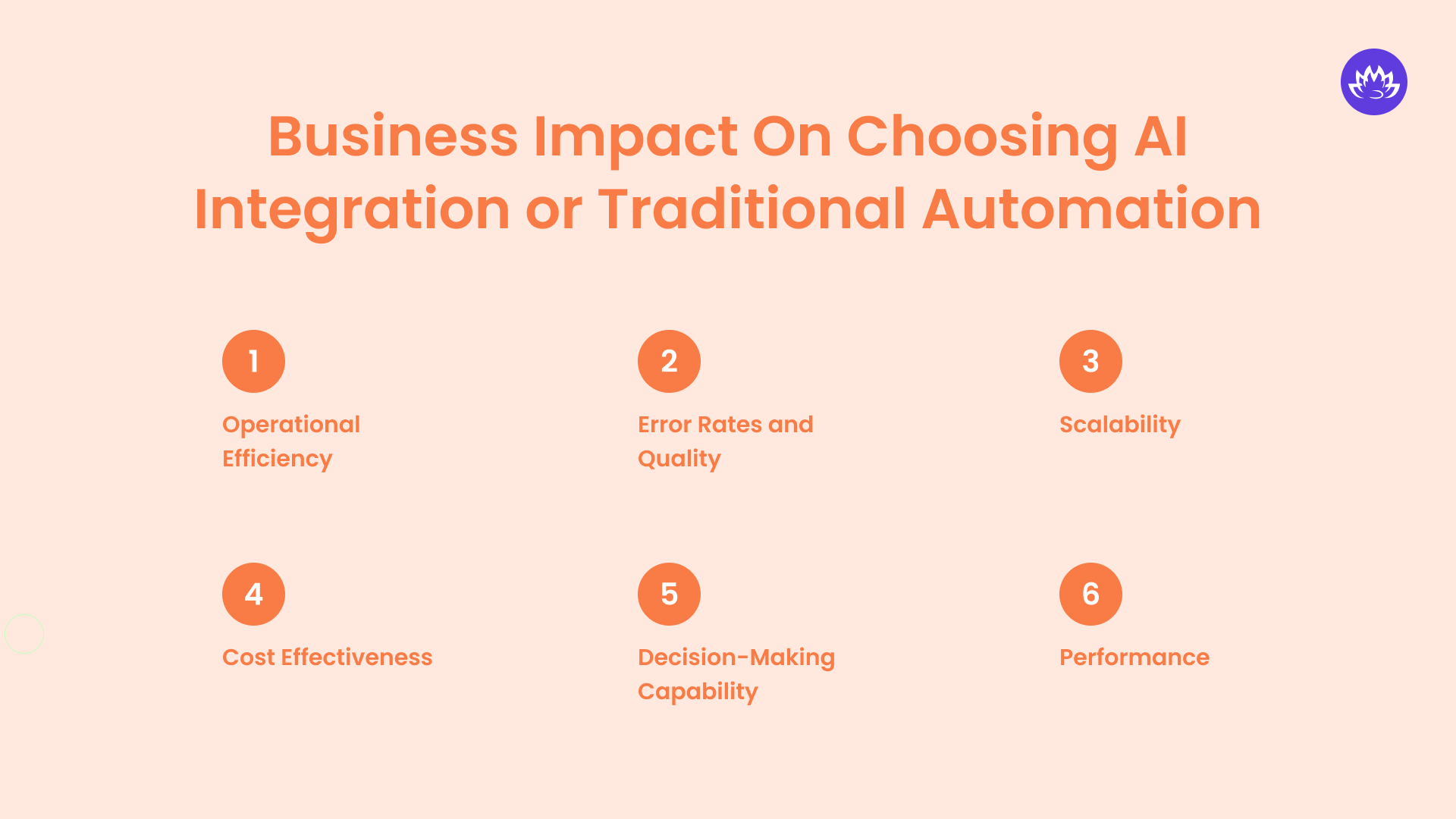
Business Impact On Choosing AI Integration or Traditional Automation
Business Impact On Choosing AI Integration or Traditional Automation
Your entire business outcome depends on the choice you make between AI and traditional automation. The real impact is evident across various aspects.

Operational Efficiency

For routine activities, traditional automation can boost processing speed by 40–60%. A manufacturing client cut down on processing time from 15 minutes to 3 minutes per invoice by using RPA to automate their invoice processing.
By removing entire job categories, AI automation increases productivity by 70–90%. A financial services organization utilized AI document processing, which not only extracted data faster but also eliminated the need for manual verification in 85% of cases.

Error Rates and Quality

Conventional automation reduces errors in most scenarios, but it often introduces new types of faults at the boundaries of processes. Data entry errors decreased by 65% for one healthcare provider, but exception handling problems increased by 30%.
AI automation correctly handles exceptions, lowering total error rates. By recognizing and adjusting to anomalous claim patterns, an AI-powered claims processing system for an insurance firm decreased overall errors by 76%.

Scalability

Conventional automation struggles with variability and scales linearly with investment. To deal with minor differences in its inventory procedures, a retail chain had to develop 17 distinct automation workflows.
As AI learns from more situations and data, its automation grows dramatically. You can hire dedicated developers from a reliable AI development company to create scalable AI automation solutions. 

Cost Effectiveness

Depending on the system’s complexity and data requirements, AI maintenance can cost anywhere from $10,000 to over $100,000 per year. Maintenance expenses for traditional automation typically range from $5,000 to $50,000 per year, contingent on software fees and system complexity. Because AI development services automate decision-making and reduce manual oversight, they lower long-term operating expenses but require a greater initial investment.
  • AI is affordable for companies that require long-term, flexible automation that improves over time.
  • For companies managing structured, repetitive processes that don't change often, traditional automation is more affordable.
  • To strike a balance between cost and efficiency, several companies integrate AI with conventional automation.

Decision-Making Capability

Artificial intelligence examines data, identifies trends, and bases decisions on previous results. AI can improve over time by refining its reactions and predictions through machine learning.
Functions well in fields that call for flexibility, such as chatbots, demand forecasting, and fraud detection.
Traditional automation lacks learning capabilities and adheres to preset rules and routines.
Performs better in scenarios like data entry and form processing, where input and output are predictable. The automation has to be manually updated to reflect any changes in the situation.

Performance

AI is designed for tasks that are unpredictable and require real-time decision-making. Mostly, it is used for fraud detection, predictive analytics, and customer interactions. At the same time, traditional automation is used for repetitive tasks. It is mainly designed to automate structured and repeatable tasks that do not change, such as data entry, invoice processing, and IT workflows.

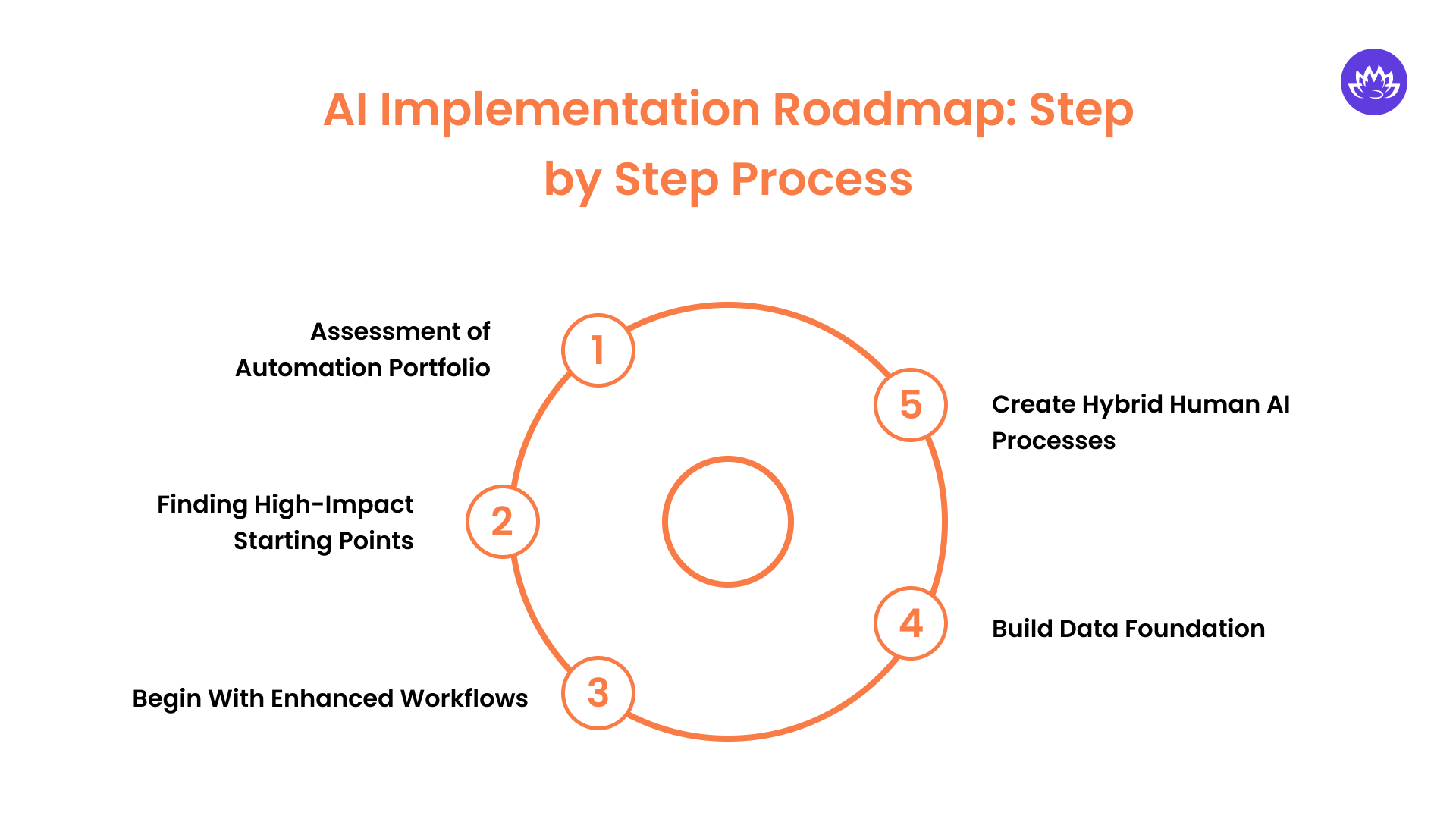
AI Implementation Roadmap: Step by Step Process
AI Implementation Roadmap_ Step by Step Process
If you are using traditional automation for all your business processes, it is time to implement AI capabilities in areas with heavy workflows and increased complexity. So here is the simple process that we recommend to all our customers.

Step 1: Assessment of Automation Portfolio

Categorize your current process. It can be any of these.
  • Rule-driven process that works well with traditional automation
  • Judgment is a heavy process that needs AI automation
  • A hybrid process that benefits from combined approaches

Step 2: Finding High-Impact Starting Points

Are you looking for a process that has the following characteristics?
  • There are more manual interventions.
  • Important natural language or unstructured data
  • A procedure where speed or quality changes needs substantial business value

Step 3: Begin With Enhanced Workflows

Before deploying fully autonomous agents, start with AI-enhanced workflows that complement your current systems. This makes the change more straightforward to handle.

Step 4: Build Data Foundation

AI automation needs better data practices. So, make sure you have mechanisms that take up all the process decisions and outcomes. You must also implement a feedback mechanism for data training. Lastly, establish transparent quality metrics to track and measure improvement.

Step 5: Create Hybrid Human AI Processes

The most effective implementations require seamless collaboration between humans and AI. Make sure you identify those areas where you have the liberty to either automate or continue with human work. Make intuitive interfaces for humans to review AI decisions.

Conclusion

To summarize, there is no single approach when you want to choose between AI and a traditional approach. It all depends on the business needs. Moreover, it is all about finding the right balance. We recommend using AI where it adds value to your business, and traditional automation where efficiency and cost-effectiveness are a concern. If you are looking for some impactful AI automation solutions, Whitelotus Corporation is here to help your business integrate with smart and scalable AI solutions that will match your business requirements. Contact us today for further consultation.

Author

  • Sunil Chavda

    Sunil is a result-orientated Chief Technology Officer with over a decade of deep technical experience delivering solutions to startups, entrepreneurs, and enterprises across the globe. Have led large-scale projects in mobile and web applications using technologies such as React Native, Flutter, Laravel, MEAN and MERN stack development.

    View all posts

Don't skip sharing this post!

Inquiry now

    MAKING IT EXTRAORDINARY