Evolution of On-Demand Apps and Ecommerce Platforms
- Food delivery apps
- Healthcare booking platforms
- Home service marketplaces
- Ride-sharing platforms
- Rental and accommodation marketplaces
- Freelance hiring platforms
- Personalized recommendations
- Transparent pricing system
- Hyper-relevant search results
- Faster service fulfillment
- Higher security
- Real-time support
Why AI is Now Crucial for Modern Marketplace Platforms
- Which customer should be paired with which provider?
- How should demand affect prices?
- How can fraudulent behavior be quickly identified?
- Which goods ought to be suggested?
- How can customer service be provided around-the-clock?
How AI is Transforming On-Demand Applications
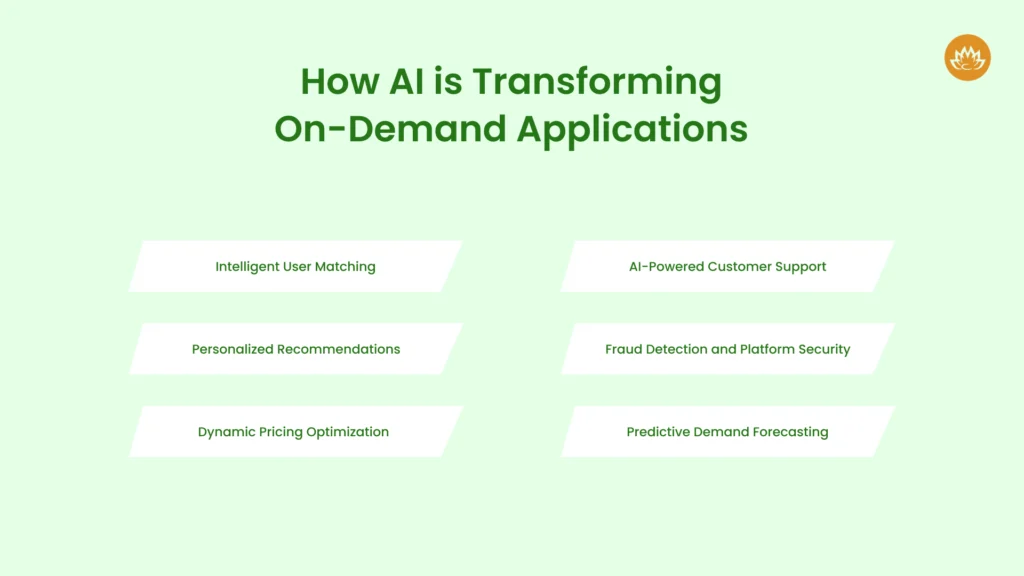
1. Intelligent User Matching
AI greatly increases the accuracy of matching by examining:
- Location data
- Availability
- Service quality metrics
- Ratings and review
- Historical behavior
- User preferences
For example:
A ride-sharing application will match passengers with the most suitable driver based on criteria like proximity, traffic conditions, driver performance, and customer preferences.
Along similar lines, a freelance marketplace will recommend the best professionals for specific projects based on criteria such as skills, project history, and experience. This will create faster fulfillment and better customer satisfaction.
2. Personalized Recommendations
Customers are expecting platforms to better understand their preferences.
Recommendation engines driven by AI examine vast volumes of behavioral data to make the following recommendations:
- Content
- Providers
- Product
- Services
- Promotions
With this level of personalization, users will be able to find what they need much faster. It will also increase engagement and conversion rates.
For example, when:
- Food delivery apps recommend dishes according to previous orders
- Travel platforms suggest destinations based on user interests
- E-commerce marketplaces recommend products that you may likely purchase
The results will always be more intuitive, and you will get an engaging user experience.
3. Dynamic Pricing Optimization
One of the most effective levers for market profitability is pricing.
AI is able to continuously evaluate elements like:
- Fluctuations in demand
- User behavior
- Supply availability
- Competitor pricing
- Seasonal patterns
- Geographic conditions
According to these types of inputs, all such platforms get enough space to adjust to the prices in real time.
During times of high demand, ride-sharing businesses employ surge pricing.
Delivery fees are adjusted by food delivery services according to driver availability and order volume.
Pricing is optimized by hospitality markets according to local demand and occupancy rates.
While preserving market equilibrium, dynamic pricing aids in revenue maximization.
4.AI-Powered Customer Support
For on-demand companies, customer service is often among the most costly operational tasks.
Support experiences are being revolutionized by contemporary AI-powered assistants through:
- resolving routine issues
- Handling booking changes
- Providing updates on orders
- Answering common queries instantly
- Escalating complex cases
Unlike other chatbots, AI assistants nowadays have contextual understanding and can maintain conversational continuity.
And because of that, businesses today can deliver 24/7 support services, incurring minimal operational costs.
According to recent industry studies, sophisticated AI agents are increasingly handling complex customer interactions, reducing support workloads while improving user satisfaction and response times.
5.Fraud Detection and Platform Security
As transactions on the marketplace increase, there will be greater risk of fraud. Some of the most common threats are:
- Payment fraud
- Fake accounts
- Identity theft
- Account takeovers
- Review manipulation
With AI systems in place, businesses can now analyze transaction patterns and behavioral signals in real time to detect suspicious activity.
So instead of relying solely on manual reviews, platforms can quickly detect and prevent fraudulent activity before it causes any damage.
With this comes trust among the users and across the marketplace ecosystem.
6. Predictive Demand Forecasting
Demand forecasting is very important for conducting efficient operations:
AI will predict the future demand patterns through the following analysis:
- Local events
- Weather conditions
- Economic factors
- User behavior
- Seasonal trends
- Historical transactions
For example:
A food delivery app can estimate order surges during the weekends
A logistics platform can allocate resources at the right time.
A healthcare booking platform can predict appointment demand in specific regions.
With accurate forecasting, there will be better resource utilization and customer satisfaction.
How AI is Enhancing Marketplace Operations Behind the Scenes.
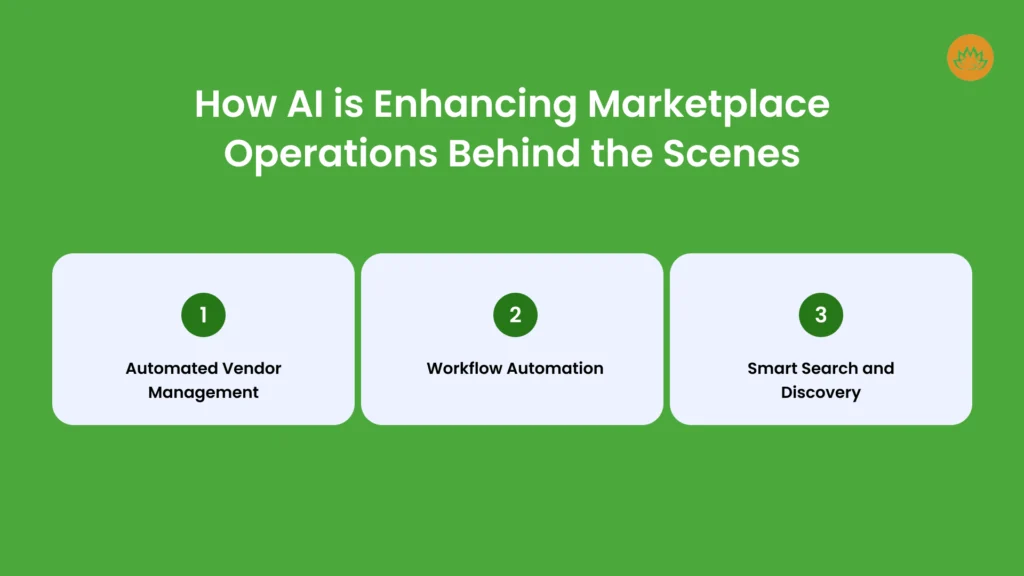
Automated Vendor Management
The ecommerce platform operators manage thousands of sellers and various service providers. With AI, they can automate:
- Quality assessments
- Onboarding
- Contract management
- Compliance verification
- Performance monitoring
There is less administrative burden, and it also ensures better quality management.
Workflow Automation
AI will automate repetitive operational tasks. Some of them are:
- Order processing
- Lead qualification
- Inventory updates
- Customer communications
- Appointment scheduling
Automation will help businesses scale efficiently, with very low operational costs and speedy completion.
Smart Search and Discovery
Traditional keyword research methods will yield limited results.
However, with AI-powered search, the system will understand the user’s intent and context with efficiency.
For example, when a customer searches for “family-friendly vacation rental in the mountains”, AI will exactly interpret the meaning instead of simply matching with the keywords.
With this, there will be improvements in results and discovery experiences.
Top AI Trends That Shape Up Next-Generation Marketplace Platforms
Agentic AI and Autonomous Commerce
The rise of agentic AI is one of the most fascinating developments.
In contrast to conventional AI systems, which merely react to commands, AI agents are able to:
- Plan proper actions
- Make decisions
- Understand business goals
- Execute multi-step workflows
This change is referred to by industry analysts as “agentic commerce,” in which AI agents assist consumers in finding things, weighing their options, negotiating, and even completing deals. According to research, this paradigm is anticipated to change marketplace interactions and digital commerce in the upcoming years.
For example, when the marketplace users state an objective:
“Find the best event manager for my wedding within my budget”.
The AI agent will search, evaluate, compare, negotiate, and present the best options.
Hyper-Personalization
Future platforms will go far beyond just recommendations.
AI will personalize various actions, such as:
- Service packages
- Search results
- Marketing messages
- Pricing models
- User interfaces
Every customer’s journey will be unique and special.
Conversational Marketplaces
Now, almost all the traditional interfaces will be supplemented by conversational experiences. The users will interact naturally through systems like:
- AI chat interfaces
- Voice assistants
- Conversational search
- Smart recommendations
AI-powered marketplace assistants show strong promise for streamlining complex buyer-seller interactions and increasing overall productivity, according to research.
Multi-Agent Ecosystems
The futuristic marketplace platforms will now be seen deploying multiple specialized AI agents working together. Some of the examples include:
- Vendor management agents
- Logistics optimization agents
- Pricing agents
- Fraud monitoring agents
- Customer service agents
Adaptive decision-making and highly scalable processes are made possible by this distributed intelligence approach. New studies show that multi-agent systems that dynamically adapt to user requirements and market processes are becoming increasingly popular.
Why Companies Should Invest in AI-Powered Marketplace Development Today
Companies should invest in AI-powered mobile app development as they will gain tremendous advantages in the coming years. Future businesses partnering with an AI development company will get benefits such as:
- Stronger marketplace trust
- Improved revenue generation
- Higher customer retention
- Higher operational efficiency
- Faster scalability
- Better user experiences
As customer expectations continue to change, companies that only deploy legacy platform architectures risk falling behind.
AI is becoming the cornerstone of contemporary digital platforms; it is no longer just a fad.
Businesses that adopt AI-powered mobile app development now will be better positioned to dominate their respective sectors in the years to come.
Conclusion
The future of on-demand applications and marketplace platforms is shining and intelligent. Artificial intelligence is changing every single aspect of how digital marketplaces work. Talk about personalized recommendations to predictive analytics, or from autonomous AI agents to conversational commerce, everything is automated, optimized, and continuously improved through machine learning and intelligent decision-making.
Those businesses that want to launch or modernize their marketplace platforms or on-demand mobile applications can hire AI developers from a reputable AI development company. They can gain this strategic advantage by providing seamless user experiences through intelligent automation.
As an experienced AI development company, Whitelotus Corporation is helping businesses build secure, scalable, and future-ready marketplace solutions. We provide advanced AI-powered mobile app development services. If you want to create a new platform or enhance your existing ecosystem, leverage AI today to position your business for long-term growth, productivity, and efficiency in this highly competitive digital world. Contact us to know more about our services.