

AI is changing the world rapidly. Every second, the demand for products and services evolves. Initially, applications were used to perform tasks based on given instructions. Responses came only when users clicked the button. However, today’s users want these apps to predict their needs, deliver experiences, and automate repetitive tasks. They want apps that are intelligent and work effortlessly.
Enterprises nowadays partner with an experienced AI development company to build smart apps. It can be a shopping app that recommends a perfect product, a healthcare platform that analyses patient data in real time, or a finance app that detects suspicious transactions. AI is shaping how the world uses digital products.
Investing in smart, AI-powered applications is crucial. It needs the right strategy and an innovative roadmap that leads to a successful product that solves real business problems. In this blog, we shall explore how any business that needs to build intelligent applications with AI can build a powerful AI-powered app today. So let us dive in.
What are Smart Applications?
When applications are deeply enhanced with Artificial Intelligence and Machine learning technologies, they become smart apps. Smart applications can do so much more than traditional apps used to. For example, they can:
- Learn from user behavior
- Automate decisions
- Recognize patterns
- Improve performance continuously
- Automate decisions
- Make predictions
- Analyze large datasets
- Understand natural language
Some of the most common examples of smart applications built with AI are:
- Fraud detention systems
- Smart healthcare apps
- Personalized ecommerce platforms
- AI chatbots and virtual assistants
- AI-driven recommendation engines
- Workflow automation systems
- AI chatbots
- Virtual assistants
In the coming years, it is predicted that agentic AI systems and AI-native software will be seen at the core of any business infrastructure.
Why Enterprises Want to Invest in Smart AI Applications?
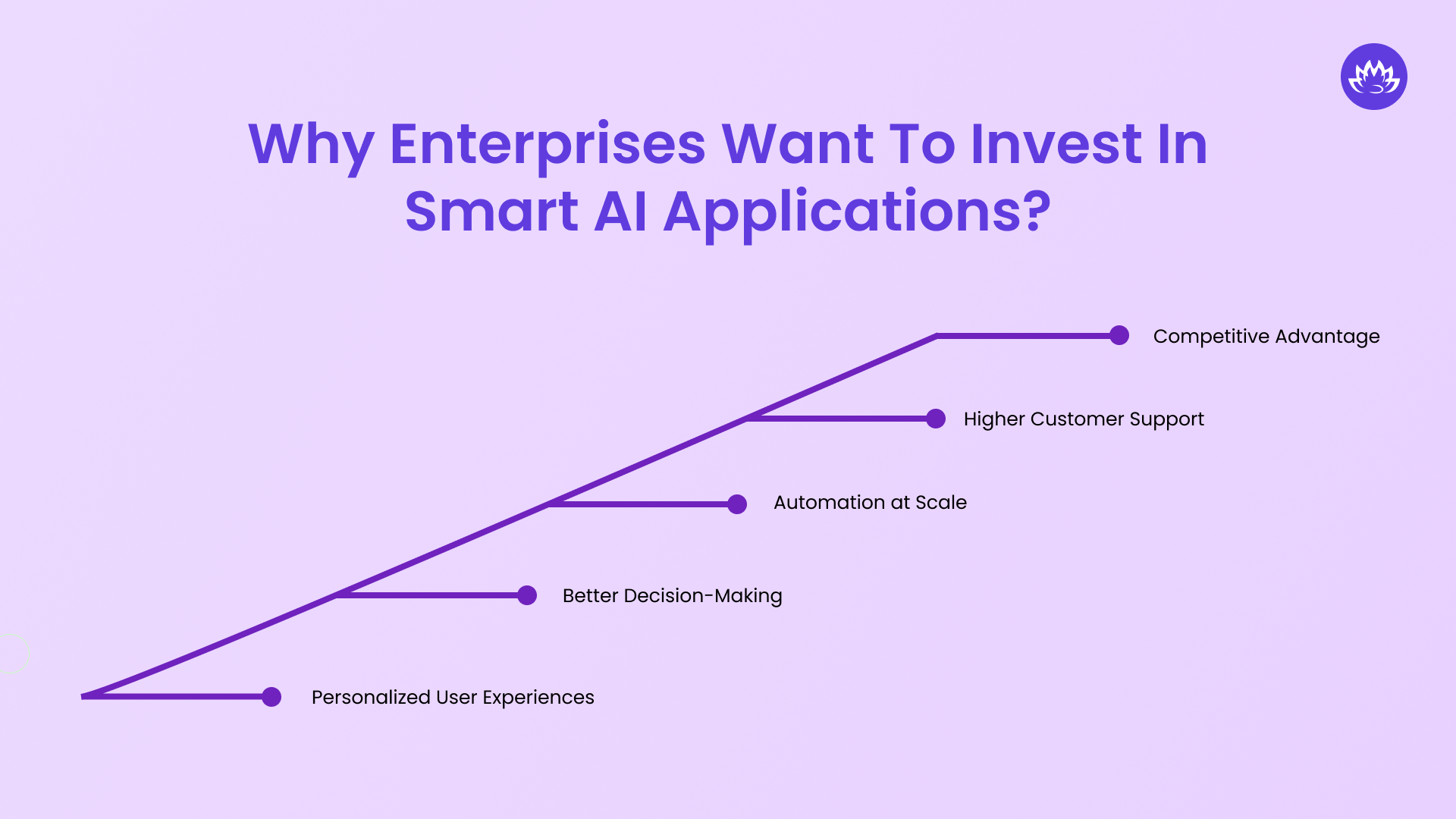
AI-driven applications give many advantages to companies worldwide. Enterprises, small or big, use AI to enhance their business productivity, operational efficiency, and automate repetitive tasks. AI is also used rigorously to uncover hidden insights from massive datasets. The top benefits of investing in Smart AI applications are:
Personalized User Experiences
AI apps will analyze human behavior, identify patterns, and interact efficiently to provide high-quality, personalized experiences. Some of the examples are:
- Streaming platforms are suggesting content
- Banking applications offer customized financial advice
- Ecommerce apps recommend the products
- Healthcare apps offering personalized treatment suggestions.
Better Decision-Making
AI applications can process large amounts of data faster than humans. AI is helping business entrepreneurs predict and analyze data, gaining intelligent insights to make faster, more informed decisions. AI is used for the following industries:
- Manufacturing
- Retail
- Finance
- Supply chain management
- Logistics
- Healthcare
Automation at Scale
Various AI-powered smart apps can automate repetitive workflows, allowing staff to focus on productive tasks. Some of the examples are:
- Processing invoice
- Responding to customer support
- Data extraction
- HR onboarding workflows
- Lead qualification
- Verifying documents.
AI agents are now quickly influencing businesses to handle multi-step workflows with very little human intervention.
Higher Customer Support
These days, AI chatbots and virtual assistants offer round-the-clock customer service with human-like dialogues.
Contemporary conversational AI systems are capable of:
- Recognize intent
- Identify sentiment
- Answer questions
- Intelligently escalate problems
- Gain knowledge from conversations
This lowers support expenses while increasing client happiness.
Competitive Advantage
Businesses get a significant competitive advantage when they successfully incorporate AI into their applications.
They turn into:
- Quicker
- Greater scalability
- Greater data-driven
- More flexible in response to shifting market conditions
Businesses with AI capabilities can simultaneously increase operational efficiency and innovate quickly.
Top Technologies Used to Build Smart Applications
AI-powered mobile app development involves several processes. To build intelligent applications, you need to combine several technologies and ideas.
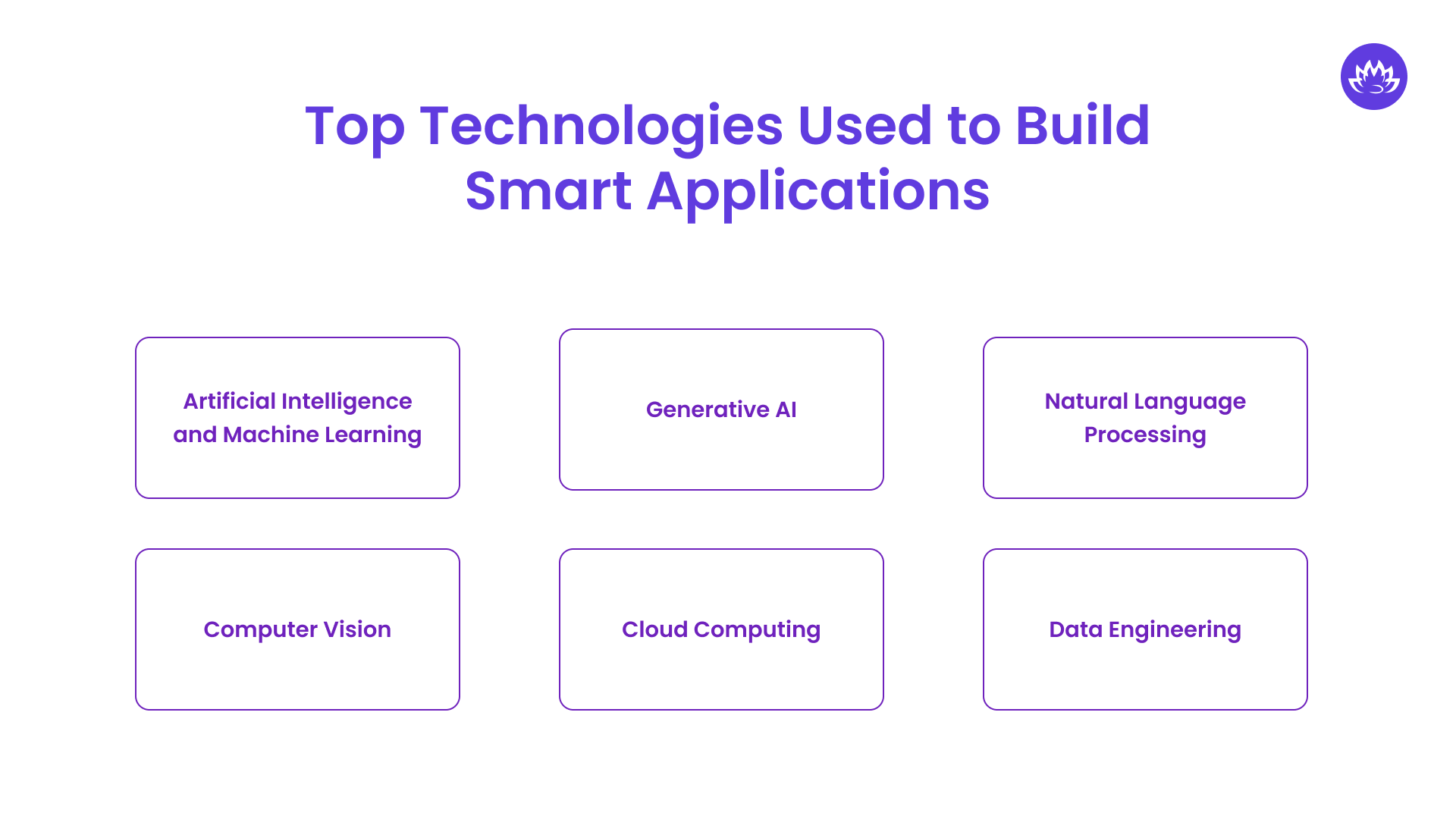
Artificial Intelligence and Machine Learning
ML technology can empower applications to learn patterns from data and doesn’t require any hardcore logic. Top ML approaches include reinforcement learning, supervised learning, and deep learning.
AI/ML models can help applications to predict outcomes, understand language, generate content, detect anomalies, and much more.
Generative AI
With generative AI, you can create text, audio, designs, code, videos, and images. Companies, small and large, integrate generative AI into applications for various purposes, such as customer support, content creation, coding assistance, workflow automation, and product recommendations.
Natural Language Processing
Applications can comprehend and produce human language thanks to NLP.
It provides electricity to:
- Chatbots
- Voice assistants
- AI search engines
- Systems for translating languages
- Tools for sentiment analysis
Due to sharp progress in large language models, modern NLP systems are becoming more conversational and context-aware.
Computer Vision
Applications can analyze and interpret visual data using computer vision.
Typical usage cases include:
- Recognition of faces
- Inspection of quality
- Imaging in medicine
- Monitoring of security
- Retail analytics for object detection
Computer Vision
Applications can analyze and interpret visual data using computer vision.
Typical usage cases include:
- Recognition of faces
- Inspection of quality
- Imaging in medicine
- Monitoring of security
- Retail analytics for object detection
Cloud Computing
To train and deploy models for smart AI apps, you need scalable infrastructure. There are cloud platforms that provide commendable infrastructure, such as Scalable APIs, data storage, GPU computing, MLOps infrastructure, and AI services. You do not need massive investments to develop a cloud native AI application.
Data Engineering
High-quality data is essential to AI systems.
Data pipelines are necessary for:
- Data gathering
- Data cleaning
- Transformation of data
- Data governance and real-time processing
Even sophisticated AI models are ineffective without a solid data infrastructure.
Step-by-Step Process to Build Smart Applications with AI
As an AI development company, we share one of the most practical development processes we use when developing AI-powered smart applications.
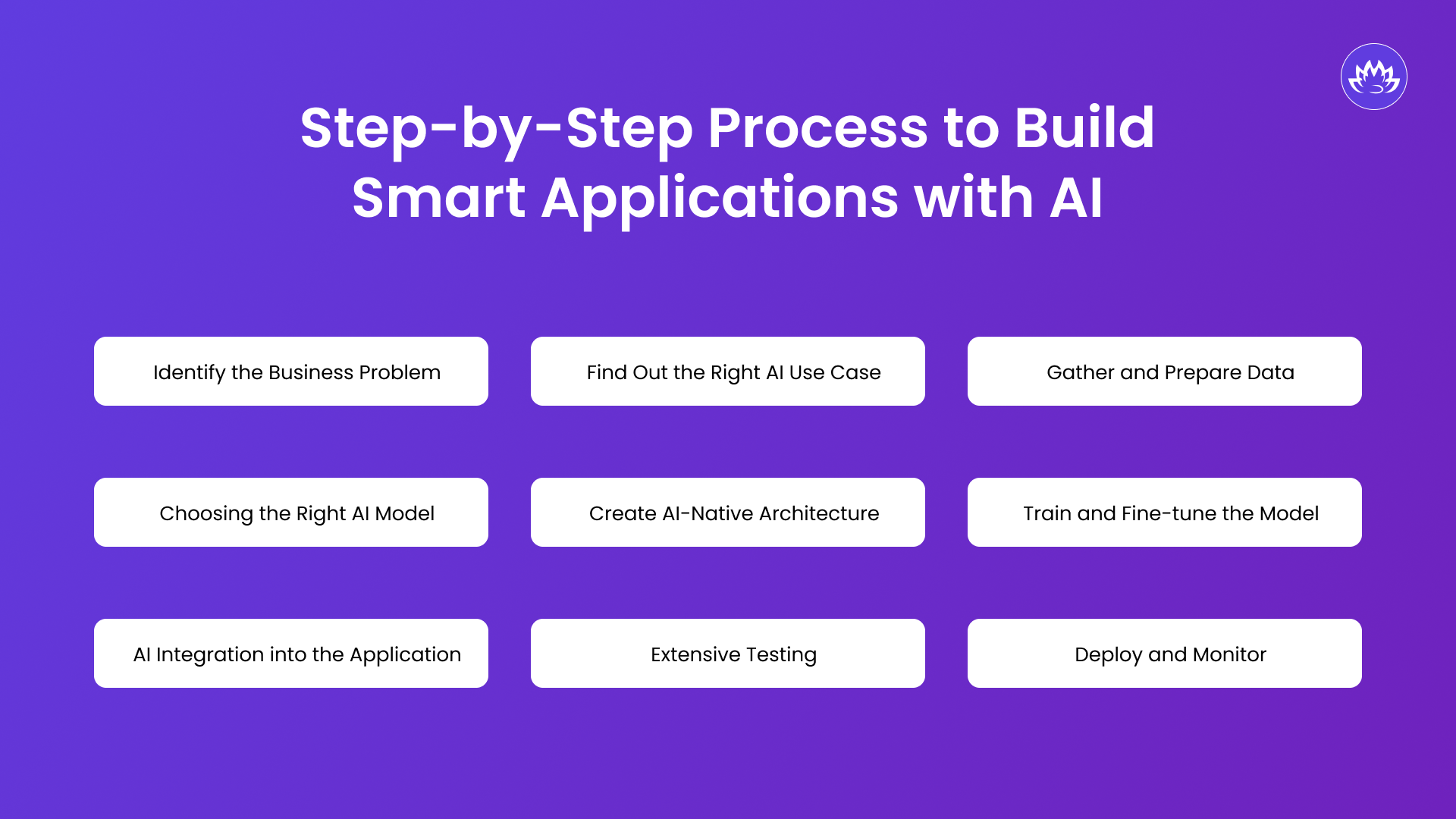
Identify the Business Problem
Most of the time, companies make mistakes by focusing on what AI can do rather than starting with the actual business problem. Therefore, before considering what code to write, we recommend you find answers to the following questions:
- What is the challenge that needs to be solved?
- What is the end result that users expect?
- What set of processes needs improvement?
- What are the measurable results AI can provide?
AI supports only when you have a clear business objective. For example:
- Improve sales forecasting accuracy
- Increase customer retention
- Detect fraud speedier
- Reduce support response time.
Find Out the Right AI Use Case
All features do not need AI.
AI is used when you want to create meaningful values using its intelligence. Some of the most occurring use cases are:
- Predictions
- Automation
- Recommendations
- Content generation
- Pattern recognition
- Intelligent search
Bad AI use cases only need simple rules and standard automation. However, the above use cases can leverage AI capabilities to a great extent.
Gather and Prepare Data
Data is the core foundation of any AI application. The data should be relevant, structured, clean, diverse, and updated. This is because the quality of your data directly impacts the entire AI performance. For data preparation, what you need is;
- Labeling datasets
- Data normalization
- Feature engineering
- Handling missing values
- Removing all duplicates
Choosing the Right AI Model
Each AI problem does not have only one solution. There are several ways and means to use AI and get the best out of its capabilities. Some examples are:
- Recommendation systems lead → collaborative filtering
- Image analysis → neural networks
- Forecasting → time series models
- Fraud detection → classification models
- Chatbots → large language models.
Nowadays, companies use specialized AI models and multi-agent systems tailored to specific workflows.
Create AI-Native Architecture
For intelligent applications, traditional software design is no longer sufficient. Modern AI applications need the following technologies:
- Model orchestration
- Real-time inference
- Vector databases
- Knowledge retrieval systems
- API integrations
- AI governance layers
Applications may become context-aware, flexible, and constantly improving thanks to AI-native architecture. Some of the key architectural components include:
- AI model layer
- Data pipelines
- Vector databases
- Monitoring systems
- Security controls
- Frontend interfaces
- Backend services
Train and Fine-tune the Model
AI models continuously improve through rigorous training. To train and fine-tune these models, AI development companies follow the following process:
- Feed training data
- Check the level of accuracy
- Fine-tune the parameters
- Reduce bias
- Optimize performance.
For enterprise AI systems, continuous learning is becoming increasingly crucial.
AI Integration into the Application
Once all the models are ready, they should integrate seamlessly into the application workflow. The integration happens through:
- APIs
- AI platforms
- SDKs
- Cloud services
- Embedded AI frameworks.
Essentially, the AI experience should sound and feel natural to the users instead of being forced upon something that is extremely complex.
Extensive Testing
Compared to typical software, AI applications need far more thorough testing.
The testing should include the following aspects:
- Functional testing
- Security testing
- Scalability testing
- Bias detection
- Accuracy validation
- Performance testing.
Human oversight remains essential for production-grade AI systems.
Deploy and Monitor
AI deployment will not become the final step. All smart applications powered with AI need continuous monitoring, optimization, retraining, governance, and security updates.
Any successful business will continue to improve its systems using AI technologies and tools.
Key Features Every Smart AI Application Must Have
When you hire AI developers from an experienced and reliable software development company, you are sure to get the following features in your smart AI application. So let us find it out.
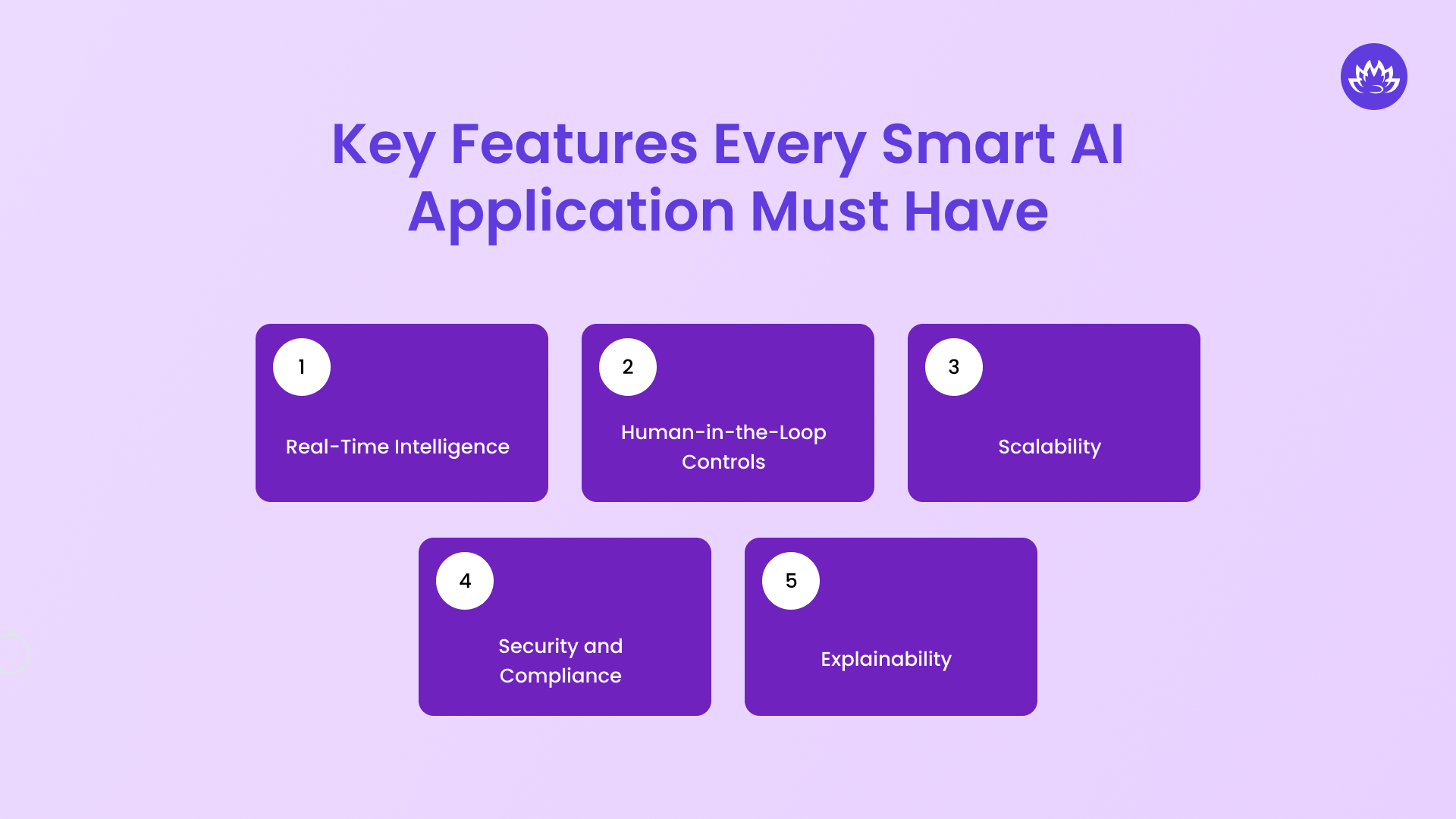
Real-Time Intelligence
Modern users expect instantaneous reactions and recommendations.
Whenever feasible, applications should process input and produce intelligent outputs instantly.
Human-in-the-Loop Controls
AI should supplement human oversight, not take its place.
Companies are increasingly using approval layers, which allow humans to verify important AI choices.
Scalability
Workloads involving AI can soon become resource-intensive.
Applications ought to scale effectively across:
- Users
- Volume of data
- AI inquiries
- Workflows using many agents
The purpose of contemporary compound AI systems is to more effectively manage high-volume intelligent operations.
Explainability
Companies and entrepreneurs eagerly want to know how AI can make informed, accurate decisions most of the time. If there is explainable AI, it will improve trust, adoption, compliance, and transparency.
Challenges Businesses Face While Building Smart Applications
To build AI-powered applications is always an exciting experience. However, there are certain challenges that every business comes across.
Data Quality Issues
Inadequate or inconsistent data cause unreliable AI results.
Enterprises often underestimate the work involved in preparing data.
High Development Costs
The development of advanced AI necessitates:
- Expert developers
- AI tools, infrastructure, and data scientists
- Constant optimization
AI application development is becoming more accessible, though, thanks to low-code and AI-assisted development platforms.
AI Governance and Ethics
All enterprises, large and small, must address privacy, transparency, accountability, bias, and regulatory compliance.
Complexity in Integration
AI systems must be capable enough for integration with ERPs, Databases, APIs, Business workflows, and CRMs. If businesses need AI ecosystems to thrive, ensure the integration process is executed accurately.
Future Trends in Smart AI Applications
The future of smart AI applications is all set to become adaptive, autonomous, and highly intelligent. Some of the upcoming trends in the world of AI are:
- AI systems are evolving from assistants to autonomous agents capable of independently planning and executing intricate tasks.
- Companies are using multiple AI agents to collaborate across workflows.
- Future applications will be built completely around intelligent interactions from the start, rather than incorporating AI later.
- Because low-code and no-code platforms simplify engineering, AI development is accelerating.
Conclusion
Static software experiences will no longer be the main focus of application development. Intelligent systems that can adjust, automate, personalize, and continuously change in response to user behavior and market demands are essential for businesses today. That’s precisely where intelligent AI-driven apps are making a huge difference.
However, to build a truly smart application, you need more than adopting AI tools. For this, you need a combination of strategic planning, high-quality data engineering, and seamless integrations with user-centric design. And for all these activities, you need to partner with a reputable software development company. Whitelotus Corporation helps businesses turn innovative ideas into intelligent digital solutions. With our expertise in AI-powered mobile app development, we provide automation solutions, custom software engineering, and scalable digital transformation. Contact us to know more about our services.
Author

Sunil is a result-orientated Chief Technology Officer with over a decade of deep technical experience delivering solutions to startups, entrepreneurs, and enterprises across the globe. Have led large-scale projects in mobile and web applications using technologies such as React Native, Flutter, Laravel, MEAN and MERN stack development.
View all posts