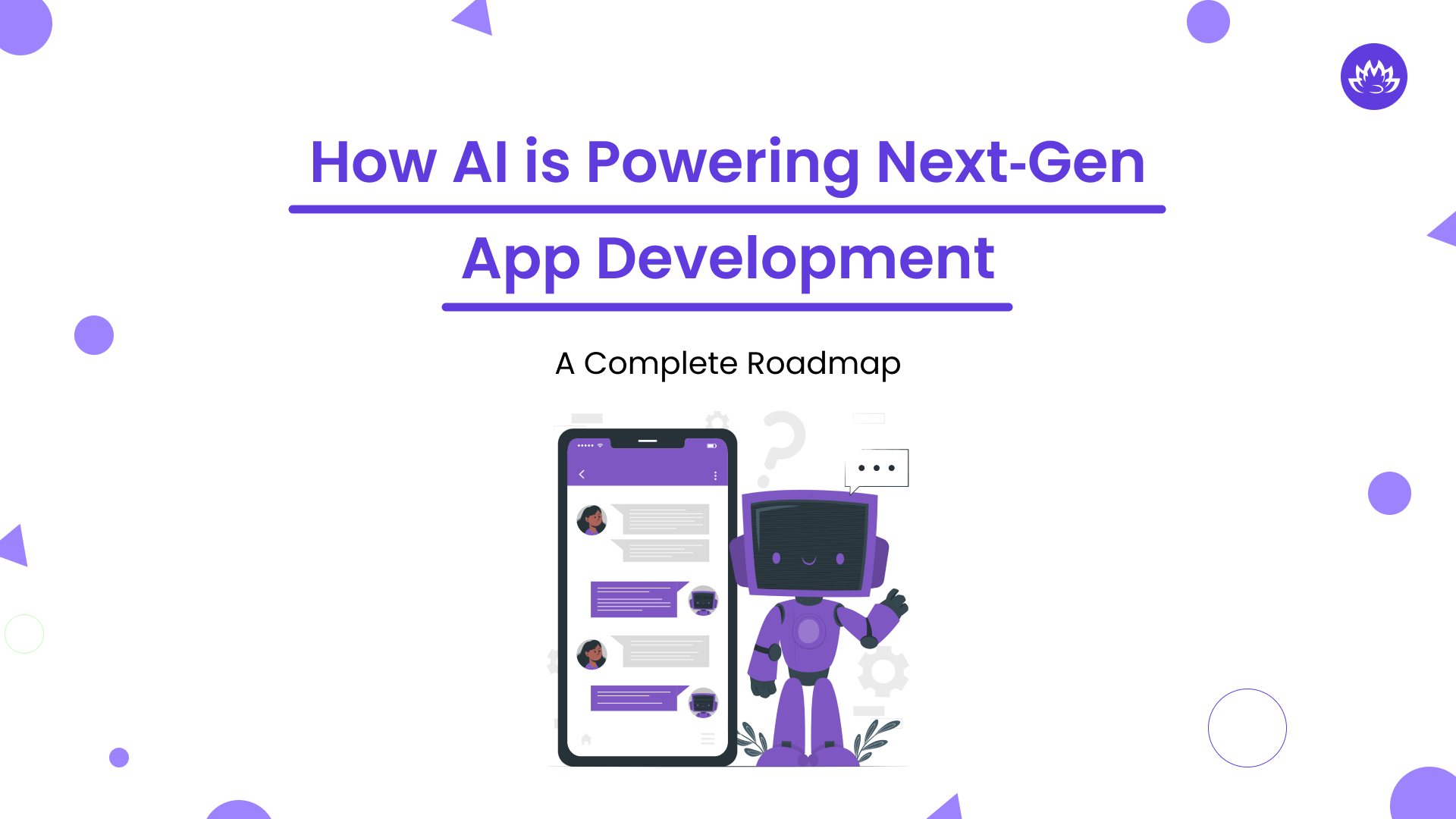
Mobile application development is harnessing AI capabilities for so many use cases. Apps have become smarter and can give enhanced user experiences, task automation, higher efficiency, and real-time processing.
The blog covers different applications, benefits, and challenges of using AI in building next-gen mobile applications for businesses. What you will understand is how AI takes over core challenges of industries and drives innovation to bring viable solutions. So let us dive in.
What is AI in mobile app development?
The technology known as artificial intelligence (AI) enables robots to think, learn, and adapt human intelligence through data-driven learning, decision-making, pattern recognition, and gradual improvement. Artificial Intelligence (AI) encompasses a number of technologies, including automation, computer vision, natural language processing (NLP), and machine learning.
In the context of mobile app development, artificial intelligence (AI) refers to the use of AI-driven technologies to improve mobile applications with intelligent features that make them more intelligent, user-friendly, and responsive. Also, AI-powered apps evaluate data, automate tedious chores, make wise decisions, and anticipate user preferences without human intervention by following pre-programmed instructions.
Examples of AI mobile applications include tailored content recommendations, voice command recognition, intelligent response, text-based conversation processing and comprehension in chatbots, predictive analytics to increase user engagement, and improved search accuracy.
How AI operates in mobile apps:
- With machine learning algorithms, AI will assist apps to learn from user interactions and improve over time.
- Natural language processing empowers chatbots and voice assistants to understand user interactions and give natural responses.
- Through computer vision it helps apps to recognize faces, objects, and gestures.
- Powered with predictive analytics tools, AI will use data to anticipate future needs and behaviors.
- AI-powered automation can handle repetitive tasks to improve efficiency.
Top Applications of AI Mobile App Development
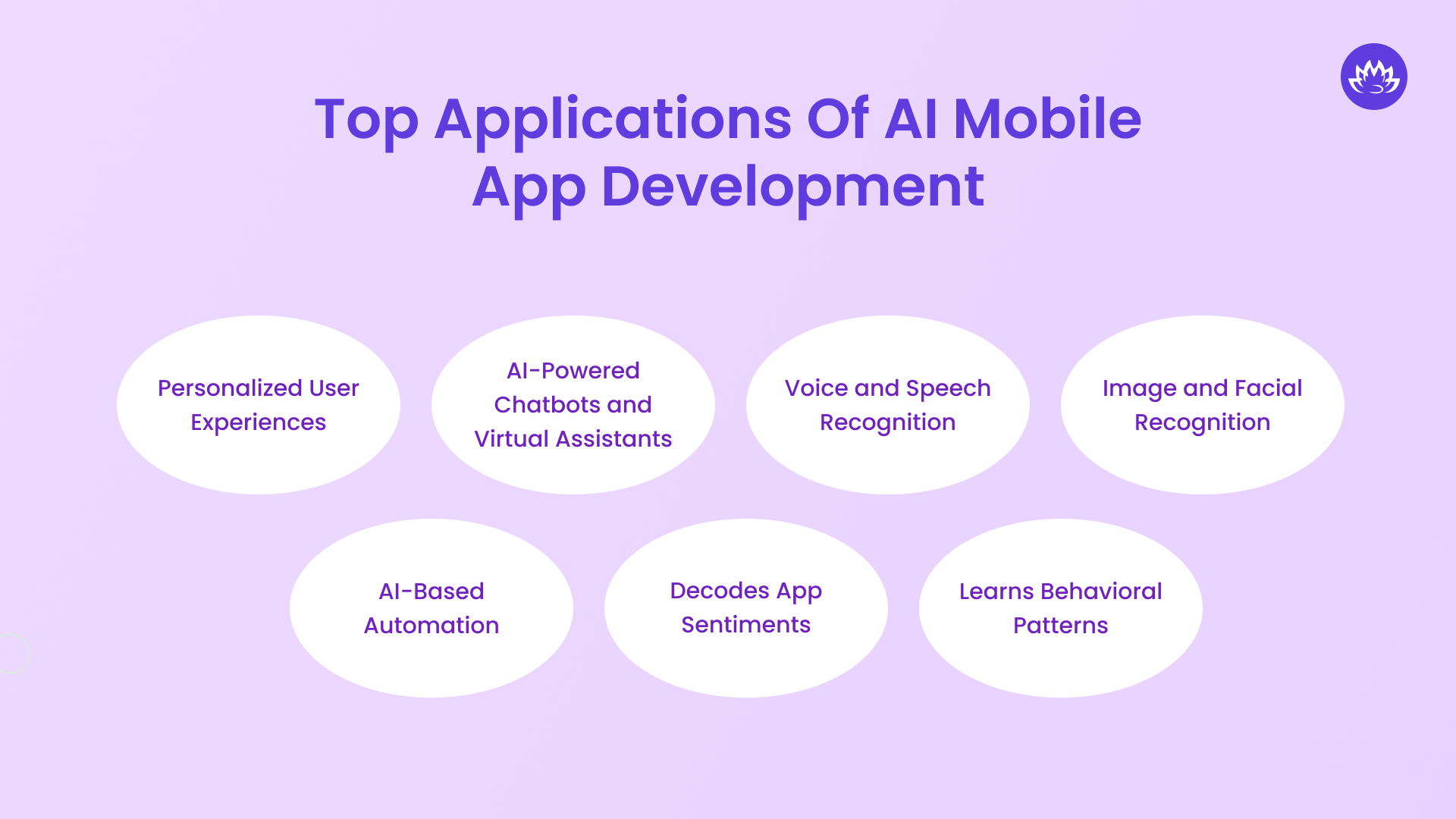
AI has created a remarkable impact in the world of mobile app development. The way it contributes has enhanced user experiences, automated tasks, and improved the decision-making process. In shorter timelines, companies can execute various operations and processes more efficiently. Some of the best use cases that have differentiated AI-powered mobile applications from traditional mobile apps are as follows:
Personalized User Experiences
AI will provide personalized recommendations and content by examining user behavior, preferences, and previous interactions. It increases the relevance and engagement of your AI-powered mobile apps for every user.
- Netflix, YouTube, and Spotify are examples of streaming apps that make content recommendations based on user viewing or listening history.
- To increase sales, e-commerce sites like Amazon, eBay, and Flipkart offer tailored product recommendations.
- Apps for reading and news (like Google News and Apple News) select content according to user interests.
AI-Powered Chatbots and Virtual Assistants
Artificial intelligence (AI)-powered voice assistants and chatbots provide conversational, intelligent, and immediate assistance, negating the need for human participation.
- Chatbots, like ChatGPT, automate customer care by responding to inquiries around the clock.
- For tasks like creating reminders and conducting information searches, voice assistants—such as Siri, Google Assistant, and Alexa—allow hands-free engagement.
- Based on symptoms, healthcare apps employ AI chatbots to offer medical recommendations.
Voice and Speech Recognition
Voice-controlled interactions become more fluid when apps are able to comprehend and process natural language commands thanks to artificial intelligence.
- NLP is used by Apple Siri and Google Assistant to answer user questions.
- Users can turn spoken utterances into written text with the aid of speech-to-text services.
- AI is used by call centers and customer support apps to evaluate sentiment and transcribe conversations.
Image and Facial Recognition
Your mobile apps can recognize faces, objects, and patterns thanks to AI-powered computer vision, which enhances security and adds interactive features.
- For example, Apple Face ID uses facial recognition to offer secure authentication.
- With Google Lens, users can translate language, scan objects, and use photographs to find information.
- AI is used by social media apps like Instagram and Snapchat to recognize faces and create AR filters.
AI-Based Automation
AI improves efficiency and user experience by automating manual and repetitive operations, which increases productivity.
- Emails are automatically sorted into Primary, Social, and Promotions categories by Gmail.
- Google Messages’ Smart Reply feature recommends prompt text responses.
- Google Calendar and other scheduling apps with AI capabilities will automate event planning and reminders.
Decodes App Sentiments
- The Sentiment Analysis function of AI tracks discussions about your app across several channels, including review websites, forums, and social media.
- It determines users’ sentiments—whether good, harmful, or neutral—by analyzing the words they use.
- Monitoring these conversations provides insightful information about user preferences and interactions.
- This analysis aids in discovering patterns, trends, and areas where the app needs to be improved.
Learns Behavioral Patterns
- Platforms frequently employ AI to comprehend user purchasing patterns in order to facilitate more seamless interactions.
- For instance, NLP and machine learning are used by hotel booking site Snaptravel to have natural conversations with customers.
- Humans intervene to instruct the chatbots if they encounter problems.
- By examining credit card information and past purchases, AI also helps identify fraudulent online payments.
- AI marks a purchase as possibly fraudulent if it doesn’t match the user’s expenditure.
Challenges of AI in mobile development
AI can improve mobile apps to a great extent. It powers these apps with intelligence and automation. However, the integration part has many hurdles. If you need a seamless and efficient AI-driven app, you must consider all the challenges that may come. And then execute the integration process.
- Due to the high cost of AI tools, highly qualified personnel, and computer resources, development expenses will be higher.
- When managing sensitive user data and compliance obligations, you must exercise caution regarding data privacy and security threats.
- The restricted processing power of the mobile device will result in problems with battery life and performance.
- AI accuracy and decision-making will be impacted by data reliance and quality concerns.
- Complicated AI integration calls for specific knowledge, equipment, and a long development period.
- Because artificial intelligence is regarded as obtrusive and lacks transparency, there will be issues with user trust and adoption.
Benefits of Using AI in Mobile App Development
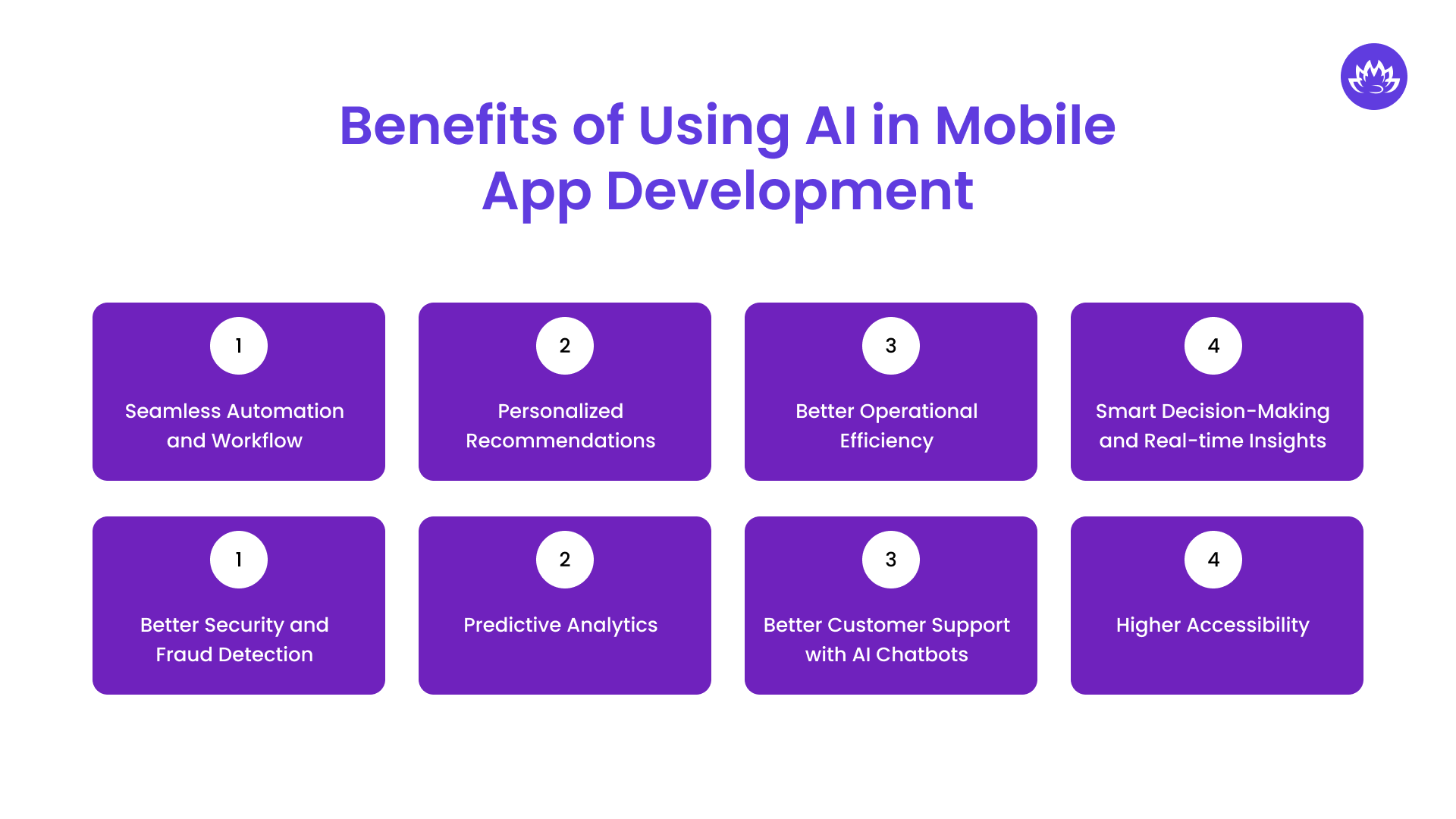
Seamless Automation and Workflow
Automation powered by AI minimizes human labor by streamlining repetitive processes like scheduling, data entry, content moderation, and customer service. AI-driven chatbots, intelligent assistants, and automated responses are examples of features that improve user ease.
Personalized Recommendations
AI enables mobile apps to dynamically adjust to the choices, actions, and interactions of each unique user. AI uses real-time data processing and predictive analytics to produce personalized content, product suggestions, and user-specific alerts.
Better Operational Efficiency
AI handles performance monitoring, predictive maintenance, and resource allocation, which greatly improves app performance and business efficiency. It guarantees seamless operation, streamlines backend procedures, and reduces downtime.
Smart Decision-Making and Real-time Insights
AI analyzes vast volumes of data in real time to find trends, identify patterns, and offer useful insights. Additionally, AI in mobile apps improves pricing and client engagement tactics, assisting in decision-making.
Better Security and Fraud Detection
App security is increased via AI-powered authentication techniques like behavior analysis, biometric verification, and facial recognition. In order to stop payment fraud, illegal logins, and cyber threats, it also instantly identifies fraudulent activity.
Predictive Analytics
AI uses browsing patterns, search histories, and in-app interactions to forecast user demands. Additionally, it enables you to enhance client satisfaction, optimize marketing tactics, and offer tailored advice.
Better Customer Support with AI Chatbots
Chatbots and virtual assistants powered by AI provide self-service solutions, enhance customer assistance, and rapidly respond to user inquiries. These round-the-clock chatbots guarantee that users receive support without having to wait for human operators.
Higher Accessibility
NLP, text-to-speech capabilities, and AI-powered voice recognition make mobile apps more accessible to people with disabilities. They support real-time translations, voice-controlled navigation, and speech-to-text typing.
AI Trends Emerging in 2025
AI Companions
Lightweight agents that offer longitudinal insights, comprehend context outside of a single screen, and learn over sessions. Consider apps for job coaching or mental health support that combine emotional intelligence with memory aids.
AI-Native Mobile App Development
Coding, debugging, and UI/UX optimization will all be automated by AI, which will improve apps and become a crucial component of the app development process.
Multimodal Fusion
Integrating geographical, audio, visual, and behavioral data to build interfaces that holistically comprehend user intent.
Regulatory Compliance & Ethical AI
Mobile apps will have to comply with more stringent restrictions as AI use increases in order to ensure that AI is implemented in a way that is impartial, open, and moral.
Human-Computer Interaction Powered By AI
AI will change the way people use mobile apps, replacing touchscreens with voice interfaces, gesture recognition, and brain-computer interface.
Conclusion
Whitelotus Corporation has delivered brilliant AI-powered mobile applications for many industries, including healthcare, finance, and ecommerce. Our portfolio shows quantifiable gains in retention, lifetime value, and conversion rates, ranging from customer-centric platforms that dynamically personalize UX to apps that eliminate fraud through real-time scoring.