AI

How AI and IoT Are Converging to Drive Smarter Business Decisions

How AI and IoT Are Converging to Drive Smarter Business Decisions

Artificial Intelligence and IoT — together have electrified the world with the latest advancements. Often called AIoT (Artificial Intelligence of Things), it has pushed the limits of productivity, automation, and intelligence, taking the business game to the next unbelievable level. Imagine factories that anticipate and avoid malfunctions before they occur, towns that optimize their own traffic flow, and smart homes that anticipate your needs before you even recognize them. It is actually happening right now, thus this is not science fiction. 

Smart technologies thrive with the power of AI, making machines do wonderful things like predict with precision and make decisions on behalf of humans. This speeds up business operations and accelerates the generation of higher productivity and profitability. AI and machine learning are driving forces, and IoT is the nervous system of the digital world. When smart thermostats adjust temperatures, wearable track health metrics, and industrial networks can seamlessly produce, it is the power of convergence of AI and IoT.

Devices in an ecosystem that combines AI and IoT do more than just connect. They act, perceive, and learn. We’ll explain what IoT and AI integration means below, along with the concrete advantages it offers, such as quicker decision-making, increased efficiency, and edge innovation. The blog will also shed light on how this convergence can improve the entire process of IoT app development. So let’s dive into it.

Convergence of AI and IoT To Drive Business Value

The Internet of Things is very good at gathering a lot of data in real time. That unprocessed input is transformed into judgments, forecasts, and actions by artificial intelligence. Reactive tools give way to proactive agents that can optimize both themselves and the systems around them in the AIoT era.

When AI and IoT are converged, they create three layers of value:

  • Brings in more operational intelligence in real time. Helps forecast needs instead of just responding.
  • Devices act autonomously, such as rerouting delivery fleets or automatically adjusting to the factory machinery.
  • Continuous improvement of machine learning models ensures scalability, accuracy, and brings in better results.

What is IoT

An ecosystem made up of billions of devices is known as the Internet of Things (IoT), including wearables on wrists, cameras in cities, tags on packages, and sensors in factories. All of them silently gather information and transfer it into the digital bloodstream.
IoT by itself is about connecting the digital and physical worlds. The magic, though, occurs when that data is transformed into choices. AI enters the picture at that point, and the network starts to think instead of just talking.

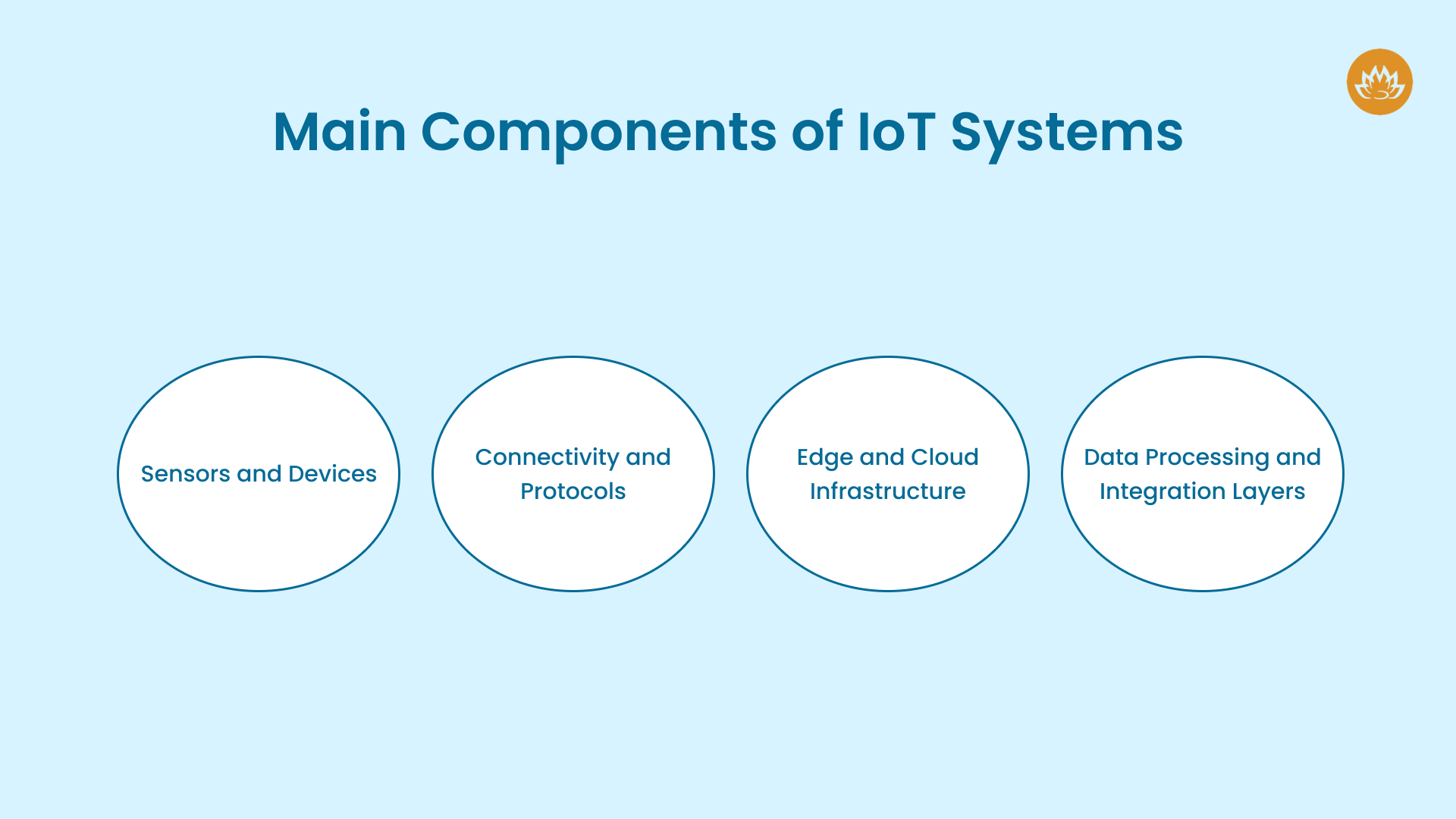
Main Components of IoT Systems:

Main Components of IoT Systems

Sensors and Devices

They are the main organs of the network, such as eyes, ears, and skin. Any change in temperature, pressure, movement, moisture, or other relevant factors is detected and converted into digital signals.

Connectivity and Protocols

The devices associated with IoT systems can speak languages rapidly with reliable connectivity. With this, there will be improved conversation leading to speed and efficiency of tasks.

Edge and Cloud Infrastructure

At the edge, close to the device, some decisions must be made in milliseconds. Others need the cloud’s broad view, which allows data from all over the network to be processed, stored, and compared.

Data Processing and Integration Layers

These are the crucial components that will clean, filter, and give relevance to the incoming noises. They feed data analysis and dashboards, control automation scripts, and pass insights to AI models.

What is AI

Fundamentally, artificial intelligence (AI) is the ability of machines to perform tasks that we previously believed were exclusive to humans—identifying patterns in the midst of chaos. Speculating about the future and recognizing context and language. AI in mobile app development has already created a revolution in the world of technology.
That skill set is revolutionary in IoT as well. Teams become overwhelmed by massive streams of sensor data, such as movement logs, vibration levels, and temperature readings. AI is now able to sort through everything and identify the signal among the noise.

IoT functions as a perceptive observer without AI, making notes and reporting back. When AI is included, it transforms into a strategist that can act, learn, and adjust instantly. That’s the change from gathering data to competing with it.

Machine Learning and Deep Learning in AI

ML will study past data, examine real-time inputs, and identify the challenges. For example, it can accurately predict the time of factory machine breakdowns well in advance.
Deep Learning is a strong partner to ML. It will leverage stacked neural networks and will chew through massive datasets. It excels in various tasks such as speech decoding, reading images, and finding defects within the complexities. Deep Learning in IoT monitors several camera feeds at the same time and can spot the intruder.

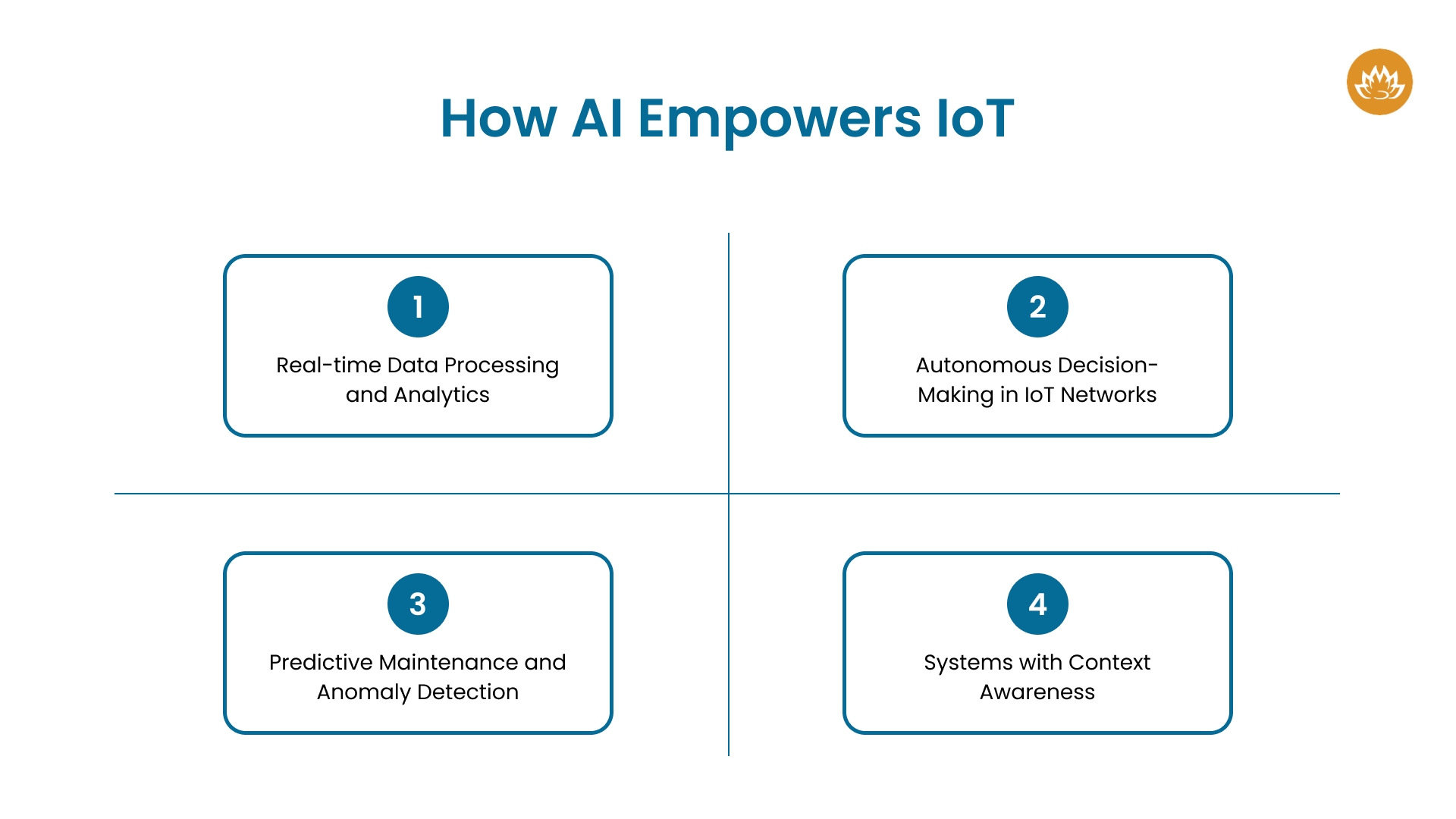
How AI Empowers IoT

How AI Empowers IoT

IoT informs you of events. When AI is included, it explains why and provides precise next steps. This is where IoT AI changes the game. Static information turns into living intelligence. Devices begin making calls instead of waiting for orders.

Real-time Data Processing and Analytics

Milliseconds count. IoT data is processed locally by AI models operating at the network edge. This may be a factory rejecting a faulty part as soon as it is manufactured, an autonomous car choosing to brake before a collision, or a hospital monitor warning staff of a patient’s abrupt decline. A round-trip to the cloud is not possible. Don’t wait.

Autonomous Decision-Making in IoT Networks

With the convergence of AI with IoT, all devices act independently without any human intervention. They will act locally, and this happens based on the learned patterns.

Predictive Maintenance and Anomaly Detection

Every machine mutters before breaking down. AI detects these subtle variations in vibration, temperature, or performance and stops them before they become malfunctions.

Systems with Context Awareness

AI gives Internet of Things devices situational awareness. There is more to a smart HVAC system than just a thermostat. To choose when and where to cool, it takes into account occupancy, the outside weather, and even future forecasts.

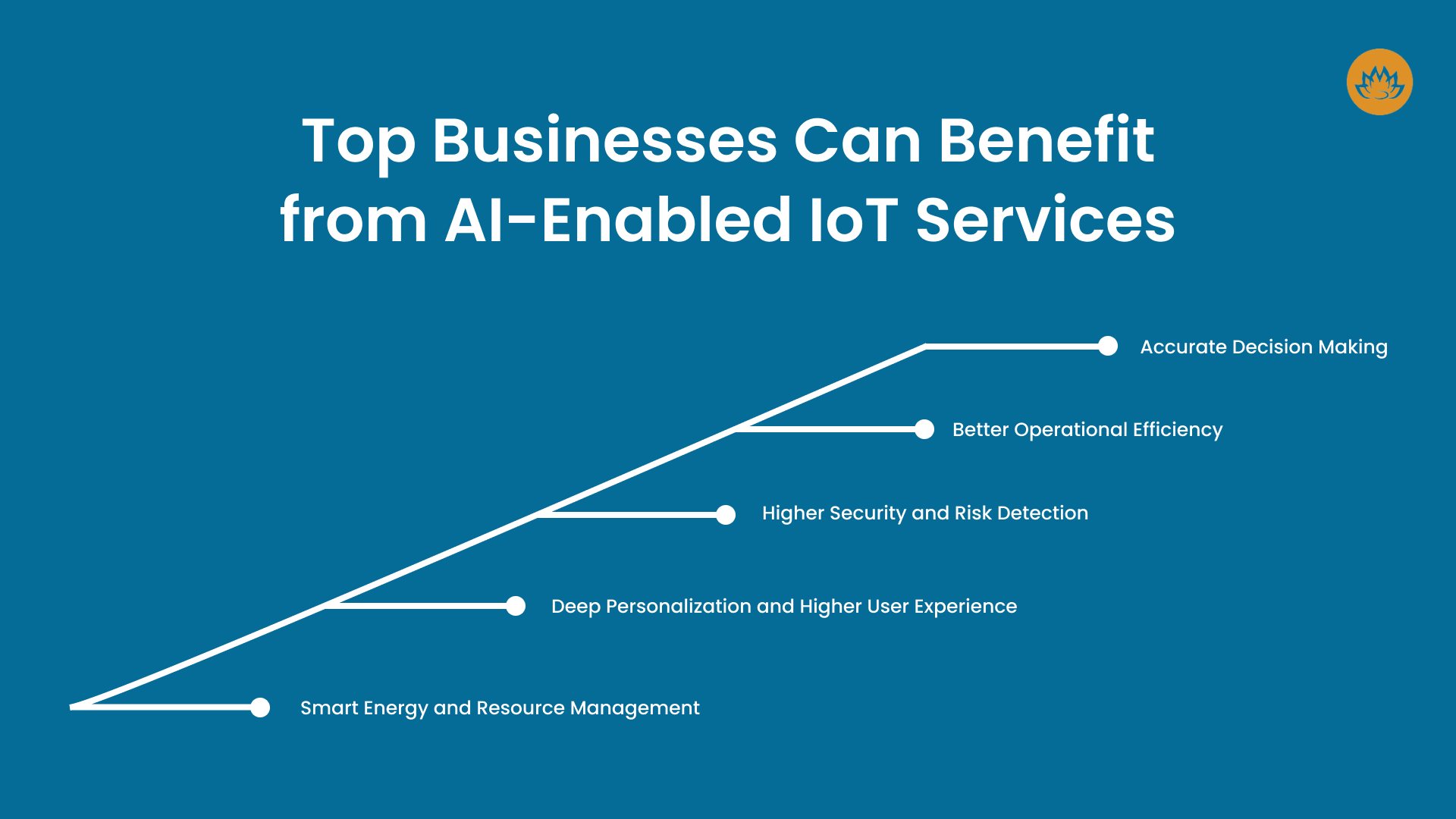
Top Businesses Can Benefit from AI-Enabled IoT Services
Top Businesses Can Benefit from AI-Enabled IoT Services
The convergence of AI and IoT is helping businesses to anticipate rather than react. The dashboards are now not filled with previous data. They give valuable insights to make informed decisions, improving revenues, and achieving sustainable goals. Moreover, the entire system earns customers’ trust ten times more than previous setups.

Accurate Decision Making

Speed is money in fields where seconds count. Before an issue worsens, AI transforms IoT data into rapid signals that can be used to reroute a delivery fleet, modify power generation, or start a manufacturing modification.
According to studies, predictive analytics can increase worker productivity while halving downtime. Executives cannot afford to lose this kind of adaptability in industries where hesitancy costs millions.

Better Operational Efficiency

Productivity is hampered by repetition. AI removes it. Energy systems automatically balance supplies, logistics networks reroute delivery routes in the middle of a trip, and connected machines adjust themselves.
AI-driven optimization reduced downtime and unlocked double-digit resource savings in manufacturing trials. Every procedure is designed to be efficient.

Higher Security and Risk Detection

Attackers simply need to leave one door open out of billions of devices. AI scans device activity, traffic flows, and user patterns in the data like an unflinching security analyst. It detects minute irregularities before they become breaches.
For sectors such as energy, transportation, or critical infrastructure, survival is more important than simply checking boxes.

Deep Personalization and Higher User Experience

It’s no longer one-size-fits-all. As customers pass by, smart retail shelves alter their promotions. Before customers even swipe their cards, hotel rooms adjust the climate and lighting. To eliminate noise and concentrate solely on real danger indicators, medical monitors adjust to each patient’s individual baseline.
Stickiness and loyalty are increased by each customized touchpoint, and in many situations, premium revenue streams are created.

Smart Energy and Resource Management

Profitability and sustainability are no longer mutually exclusive objectives. AI-powered IoT turns them into a single line item. Smart grids redirect power based on load predictions. AI-powered HVAC systems anticipate weather and occupancy to save energy. Farms install soil sensors to reduce water waste and preserve produce.

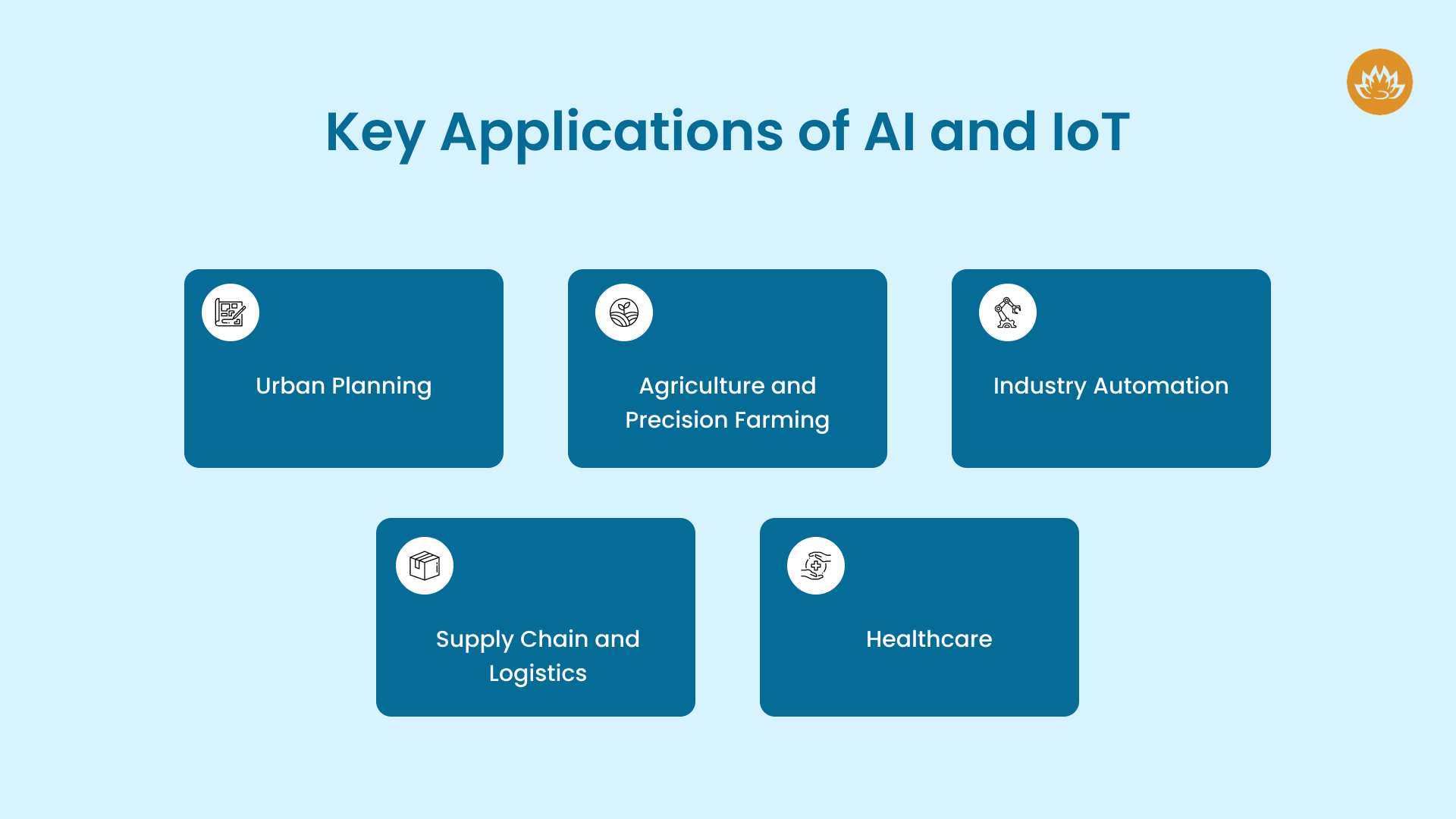
Key Applications of AI and IoT

Key Applications of AI and IoT
Artificial Intelligence in IoT has solved real-world problems with great efficiency. Cities, supply chains, healthcare, and many industries are appreciating this convergence and using it widely in their operations.

Urban Planning

AIoT is rewiring urban life. Real-time traffic tracking is done using sensor networks, which reroute flows to reduce congestion. By only turning on when a pedestrian approaches, streetlights reduce energy consumption without compromising safety.

Agriculture and Precision Farming

There is no shovel with the new farmhand. It has drones and sensors. AI analyzes drone photos, soil data, and moisture content to forecast yields, suggest irrigation, and identify pests before they spread.
Farmers save expenses and their influence on the environment by focusing only on what is necessary, such as insecticides, fertilizer, and water. Higher yields and healthier fields are indicators of the reward.

Industry Automation

Factories are now evolving into core business hubs that have sensors lining every machine, fed by AI models to adjust workflows on the go. They can find out defects instantly and can schedule maintenance sessions before any parts break down. AIoT is now insurance against falling behind, not an upgrade, for manufacturers.

Supply Chain and Logistics

Each cargo serves as a source of data. AI systems that compute arrival times, identify delays, and redirect freight on the fly get updates from GPS trackers and condition sensors.
A port that’s blocked? Bad weather? Surge in demand? AI adjusts inventories in front of bare shelves by anticipating disturbances. Higher dependability and reduced expenses are the results. Large supply chain companies hire a mobile app development company that can help them integrate AI into their IoT services.

Healthcare

Home-based medicine is replacing hospital-based medicine. Continuous vitals tracking is done via wearables, and AI models keep an eye out for subtle warning signals like a missed heartbeat or a drop in oxygen saturation to notify clinicians before an emergency arises.
To reduce false alarms and filter noise, sophisticated systems even adjust thresholds based on patient history. Better results, earlier treatments, and less stress on already overburdened healthcare teams are the outcomes.

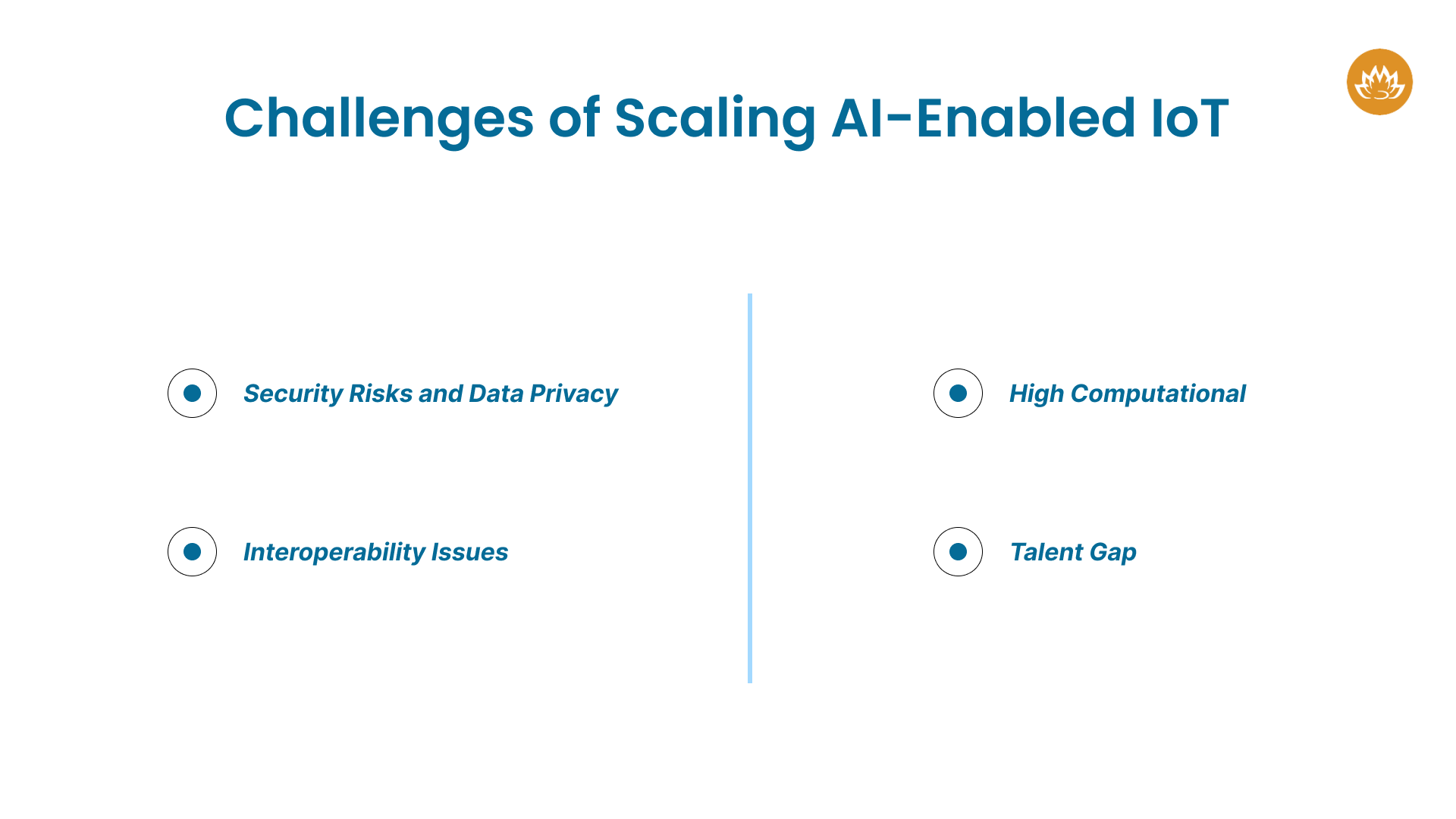
Challenges of Scaling AI-Enabled IoT

Challenges of Scaling AI-Enabled IoT
Even though AIoT is highly promising, there are some reality checks. It’s like changing an engine in midair when scaling AI-based IoT from a sleek pilot project to an enterprise network. There are risks involved, and the stakes are tremendous.

Security Risks and Data Privacy

Every new gadget opens a new entrance. Given that there are tens of billions of IoT devices globally. That number is still rising (the data we mentioned in the introduction), and there are tens of billions of potential points of entry for hackers.
AI can identify unusual traffic patterns, stop rogue connections, and sound the alert. But the same size that makes AIoT strong also makes it a greater target if it is not protected by robust encryption, strict identification controls, and adherence to GDPR, HIPAA, or industry-specific requirements.

Interoperability Issues

IoT at scale can be compared to a multilingual conference call in which half of the participants are unable to locate the mute button. Devices from several suppliers frequently refuse to work together since they each have separate protocols and features.
According to IoT Analytics, approximately half of IoT projects require integrators or specially designed solutions to fill the gaps. You are left with silos, delays, and escalating integration costs in the absence of a single architecture.

High Computational

AI is not a quick learner. The power demand increases when deep learning models’ processing cycles are executed at the edge. Efficiency is a design need, not an afterthought, for businesses striving to meet sustainability goals since every kilowatt-hour counts.

Talent Gap

IoT and AI are not a single talent. Data operations, cloud architecture, cybersecurity, machine learning, and embedded engineering are all combined into one.
Many businesses struggle to find qualified personnel in these crucial technical fields. Even the greatest technological stack stands unused without the proper team. There is a real talent war, and it is already intense in AIoT.

The Future of AI and IoT

The Future of AI and IoT
The future of AI and IoT is highly promising. Progress is clearly visible in various industries. Especially in specific sectors such as manufacturing, healthcare, and logistics, we find amazing benefits from AIoT.

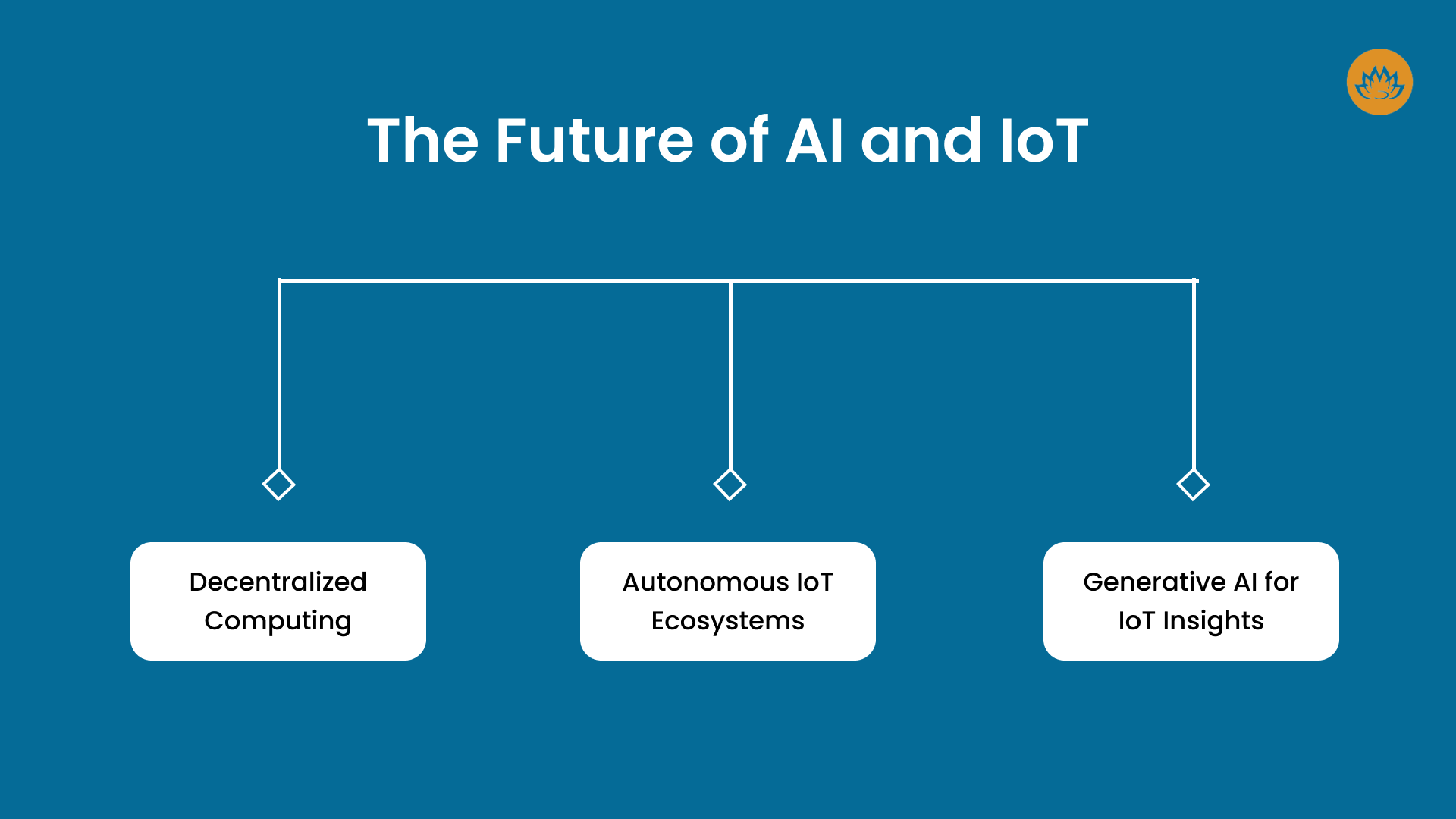
Decentralized Computing

Although distance costs time, the cloud is powerful. By processing data where it originates—inside the machine, on the manufacturing floor, or in a hospital ward—Edge AI bridges that gap. There is a decrease in latency. Privacy becomes more stringent. Bills for bandwidth get smaller.

Autonomous IoT Ecosystems

The next generation of AIoT will organize devices rather than merely link them. Consider a production line that immediately adjusts to prioritize goods that are still on schedule after detecting a delayed shipment of a single component.
No time lost, no manager permission. Networks can instantly reroute traffic, balance workloads, and self-heal after a malfunction. It combines operational agility, energy efficiency, and supply chain resilience to operate continuously without oversight or exhaustion.

Generative AI for IoT Insights

Generative AI illustrates what might occur next, whereas traditional analytics explain what is already happening. It can generate scenarios, simulate outcomes, and even create the briefing a CEO will read before their morning coffee if you feed it terabytes of IoT data.

Why Choose Whitelotus Corporation for AI and IoT Development?

When your business needs the power of both AI and IoT with practical strategies, you cannot gamble on a partner who keeps guessing. You need a trustworthy solution provider who can understand your core systems, challenges, and the brain of AI. You need to collaborate with a software development company that can understand how to tie all this together. When you hire dedicated developers from Whitelotus Corporation, you get it all. We provide you with,
  • Full spectrum of IoT development, including IoT app development, prototypes, embedded systems, cloud platforms, middleware, dashboards, etc. 
  • You get strong embedded and architecture expertise to build complex IoT systems. 
  • AI-powered software engineering from our own AI engineers who can build intelligent systems using AI/ML, Azure, .NET, etc, for AI services
  • Better integration and continuous delivery with a powerful DevOps team.

Conclusion

The question for company executives is not whether to relocate. It’s the rate at which you can grow without falling. The people who transform pilot projects into corporate engines before the competition catches up will emerge victorious in both boardrooms and control rooms. The power of AI combined with IoT can increase the capabilities in so many ways. If your business needs a thrust and a quick revamp, we are here to help you reinvent the entire system with the power of AI and IoT. Contact us to know more about our services.

Author

  • Sunil Chavda

    Sunil is a result-orientated Chief Technology Officer with over a decade of deep technical experience delivering solutions to startups, entrepreneurs, and enterprises across the globe. Have led large-scale projects in mobile and web applications using technologies such as React Native, Flutter, Laravel, MEAN and MERN stack development.

    View all posts

Don't skip sharing this post!

Inquiry now

    MAKING IT EXTRAORDINARY