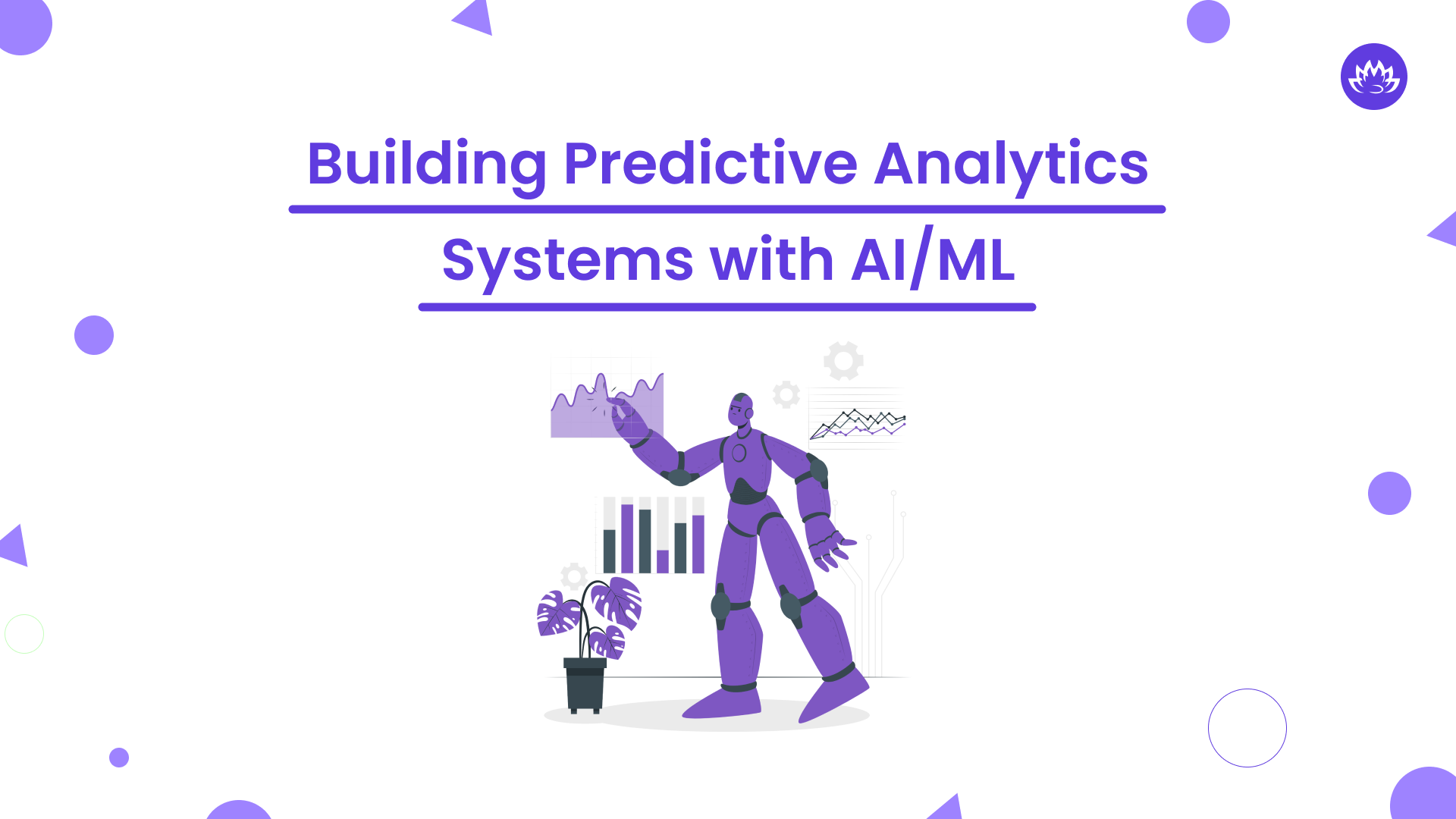
We are living in a heavily digital-driven world. People can instantly connect with companies, and companies can know a lot about their customers’ preferences. Companies use the collected information to make predictions about future data trends. But what matters is the quality of data they generate and the kind of insights from these huge data sets. Predictive analysis is the cornerstone of all businesses, but not without artificial intelligence and machine learning.
Incorporating AI and ML into predictive analysis requires a deeper understanding of how computer algorithms work. Businesses now use data to forecast trends, improve strategy, and make data-driven decisions in a completely different way with predictive analytics tools and frameworks. Also, for AI in mobile app development, these systems analyze historical data and offer useful insights by utilizing machine learning, statistical modeling, or artificial intelligence.
The article is a short guide that defines predictive analytics backed by various AI/ML tools and frameworks. They give so many benefits to get high-quality and effective data that can boost business sales and conversion ratios.
Predictive Analytics Tools and Frameworks - What are they?
Software programs known as predictive analytics tools and frameworks employ statistical algorithms, machine learning, and artificial intelligence to forecast future events based on historical data. Organizations may assess risks, identify trends, and make more precise data-driven decisions with the help of these technologies.
Large volumes of both structured and unstructured data are analyzed by predictive analytics tools, which then transform the raw data into insights that can be applied. To provide forecasts in real time, they interface with databases, cloud services, and business intelligence platforms. Automation features in many contemporary products allow companies to eliminate human interaction in data analysis and streamline operations.
However, frameworks offer a more organized setting for creating predictive models. The majority of predictive analytics frameworks and solutions are often proprietary or open-source libraries aimed at data scientists and analysts. To make the development, training, and enhancement of predictive models more efficient, they provide pre-made AI algorithms, adaptable modeling techniques, and deployment strategies.
Features of Predictive Analytics Tools
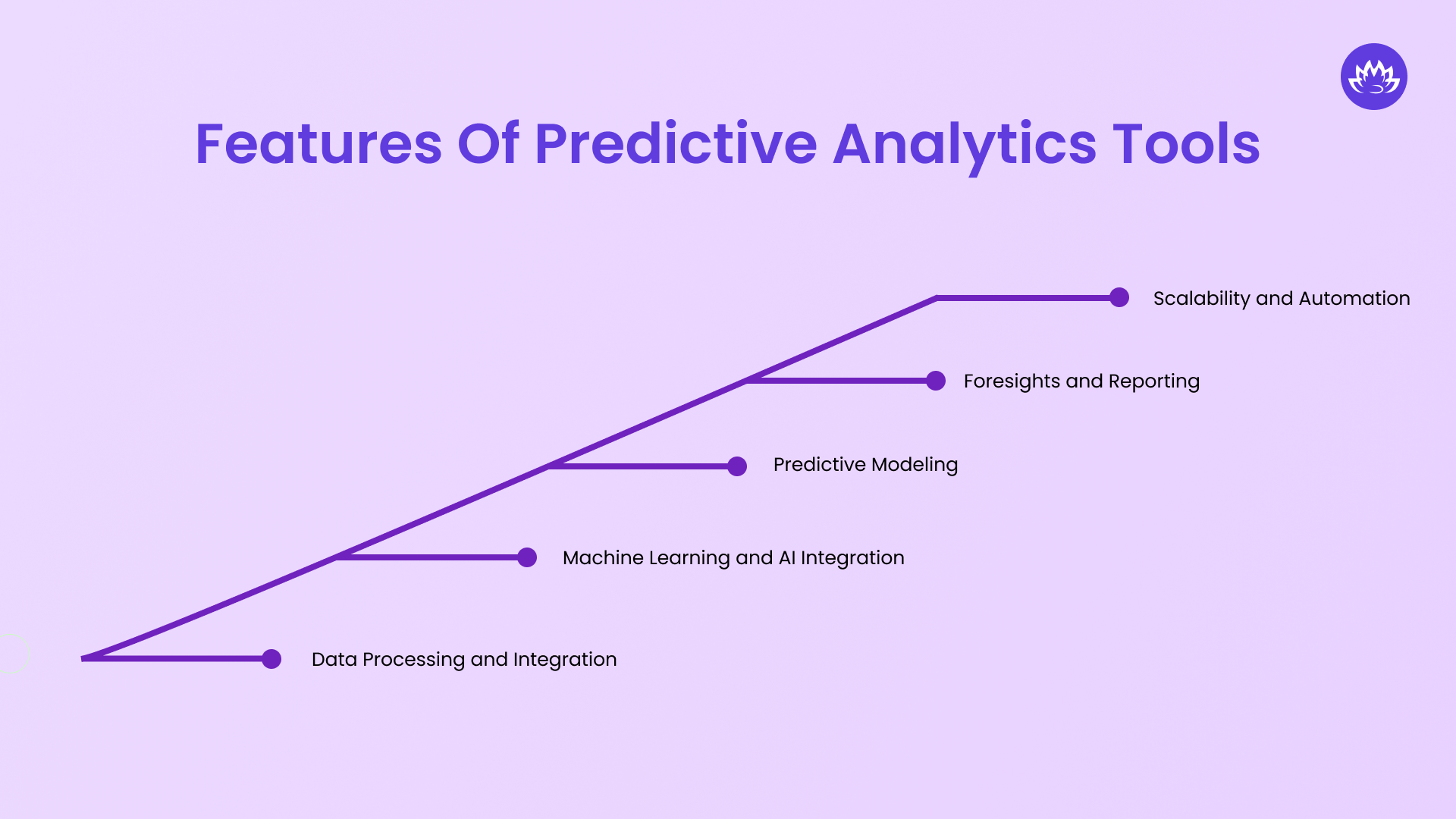
There are several features of predictive analytics tools that can optimize data analytics and forecasting for better decision-making.
Data Processing and Integration
- Clean, organized data from several sources is essential for effective predictive analytics.
- Real-time data intake, preprocessing, and interaction with databases, cloud storage, and third-party apps are all supported by these solutions.
- Businesses may produce insights from a variety of datasets, including as transactional, social media, and Internet of Things data, by integrating data seamlessly.
- It improves model accuracy and efficiency.
Machine Learning and AI Integration
- AI/ML is used by predictive analytics systems to automate data processing, spot trends, and produce precise projections.
- Over time, the quality of predictions is improved by sophisticated machine learning algorithms that continuously learn from fresh data.
- In sectors including e-commerce, healthcare, and finance, this capability is essential for demand forecasting, fraud detection, and personalized suggestions.
Predictive Modeling
- To foresee future trends, these technologies employ statistical methods including regression analysis, time-series forecasting, and deep learning.
- Predictive modeling technologies assist companies in evaluating financial risks, streamlining supply chains, and enhancing client retention by examining past data.
- High-accuracy predictions allow organizations to test several models, improve factors, and make better decisions.
Foresights and Reporting
The financial model of serverless AI needs typical parameters:
- Without much technical knowledge, customers can grasp forecast insights due to interactive dashboards, real-time graphics, and automated reporting options.
- Key trends, outliers, and correlations are highlighted via data visualization tools, which facilitate stakeholders’ action on results.
- These competencies are used for strategic planning in sectors like marketing, healthcare, and finance.
Scalability and Automation
- Large datasets may be handled by predictive analytics engines, which are also made to automate tedious processes like data cleaning, model training, and result interpretation.
- Machine learning consulting organizations use cloud-based solutions to supply scalable computing power, guaranteeing quick processing of intricate models.
- Automated workflows simplify processes, lowering human labor and freeing up teams to concentrate on strategic decision-making.
Top Benefits of Using Predictive Analytics Tools and Frameworks
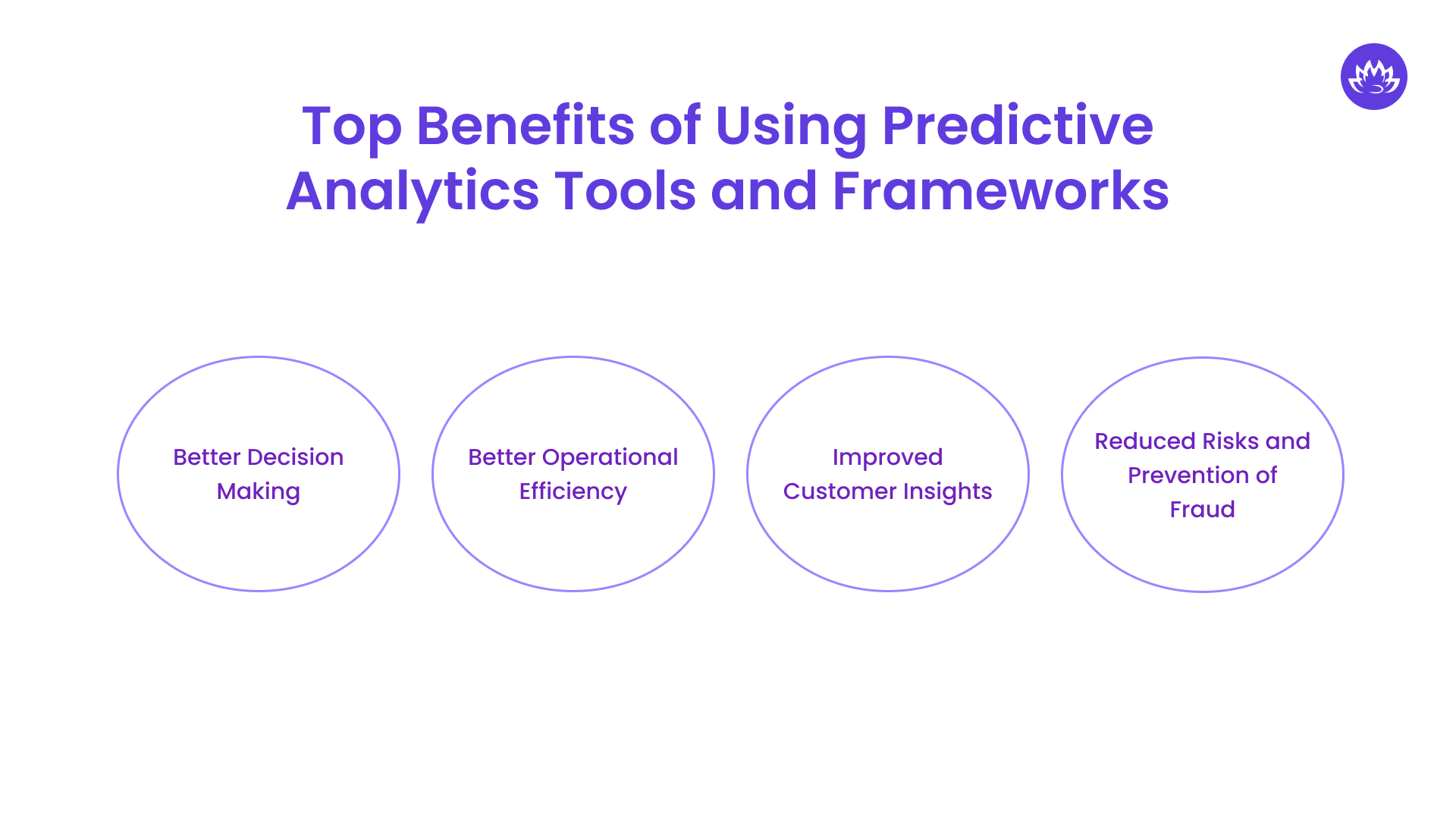
Better Decision Making
- Reduces uncertainties, gives data-powered forecasts, and finds emerging trends.
- Companies can predict market shifts, customer choices, and operational risk factors
- Gives real-time insights to make informed decisions, optimized processes
- Provides better resource allocation for higher efficiency and better ability to compete.
Better Operational Efficiency
- Data analysis automation and forecasting through predictive analytics tools will minimize manual effort and improve workflow efficiency
- Companies can get streamlined supply chains and improved management of inventory
- It reduces operational costs and improves productivity for industries like logistics, manufacturing, and telecommunications.
Improved Customer Insights
- Companies can analyse customer behavior and their preferences and choices.
- Creates personalized experiences and develops market strategies in tune with market trends
- A well-established mobile app development company backed with AI capabilities can help you build powerful predictive analytics with AI tools to assist in customer segmentation and understand sentiment analytics.
- Industries like retail, finance, and e-commerce have already started using such insights
Reduced Risks and Prevention of Fraud
- Companies can analyse customer behavior and their preferences and choices.
- Creates personalized experiences and develops market strategies in tune with market trends
- A well-established mobile app development company backed with AI capabilities can help you build powerful predictive analytics with AI tools to assist in customer segmentation and understand sentiment analytics.
- Industries like retail, finance, and e-commerce have already started using such insights
10 Best Predictive Analytics Tools and Frameworks
Businesses and researchers can use data to generate insights, automate forecasting, and optimize decision-making by utilizing predictive analytics tools and frameworks. The frameworks offer flexibility for creating unique models, while the predictive analytics tools are feature-rich and need little scripting.
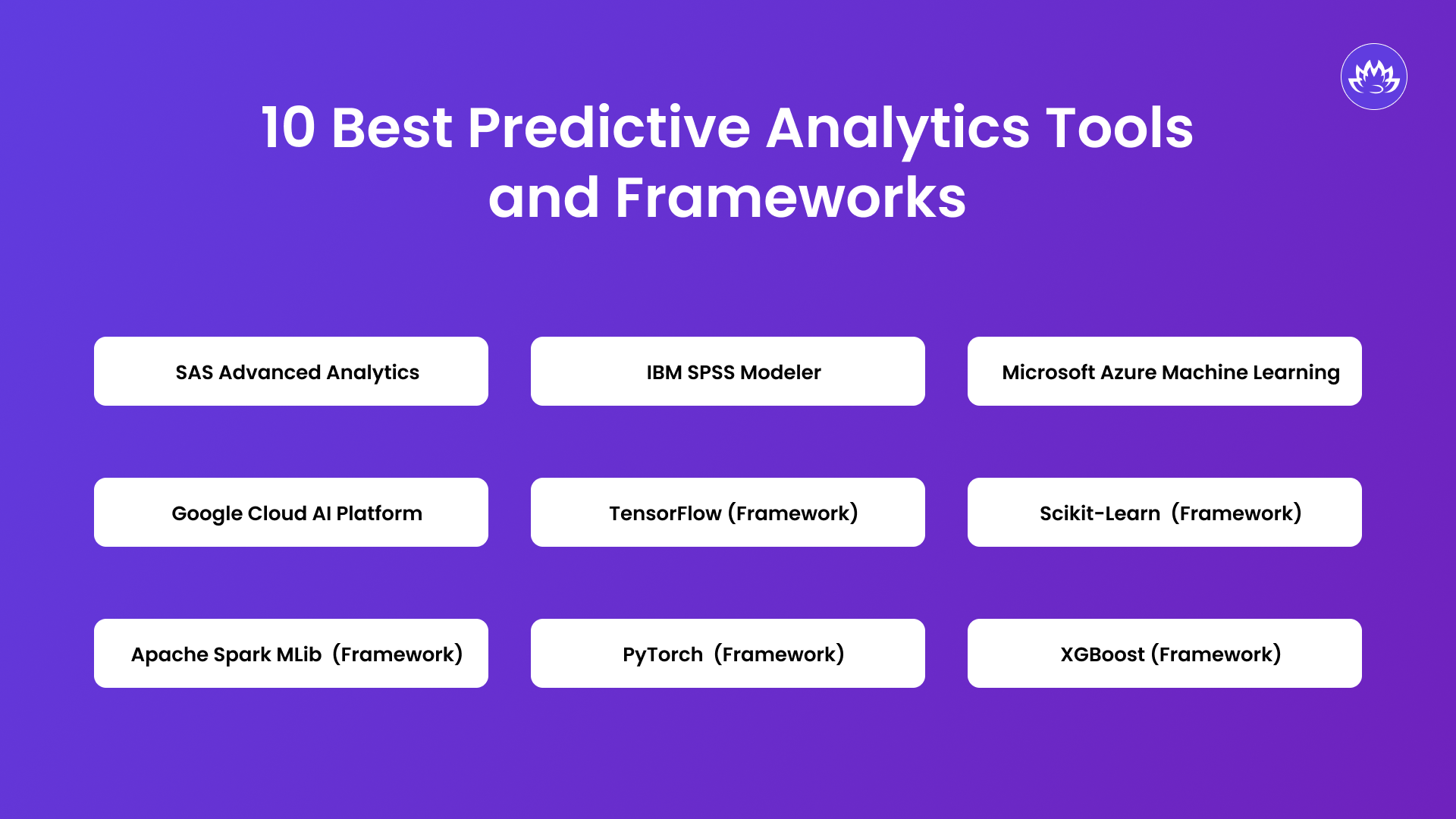
SAS Advanced Analytics
An enterprise-level solution with strong statistical modeling and machine learning capabilities is SAS Advanced Analytics. Scalability, high-performance data processing, and industry-specific applications are some of its advantages. Depending on demand, machine learning development firms frequently incorporate SAS into solutions for large businesses and data experts, especially in the government, banking, and healthcare industries.
IBM SPSS Modeler
With its robust statistical modeling features and user-friendly drag-and-drop interface, IBM SPSS Modeler is a potent predictive analytics tool. It is intended for data scientists and business analysts, supporting neural networks, decision trees, and machine learning. Its sophisticated automation, which eliminates the need for coding, is its strongest point.
Microsoft Azure Machine Learning
One cloud-based predictive analytics tool that works with Microsoft’s ecosystem is Azure Machine Learning. It offers drag-and-drop capabilities, automated machine learning, and compatibility with open-source frameworks such as Scikit-learn and TensorFlow. Its scalability and deployment simplicity make it one of the greatest predictive analytics tools available. Azure ML is used by companies, developers, and data scientists for financial forecasting, predictive maintenance, and customer churn analysis.
Google Cloud AI Platform
Google Cloud AI Platform provides a collection of machine learning tools for AI deployment and predictive modeling. It is an excellent option for data scientists and developers because of its smooth integration with TensorFlow, AutoML, and BigQuery. It covers sectors like healthcare, retail, and finance and is well-known for its potent cloud computing capabilities.
H2O.ai
An open-source platform with AI capabilities that is excellent at automating machine learning is called H2O.ai. Its AutoML features, which let companies create predictive models with little manual labor, are its strongest point. H2O.ai is used in banking, telecommunications, and insurance for credit scoring, fraud detection, and customer retention tactics. It was created for businesses and data scientists.
TensorFlow (Framework)
Google created the open-source machine learning framework TensorFlow. It supports many AI applications and is well known for its deep learning capabilities. TensorFlow is used by developers, researchers, and businesses to power applications including financial forecasting, healthcare diagnostics, and speech recognition. It is a popular option for companies creating custom AI prediction tools and models due to its scalability and versatility.
Scikit-Learn (Framework)
Regression, classification, clustering, and dimensionality reduction can all be implemented well with Scikit-learn, a Python-based machine learning framework. It is extensively utilized for predictive analytics in marketing, healthcare, and finance in both academia and industry. The simplicity of Scikit-learn is its greatest asset. For data scientists and analysts working on risk analysis, fraud detection, and consumer segmentation, this makes it perfect.
Apache Spark MLib (Framework)
A machine learning library explicitly made for handling large amounts of data is called Apache Spark MLlib. It is perfect for large-scale predictive analytics since it supports distributed computing. Its speed and scalability make it a popular option for sectors including cybersecurity, telecommunications, and finance. Organizations use Spark MLlib for real-time predictive maintenance, anomaly detection, and fraud detection.
PyTorch (Framework)
Facebook created the open-source deep learning framework PyTorch. In sectors including healthcare, robotics, and finance, it is extensively utilized for predictive analytics. PyTorch is perfect for image identification, anomaly detection, and predictive diagnostics because of its dynamic computing graph and robust neural network capabilities. Many companies use machine learning development services to take advantage of PyTorch’s versatility, which makes it possible for academics and developers to quickly create sophisticated AI models.
XGBoost (Framework)
High-performance machine learning library XGBoost is renowned for its predictive modeling speed and accuracy. It is extensively utilized in fintech, insurance, and e-commerce for fraud detection, credit scoring, and consumer behavior research. It is particularly good in gradient boosting. XGBoost is a popular option for data science contests and practical applications due to its capacity to manage big datasets and missing data.
Tips To Choose The Perfect Predictive Analytics Tool
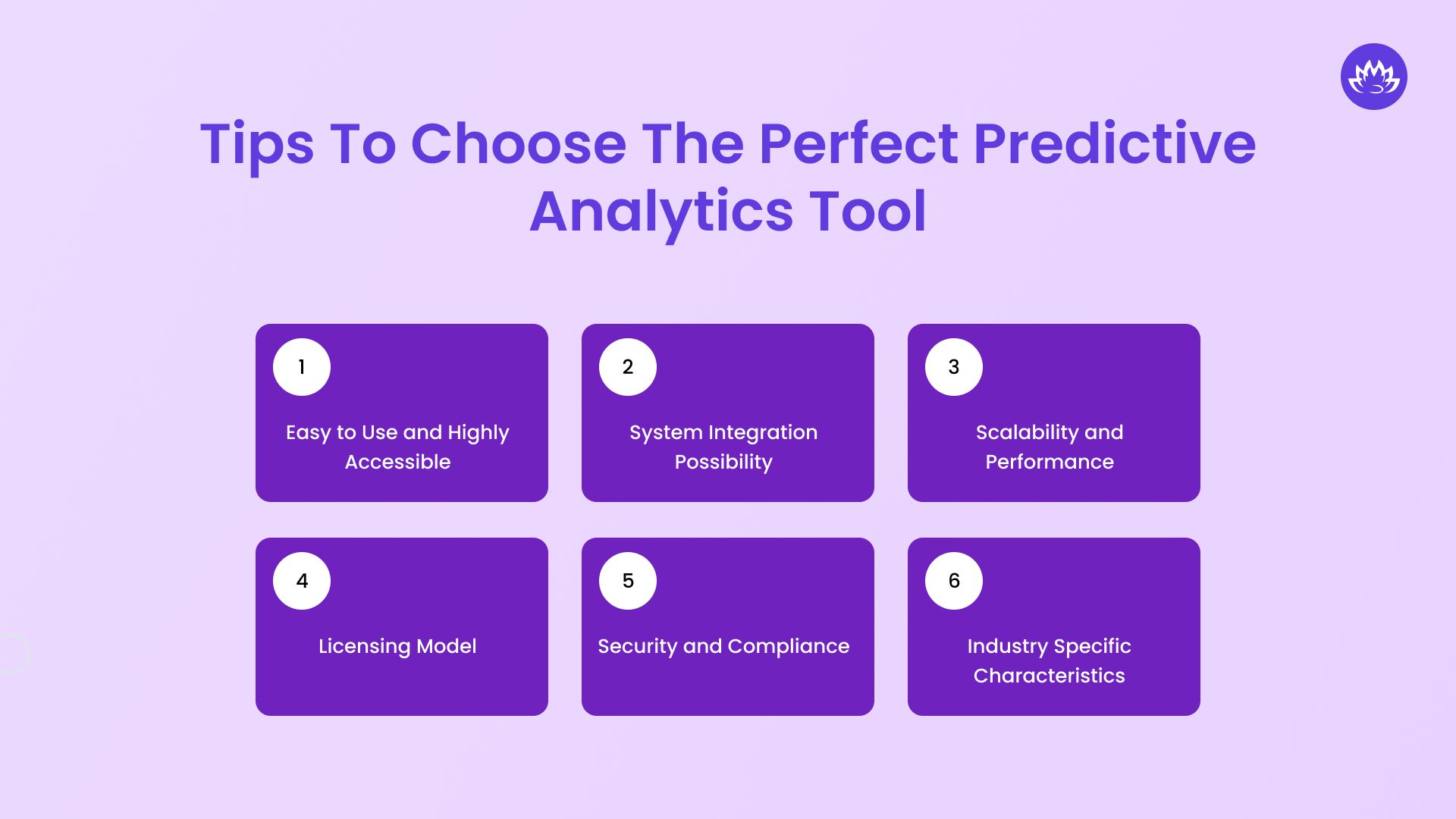
Easy to Use and Highly Accessible
- A user-friendly interface is needed along with low-code or no-code capability.
- Should not need much technical expertise
- Must have intuitive dashboards, drag and drop features, and pre-built templates
- Platform should provide self-service analytics for non-technical teams
System Integration Possibility
- Should have seamless AI integration with various databases and cloud platforms, with third-party applications
- Should be able to connect with enterprise systems like CRM, ER,P and data warehouses
- Must have strong AI support and compatibility with other types of data sources
Scalability and Performance
- Must be able to effectively process large datasets and support high-performance computing
- Should have cloud-based solutions to offer dynamic scaling and the ability to help businesses expand analytics capabilities
- Companies must see whether the platform can handle continuous processing with zero bottlenecks.
Licensing Model
- Must consider the entire cost of ownership that includes licensing, maintenance, and training.
- Open-source tools must provide flexibility and cost savings
- Enterprise-grade solutions must provide advanced features and dedicated support systems
Security and Compliance
- Data privacy and compliance are necessary for managing sensitive data
- AI tech stack should be well designe,d and the chosen predictive analytics tool must include robust encryption and all access controls
- Must adhere to industry standards like GDPR, HIPAA, and PCI DSS
Industry Specific Characteristics
- Predictive analytics tools must cater to different types of industrial requirements with tailored functionalities
- For healthcare, you need patient risk prediction
- For financ,e you need focused tools to emphasize fraud detection and risk scoring
- Retail businesses must prioritize demand forecasting and customer segmentation
Conclusion
Businesses will need predictive analytics tools to improve efficiency, productivity, and minimize risk. However, to make such effortless data-driven decisions that really work for a long time, you need to choose the best tools and frameworks. There are so many options in the market and to find suitable tools requires a clear understanding of features, pricing, and industry applications. So as technology leaps every time, predictive analytics will also play a crucial role in shaping the future of businesses. Whitelotus Corporation is a trustworthy AI development company helping small and large enterprises to integrate AI tools and frameworks for better predictive analytics. To get the perfect business solutions that work well digitally across all platforms of your business, contact us today to know more about our services.