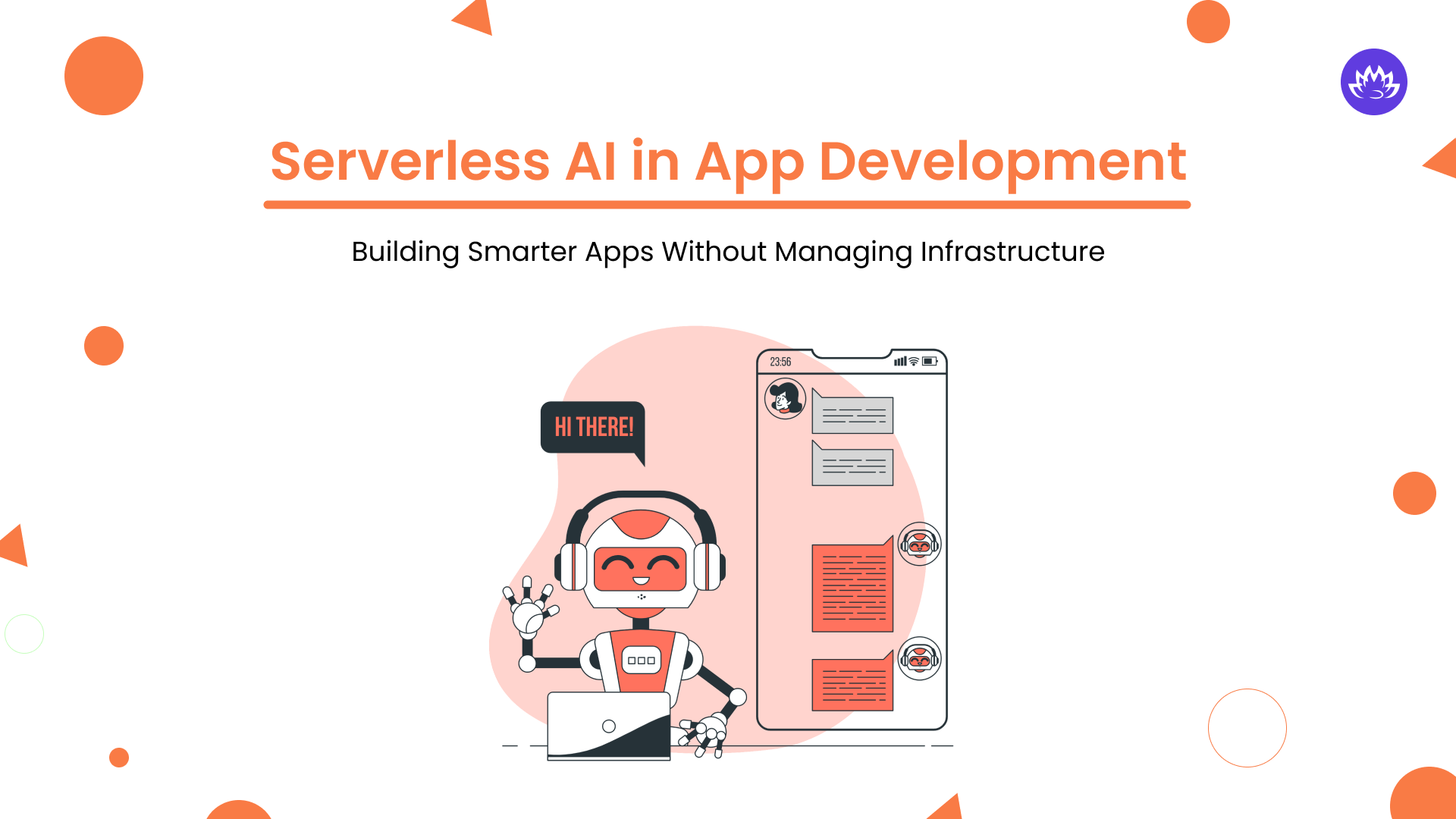
Artificial Intelligence is not new to anyone now. But what makes the world stun is how AI in mobile app development has disrupted the entire application development with traditional infrastructure. So the new thing is that AI applications can be built in just 30 minutes using serverless architecture. The combination of serverless computing and AI is changing the way companies use intelligent solutions.
The introduction of serverless AI signifies a change in the way companies handle AI implementation. AI deployment has never been easier or more affordable because of the simplification of infrastructure administration, which frees up enterprises to concentrate on innovation rather than server upkeep.
Definition and Overview of Serverless AI
Core Principles
By combining cloud computing with artificial intelligence, serverless AI enables businesses to run AI workloads without having to worry about maintaining the underlying infrastructure. This method transfers server availability, scaling, and maintenance to cloud providers so that developers can concentrate on creating AI applications.
Components To Be Implemented
- FaaS platforms such as AWS Lambda
- AI model deployment
- Automated Scaling
- Billing models with pay-per-use
Training Considerations vs. Inferences
Serverless platforms have different characteristics when managing various types of AI tasks:
Inferences
- Ideal for deployments of smaller models
- Efficient in handling specific requirements
- Suitable for widely used frameworks such as TensorFlow
- Requires that cold start times be carefully considered.
Training Considerations
- Due to resource limitations, it is less suitable for model training.
- Time constraints for lengthy procedures
- Large datasets are affected by memory constraints.
- Better managed with conventional virtual machines
Technical Challenges
- Resource limitations in RAM and processing
- Large binary files have difficulties during a cold start
- Compatibility problems with native binary and library
- Time limitations during execution
Cost Setup
The financial model of serverless AI needs typical parameters:
- Usage-based pricing
- Cost changes according to process needs
- Ability to save significantly as compared to a traditional setup
- No cost at the time of idle periods
Infrastructure Options
The latest serverless AI deployment can use different types of solutions.
- API gateways to handle requests
- Data management powered with serverless databases
- Model storage is possible with elastic file systems
- Cloud provider services are available with AWS, Azure, and Google Cloud
This architecture pattern preserves scalability and operational efficiency while facilitating the quick deployment of AI capabilities. Businesses can use AI features without having a deep understanding of infrastructure, but for best results, they must carefully analyze workload characteristics and resource requirements.
Top Benefits of Serverless AI
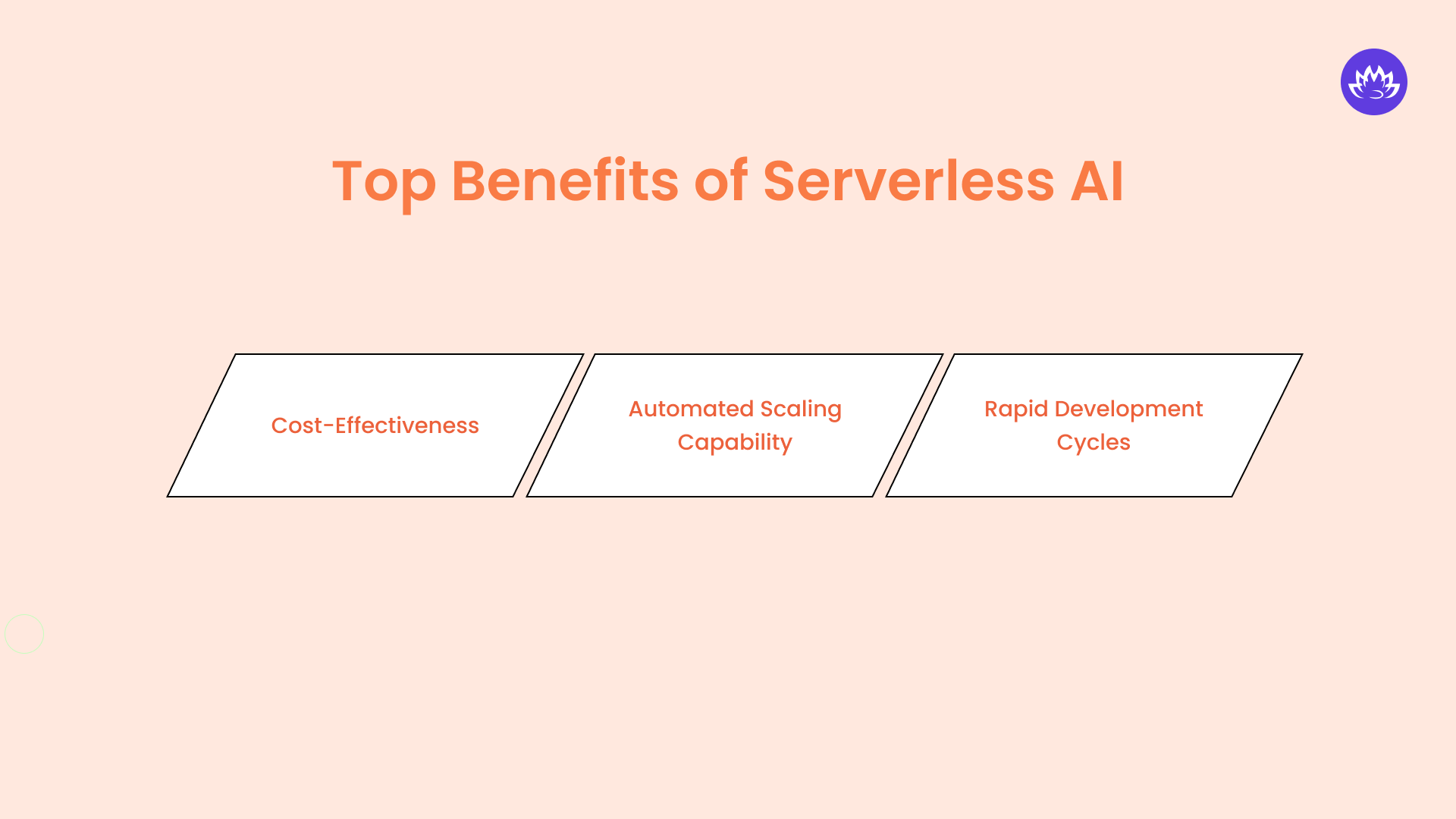
Cost-Effectiveness
Serverless AI’s pay-as-you-go architecture offers substantial financial benefits. Organizations avoid spending money on unused resources by only incurring charges during actual computing time. For example, instead of employing traditional solutions that may cost up to $1,200, a serverless infrastructure was used to create a viral online application.
Automated Scaling Capability
Resources automatically get adjusted through powerful serverless architecture. All this is based on workload demands.
- When there is more traffic, resources instantly get allocated
- In quiet periods, no resource consumption
- Through all functions, there is a built-in balancing
- Multiple requests can be processed concurrently
Rapid Development Cycles
Simple Deployment
- Deployment option available in just one click
- Needs minimal configurations
- Existing systems can be quickly integrated
- Lesser time-to-market for AI features
Development Efficiency
- Pay more attention to application logic than infrastructure.
- environments that are already set up for popular AI frameworks
- Features for compliance and security are built in
- API endpoints that are ready for use
Optimization of Resources
Resources can be used in an optimized manner with:
- Automatic memory management
- Actual needs vs. CPU allocation
- Model serving is possible through storage optimization
- Concurrent requests are efficiently handled
Because of these advantages, serverless AI is especially appealing to businesses that wish to use AI without requiring extensive infrastructure knowledge. A strong argument for using serverless architectures in AI applications is made by the combination of cost reductions, autonomous scaling, and quick deployment capabilities.
Recent Innovation That Addresses Serverless AI Challenges
Latest Cold Start Management
Generally, there is a startup latency issue using serverless AI architecture:
- EFS integration is needed for consistent and persistent model storage
- High-traffic functions need pre-warming techniques
- Load times gets reduced due to model compression
- Selective loading helps memory optimization
Resource Optimization Technologies Adopted
Smart resource allocation is now possible with modern platforms
- Cost reduction happens due to multi-instance GPU sharing
- All the traffic patterns decided automated selling
- Model serving happens due to memory efficiency
- Parallel processing capabilities
There are platforms that help multiple models to function on single GPU and also increase resource allocation alongwith maintaining perfomance standards.
Frameworks Adapted
Below frameworks are adapted for serverless AI deployment:
x86 Onyx backend support
Serverless-specific model packaging
TensorFlow inference optimization
Lightweight runtime environments
Security and Privacy Improvements
The recent innovations in security and privacy has strengthened data protection:
- Isolated execution environments are seen now
- Real-time audit logging is seen
- Role-based access controls
- Encryption protocols happens on client-side
These developments are a result of continuous attempts to enhance the deployment of serverless AI. While increasing the capacity for AI workloads in serverless settings, cloud providers and third-party platforms are creating solutions that tackle basic issues.
Applications and Use Cases of Serverless AI
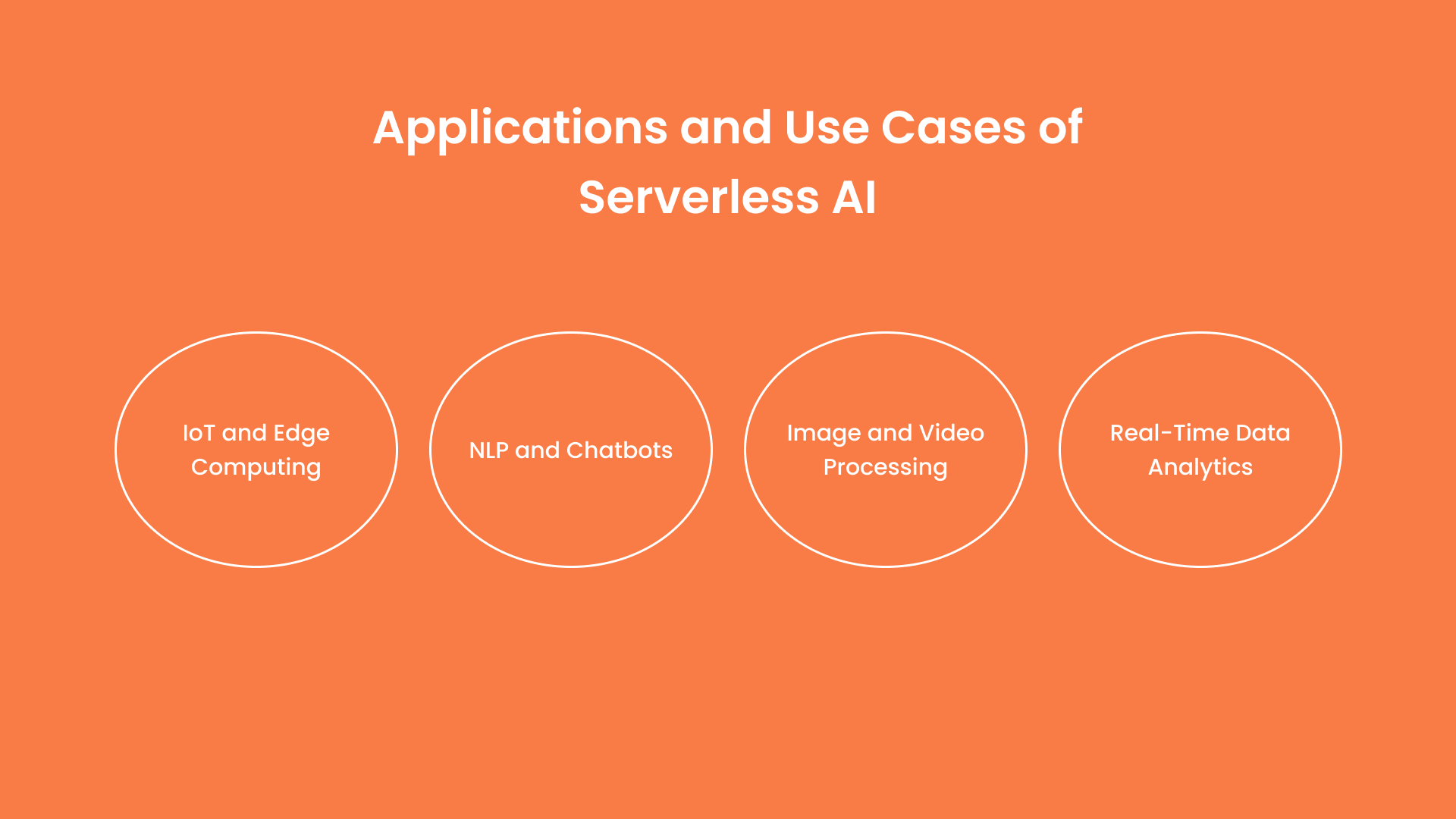
IoT and Edge Computing
Data processing has made all IoT architectures quite compatible for fitting serverless AI. Instead of using distributed devices, serverless AI makes it possible without using constant infrastructure overheads. Sensor data is processed on-demand alongwith functions spinning. The approach will support:
- Predictive maintenance interpretations
- Monitoring device state
- Sensor data analysis in real-time
- Automated response systems
NLP and Chatbots
Implementations of chatbots demonstrate a high degree of serverless architectural alignment. With serverless platforms, small businesses can implement AI chatbots for a fraction of the price of traditional solutions. AWS Lambda-powered chatbots for websites, for instance, can:
- Training to be done on 45000 pages within $2
- Can support 95 languages
- Can maintain data within private cloud accounts
- Can process all types of customer inquiries
Image and Video Processing
Serverless functions can handle media processing tasks via:
- Image classification
- Video frame analysis
- Content moderation
- On-demand OCR processing
Real-Time Data Analytics
The capacity of serverless AI to process data streams without requiring continuous infrastructure maintenance is advantageous for analytics applications. Important implementations include of:
- Financial data processing
- Traffic pattern recognition
- Customer behavior analysing
- Optimizing inventory
Things to Be Considered While Adopting Serverless AI for Applicaiton Development
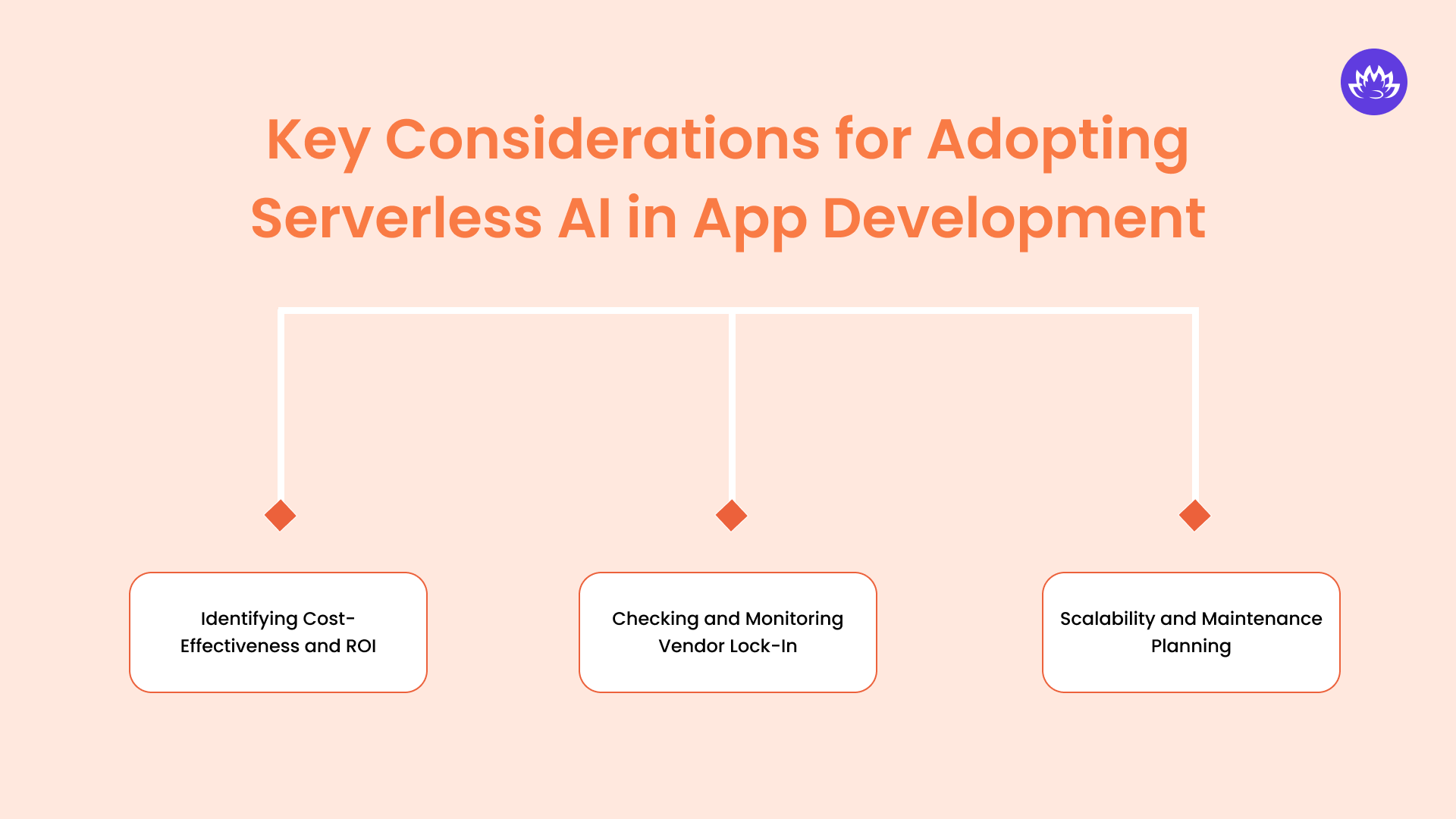
Identifying Cost-Effectiveness and ROI
Here cost-analysis is needed and is done by examining multiple factors such as:
- Finding resource consumption patterns through various workloads
- Pay-per-use pricing in comparison to fixed infrastructure costs
- Staff needed for development and maintenance
- Hidden costs through API calls and data transfer
Companies have also reported variations in costs and the observations are:
- Small applications get advantage from free tier allowances
- High-volume workloads may increase API fees
- Training costs change considerably as compared to inference expenses
- Resource optimization impacts the complete expenditure
Checking and Monitoring Vendor Lock-In
The technologies that are used here to build serverless AI applications need careful considerations:
- Framework compatibility through the cloud providers
- Requirements for API standardization
- Need of data portability between various platforms
- Assessing migration complexity
Hence there is a need of migration strategy that comes by:
- Building architectures that are platform-driven
- Model formats that built by maintaining portability
- Making abstraction layers for provider services
- Documentation of dependency requirements
Scalability and Maintenance Planning
Long-term success is affected deeply by scalability factors:
- Limits in function concurrency
- Restrictions in sizing of models
- Managing cold start
- Setting boundaries for resource allocation
Maintenance planning consists:
- Version control systems
- Performance optimization
- Monitoring infrastructure
- Model update procedures
Above and all, companies must evaluate all these factors in correspondence to their requirements and limitations. For small businesses, serverless AI is very cost effective as it provides basic implementations. On the other hand, for large businesses, there is a need for detailed analysis to scale implications. So any decision maker must first assess both kinds of benefits and also the long-term implications.
Future Trends of Serverless AI
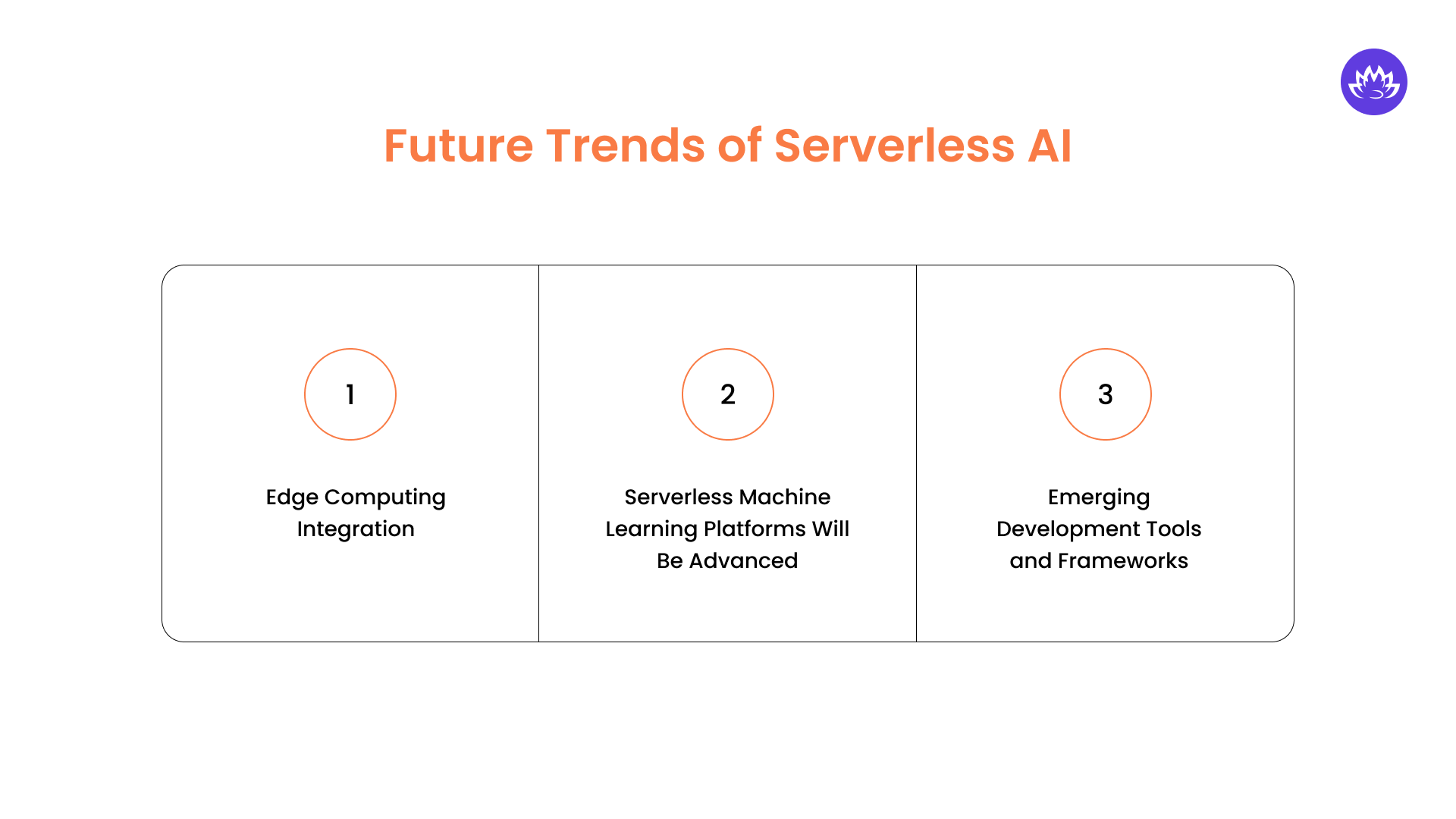
Edge Computing Integration
With edge computing serverless AI capabilities get strengthened via localized processing:
- Distribution of functions among edge nodes
- Decreased latency for tasks that require immediate attention
- Inference of local models at edge locations
- Reduced expenses for data transfer
This combination will support:
- Privacy focused processing
- Distributed AI workloads
- Bandwidth optimization
- Real-time decision making
Serverless Machine Learning Platforms Will Be Advanced
There will be newer platforms that will extend serverless AI capabilities such as:
- In-built model optimization tools
- Enhanced resource management
- Specialized runtime environments
- Auto-scaling ML infrastructure
All the cloud providers have now introduced latest features such as:
- Custom runtime support
- Integrated development environments
- Pre-trained model marketplaces
- Advanced monitoring tools
Emerging Development Tools and Frameworks
Various tools that support serverless AI development are testing frameworks, deployment automation, model optimization utilities and making a viral web app in just minutes using all types of modern frameworks.
The development priorities include:
- Far more simplified deployment processes
- Improved capabilities to debug
- Local testing enhancement
- CI/CD integration well aligned
There will be more choices for deployment, testing, and optimization for teams developing serverless AI applications. While preserving the fundamental advantages of serverless architecture, the development of platforms and tools supports both small-scale implementations and enterprise-level applications.
Conclusion
Artificial intelligence implementation is happening across the tech-space. And as serverless AI continues to take its charge in the world of mobile application development, businesses need to analyse the outcomes from different perspectives such as costs, requirements, and long-term scalability. Being a seasoned and most reliable mobile app development company, Whitelotus Corporation can provide serverless AI applications using rapid deployment capabilities. We use the most advanced AI solutions that are accessible to all companies from startups to enterprises. If you have a project that needs a kickstart with rapid app development, we are here to help you. Contact us today to learn more about our services.