AI

The Rise of Generative AI: Use Cases Transforming Business Today

The Rise of Generative AI
When smartphones were introduced to the world, we hardly knew they would become the most important tools for every person and organization worldwide. Then came the next paradigm shift—the introduction of AI, a new technology with a new revolution. In particular, Generative AI is the most significant tech innovation that everyone is amazed to use and interact with. Clutch reports that 82% of businesses believe that Generative AI will deeply impact their industry in the next five years.
Content (from emails to poetry), graphics, and video are all produced using generative AI-powered technologies such as ChatGPT, Google Gemini, Microsoft Copilot, Claude, and Perplexity. Along with solving challenging arithmetic problems, these technologies can code, analyze data, generate ideas, and facilitate real-time communication. Some claim that generative AI in mobile app development, especially, is a step toward creating historic AI, a significant breakthrough in deep learning and AI research.
Computers are now more than just tools for computing numbers. They can now understand context, interpret natural language (NLP), and display creative traits. Generative AI is helping organizations use these machines to:
  • Make better decisions by swiftly uncovering insights concealed in masses of unstructured text.
  • Automate repetitive, time-consuming tasks.
  • Simplify processes with customized product descriptions, market-ready copy, and content production.
  • Create creative products, advertising campaigns, and content that improve customer experiences.

What is Generative AI?

Large databases and libraries of text, images, code, and other data kinds are at the core of generative AI. These large language models (LLMs) absorb information and recognize patterns, structures, and connections between data pieces, just like conscientious students do. They study musical melodies, creative brushstrokes, and poetry grammar.

Generative AI analyzes these patterns and creates statistical models using neural networks and sophisticated machine learning methods. Now, when the user gives the model a prompt—a word, a sketch, a line of code, or a musical snippet—it functions as a beacon, guiding the model to a particular area on that probability map. Based on the patterns it has learned and the prompt’s nudge, the model moves through this terrain, probabilistically selecting the next element, the next, and the next.

Consider Adopting a Use-case-based Approach to Generative AI

Applying generative AI successfully requires a use-case-driven strategy that concentrates on the issues facing your business and how generative AI may address them. Important things to think about are:
  • Tech stack: Verify that your current technological infrastructure can meet the needs of data processing and AI models.
  • Model matching: Select a generative AI model that best suits your requirements.
  • Collaboration: Assemble a group of suppliers and a team with experience in data science, AI, and your sector. This multidisciplinary group will guarantee the success of your generative AI.
  • Information: Trash in, trash out. The success of generative AI is fueled by high-quality, pertinent data. To keep your engine operating efficiently, spend money on data collection techniques and hygiene.

Top 10 Generative AI Use Cases
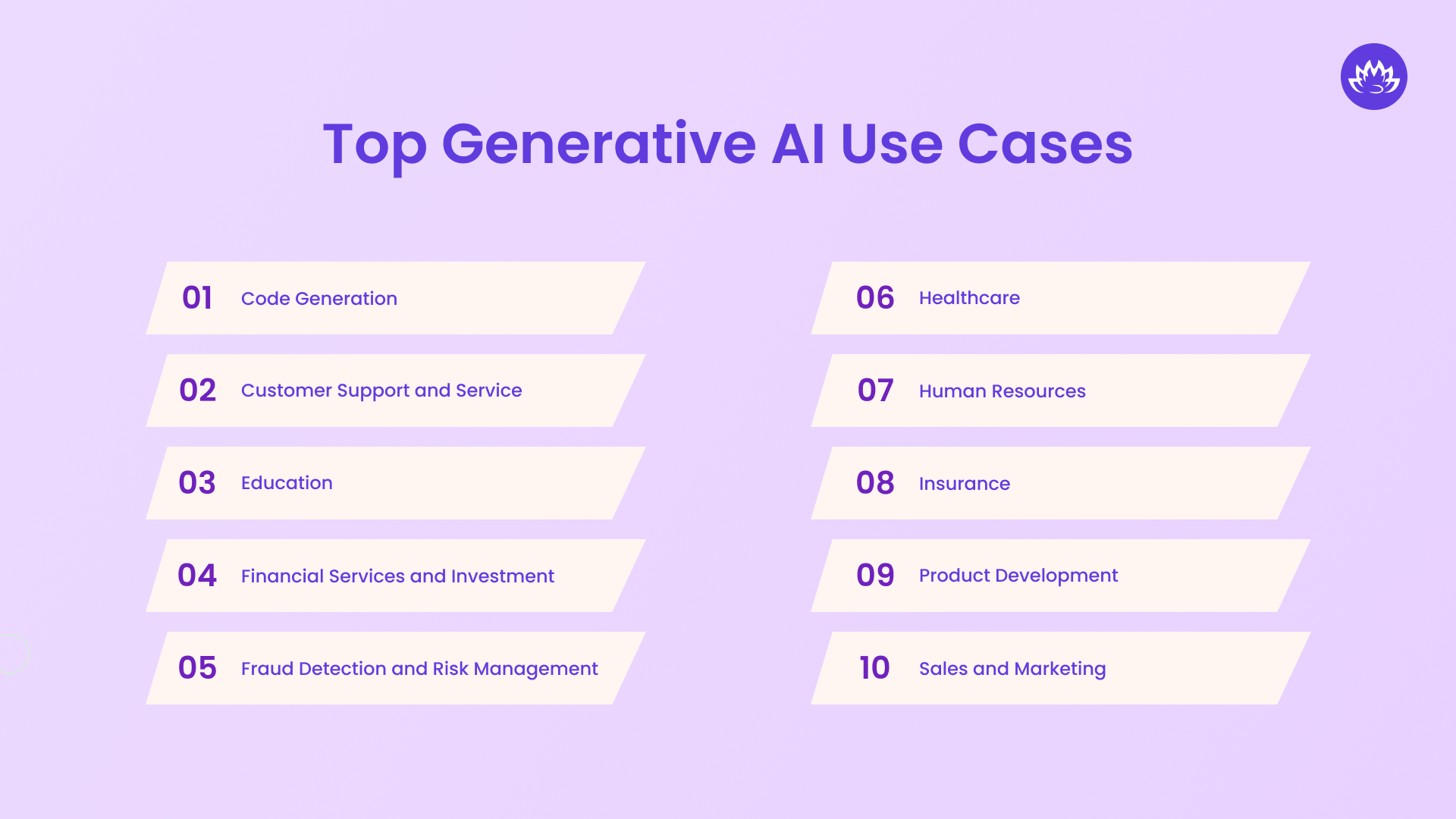
Top Generative AI Use Cases
Globally, the application of generative AI has rapidly expanded across numerous departments and industries. Sales and marketing moved quickly, and they already use generative AI in their processes. Generative AI’s capability to speed up and scale projects is phenomenal. As of now, there is no other competitive tech innovation that can beat this capacity to produce volumes of content for any discipline. Some of the top use cases are as follows:

Code Generation

During the app development, software engineers employ generative AI to write, update, and maintain code, automate debugging, and support app testing. Additionally, AI coding tools may manage testing and bug repairs and offer several kinds of documentation that a coder may require. This covers user manuals, technical documentation, and other pertinent items that come with software development.

Customer Support and Service

AI-powered chatbots and virtual agents access and process large volumes of data to provide precise answers to questions from customers and human agents. They can have natural conversations, offer 24/7 assistance, and respond with context-awareness. These sophisticated assistants lessen the need for human interaction while improving the user experience. AI is also being utilized to enhance customer service interactions and analyze customer sentiment.

Education

Automated grading, content creation, and AI-driven tutoring are becoming more popular. AI helps teachers with administrative work, research material summarization, and creating individualized learning experiences. However, issues with academic integrity, disinformation, and data privacy continue to exist.

Financial Services and Investment

For analysts and investors, AI automates financial forecasts, creates reports, and examines market movements. Personalized financial advice and trading algorithms driven by AI are becoming more widespread.

Fraud Detection and Risk Management

Generative AI can swiftly scan and compile vast volumes of data to find trends or abnormalities, supporting fraud detection and risk management while helping claims adjusters and underwriters maximize results. It streamlines decision-making by producing customized reports and insights. Generative AI enhances security and compliance in financial services by thwarting fraudulent transactions and cyber threats.

Healthcare

Through its assistance with drug research, medical documentation, diagnostics, and patient involvement, generative AI is revolutionizing the life sciences. Medical records, lab reports, and patient histories are compiled by AI-powered systems, which help doctors make quicker, better judgments. In medical imaging, generative AI is being utilized increasingly to analyze CT, MRI, and X-ray images to identify illnesses and fractures. Virtual assistants with AI capabilities aid patients by setting up appointments, reminding them to take their medications, and responding to inquiries about their health.

Human Resources

Generative AI makes hiring, onboarding, and staff development easier. It automates interview scheduling, helps recruiters screen applicants, and summarizes resumes. It tailors training materials according to roles during onboarding. It produces career development insights and structured evaluation templates for performance management.

Insurance

The use of generative AI solutions for risk assessment, fraud detection, and claims processing is growing. Although regulatory compliance is still crucial, AI tools may automate underwriting, assess policies, and enhance client relations.

Product Development

Generative AI is being used more and more by product designers to optimize design concepts at scale. It aids in structural optimization, which lowers expenses and prices by ensuring robust, long-lasting goods that consume little material. When incorporated into the whole product development lifecycle—from the original concept to manufacturing and procurement—generative design has the greatest impact. 

Sales and Marketing

Generative AI makes hyper-personalized marketing across channels possible. Large language models are guided by well-crafted prompts and inputs to produce imaginative text for blogs, social media postings, product pages, websites, and emails. Existing content can be rethought and altered, and customized language generators can be educated on an organization’s brand tone and voice to match earlier content precisely.

How to Implement Generative AI Into Your Business Operations?
How to Implement Generative AI Into Your Business Operations_
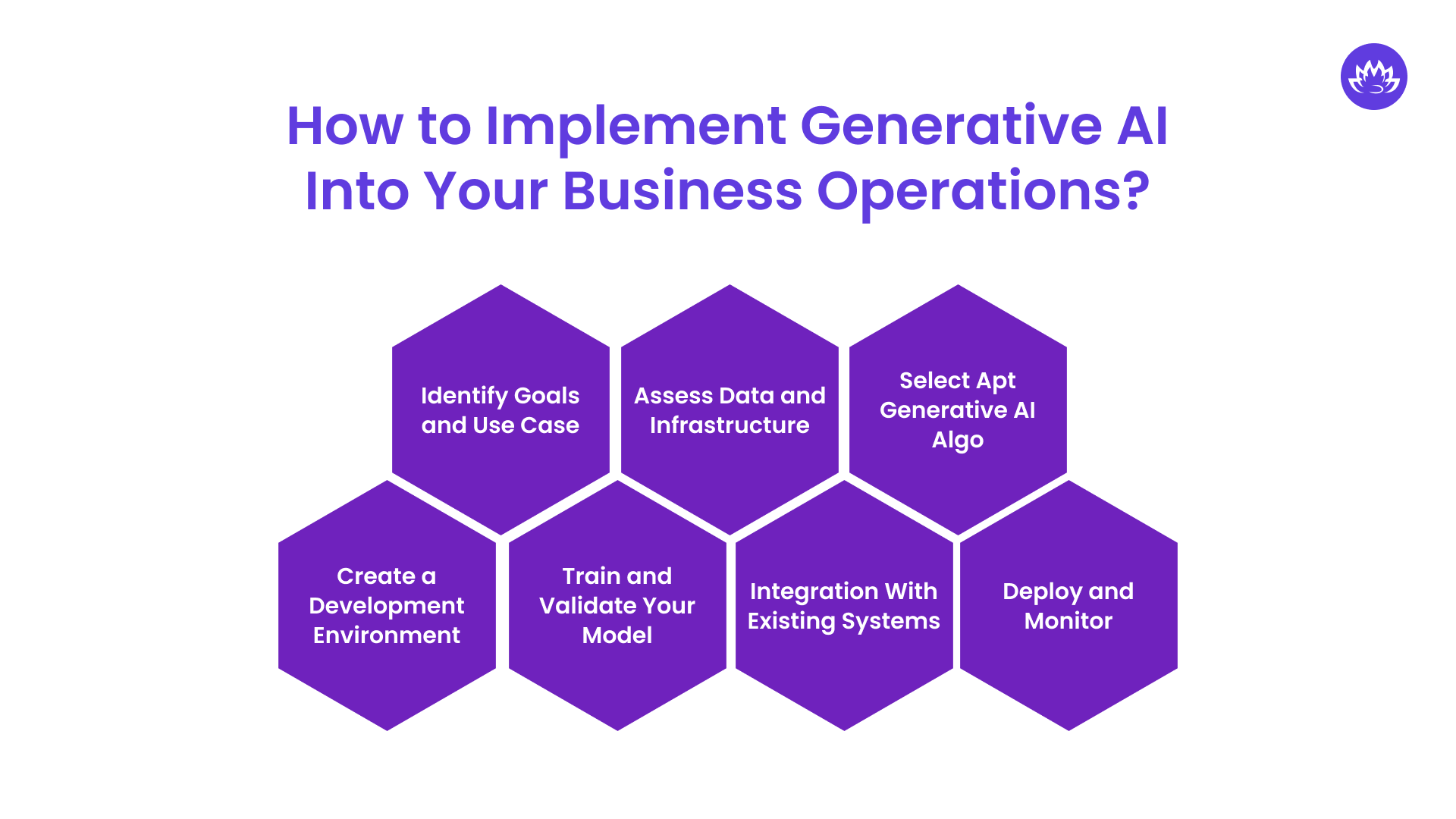
Generative AI implementation into your business operations is a systematic process. You can hire dedicated developers to integrate AI technologies into your mobile app development project.

Identify Goals and Use Case

It’s critical to specify your goals and the precise use cases in which generative AI might benefit your company before putting it into practice. Throughout the implementation phase, this will assist you in setting priorities and making wise choices.

Assess Data and Infrastructure

For generative AI models to be trained and produce useful results, high-quality data is essential. Assess your data’s accessibility, quality, and availability. Make sure that the processing power and storage capacity of your infrastructure can support the needs of generative AI models.

Select Apt Generative AI Algo

The type of challenge you have and the results you hope to achieve will determine which generative AI algorithm is best. Investigate different methods, including diffusion models, variational autoencoders (VAEs), and generative adversarial networks (GANs), to find the one that best suits your requirements.

Create a Development Environment

Create a development environment with the tools and libraries required for generative AI model training and deployment. TensorFlow, PyTorch, and Apache MXNet are well-liked choices.

Train and Validate Your Model

Using the prepared data, train your generative AI model and monitor its output closely. Verify the model’s precision, applicability, and capacity to produce accurate and practical results.

Integration With Existing Systems

To take full advantage of the trained generative AI model’s capabilities in your workflow, incorporate it into your current systems and business processes. This could entail creating unique interfaces, automating processes, or creating APIs.

Deploy and Monitor

Install the generative AI model in production and keep an eye on its functionality at all times. To find opportunities for improvement and make sure the model is in line with your business objectives, get input from users and stakeholders.

Challenges Using Generative AI

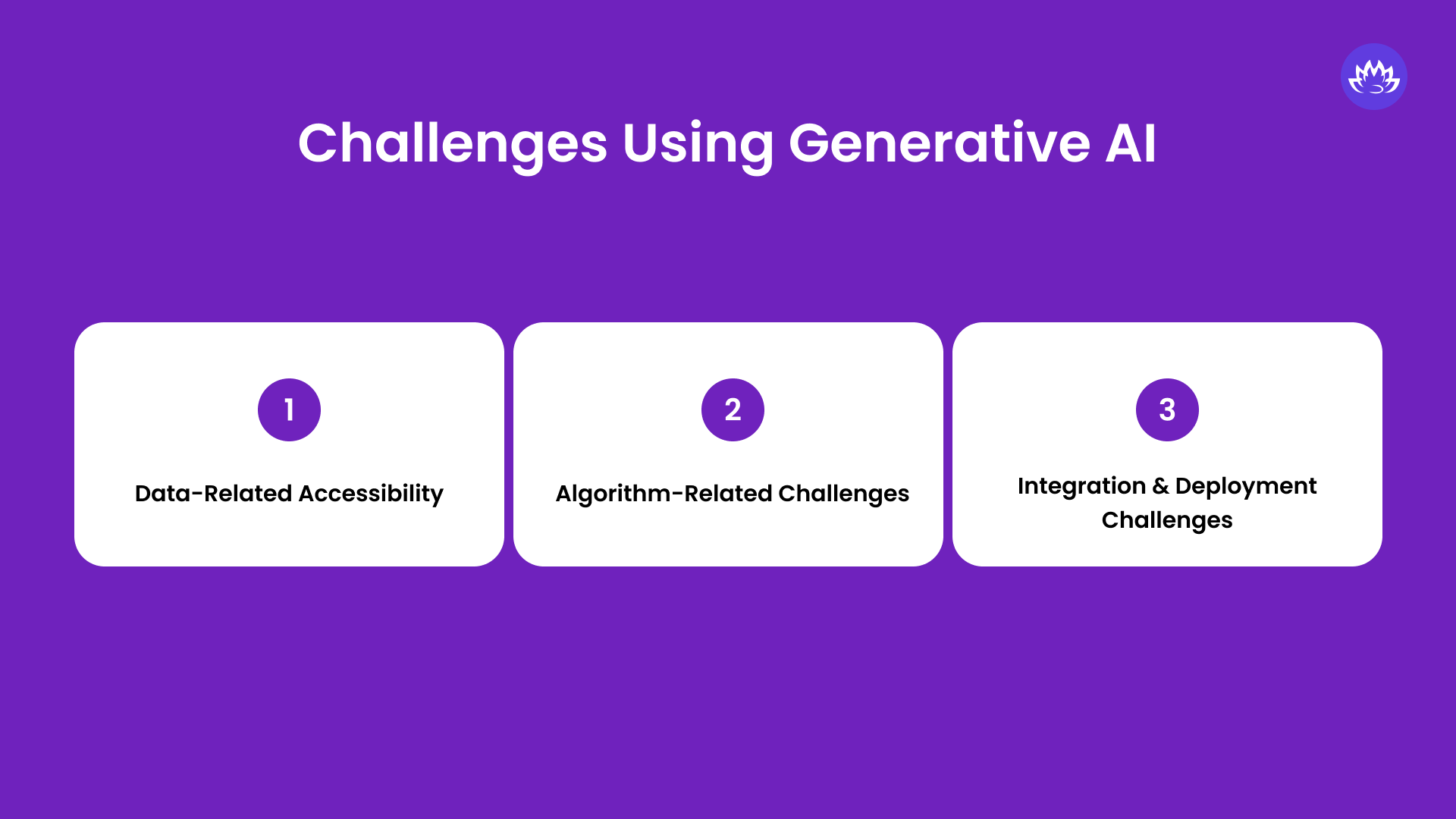
Challenges Using Generative AI

Data-Related Accessibility

Data-related issues frequently impede the deployment of generative AI models, especially in industries like healthcare and finance, where it can be challenging to access and prepare vast amounts of high-quality data because of privacy laws and data shortages.

Algorithm-Related Challenges

The process of creating and implementing generative AI models frequently encounters algorithmic challenges. For example, the computational demands of training intricate models with vast volumes of data, the difficulty of deciphering results because of limited explainability, and the difficulty of making sure the models can generate accurate and significant results in a variety of scenarios.

Integration & Deployment Challenges

There are difficulties with integration, scalability, and ongoing monitoring with Genertive AI model integration into practical applications. Careful planning and development are necessary to enable smooth interaction. You can use a variety of data sources, applications, and workflows when integrating these models into current business processes and systems.

Implement Generative AI With Whitelotus Corporation

Throughout the entire generative AI implementation process, Whitelotus Corporation offers complete end-to-end support, which includes consultation, data preparation, model building, integration, deployment, and continuous monitoring.
We stay up to date with industry developments so that you get the most creative and practical solutions. We provide custom solutions that match your company’s goals and vision. We analyse each goal set carefully and develop strategies that can scale with business growth. We are a trusted mobile app development company and implement AI technologies into multiple projects.
 Contact us to learn more about our services.

Conclusion

Similar to how smartphones revolutionized company communication and productivity, generative AI will continue to change enterprise operations across various industries. Generative AI has many applications, from automating repetitive jobs to encouraging creativity in content production and beyond. With the increasing use of digital tools in the workplace, employment responsibilities will unavoidably shift, and new skills will be required.

Author

  • Sunil Chavda

    Sunil is a result-orientated Chief Technology Officer with over a decade of deep technical experience delivering solutions to startups, entrepreneurs, and enterprises across the globe. Have led large-scale projects in mobile and web applications using technologies such as React Native, Flutter, Laravel, MEAN and MERN stack development.

    View all posts

Don't skip sharing this post!

Inquiry now

    MAKING IT EXTRAORDINARY